It is common in the skies over Galápagos waters to see large, black birds, hovering lazily in place, looking for all the world like kites. These are frigatebirds. Frigatebirds belong to the family Fregatidae, which contains five species world-wide. In the Galápagos there are two species: the great frigatebird (Fregata minor) and the magnificent frigatebird (Fregata magnificens). Of the two, the great frigatebird has the greater world-wide distribution, being found primarily throughout the tropical Pacific and Indian Oceans, while the magnificent frigatebird is found in the Caribbean and on the Pacific and Atlantic coasts of the Americas. The Galápagos population of magnificent frigatebirds is considered to be an endemic subspecies, F. m. magnificens (when a species contains more than one subspecies, the name of one, the nominal subspecies, bears the same name as the species). In the Galápagos, the two species can be seen nesting side by side on Seymour Norte, but when frigatebirds are sighted in the air, they typically are magnificent frigatebirds, because great frigatebirds tend to forage much farther out at sea. As with the three similar species of booby, essentially similar species avoid competition by feeding in different locales.
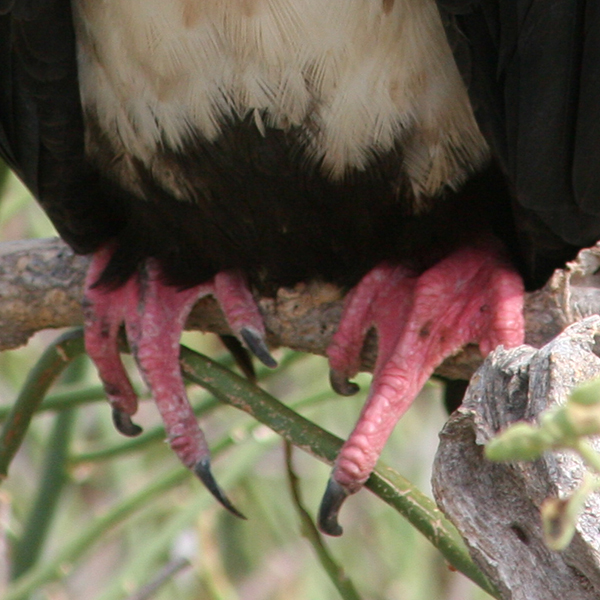
As members of Pelecaniformes, frigatebirds have the key characteristics of a furcula that is fused to the breastbone, a gular sac, and all four toes being connected by the web. Although there is definitely a web on the frigatebird’s foot, the webbing is reduced and part of each toe is free. Frigatebirds produce very little oil and therefore do not land in the water. In all my years of observing frigatebirds, I have only seen two individuals in the water and that was accidental: two juveniles were cavorting with one another and they collided and fell in. They were able to get out with some difficulty. The gular sac is used as part of a courtship display and is, perhaps, the most striking frigatebird feature.
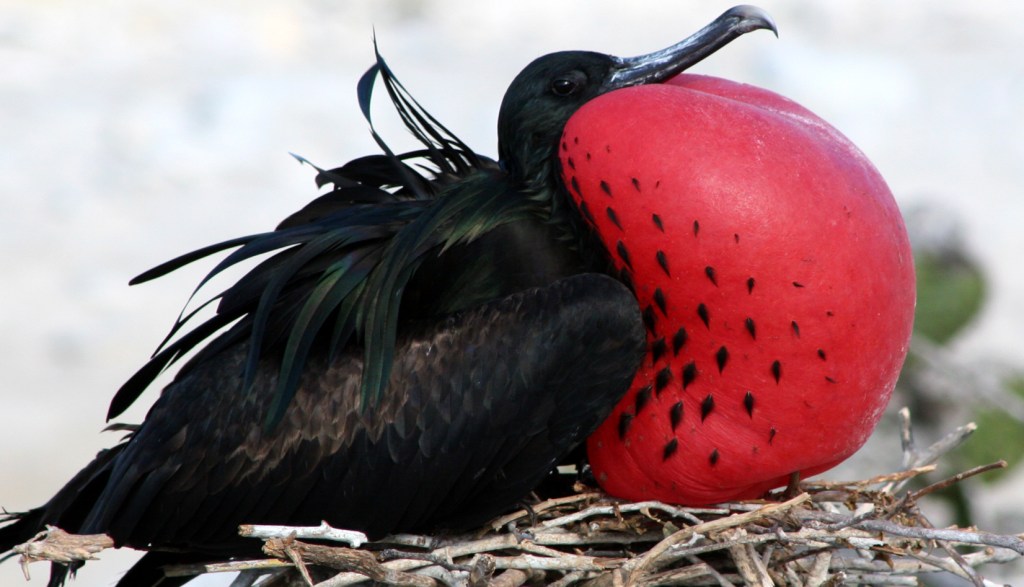
In males, the gular sac appears as a patch of red skin at the throat. However, during courtship display, the male forces air into the sac, causing it to inflate over a period of 20 minutes into a startling red balloon. As males tend to display in groups, the effect is magnified (an area where males gather together to display is called a lek). Then the males sit quietly in the low shrubs watching for a female to fly overhead. Then the males waggle their heads from side to side, shake their wings and call. If the display is attractive enough, then the female will land and sit beside her paramour.
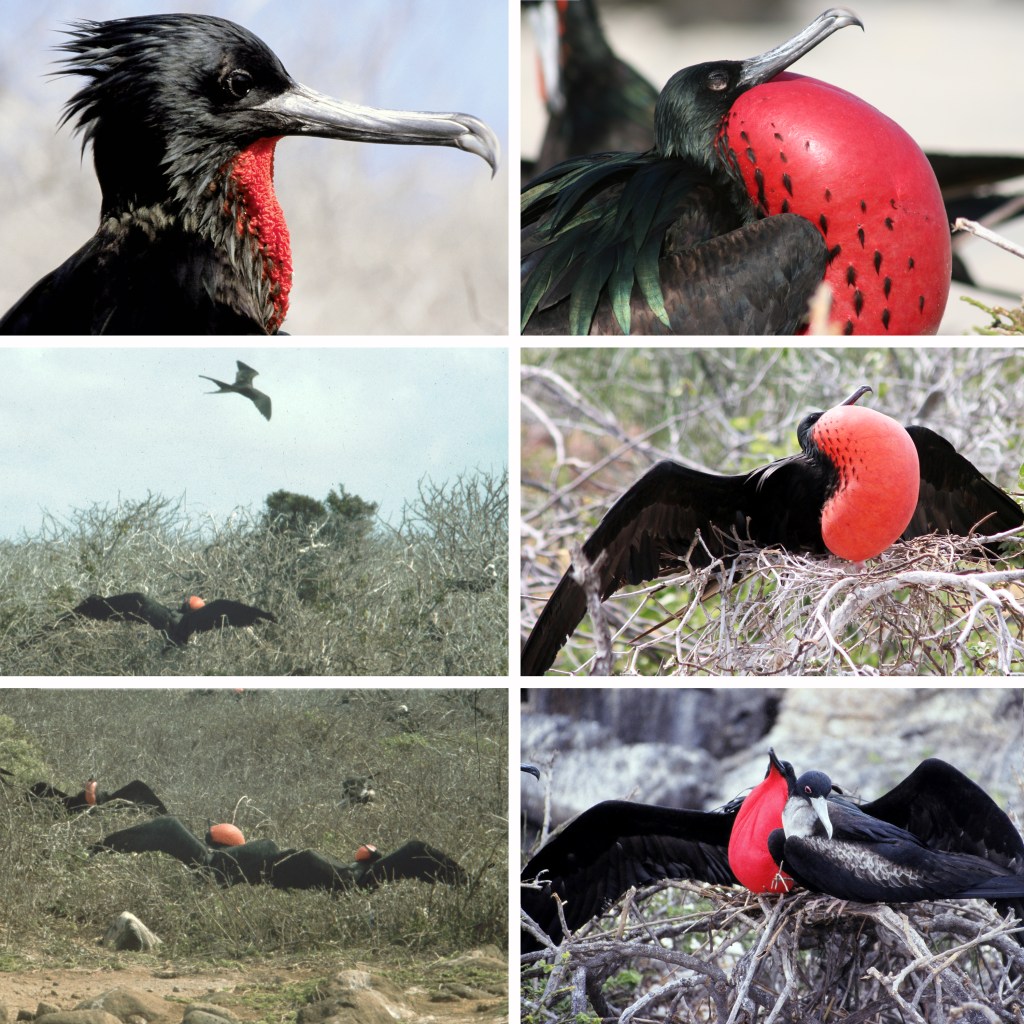
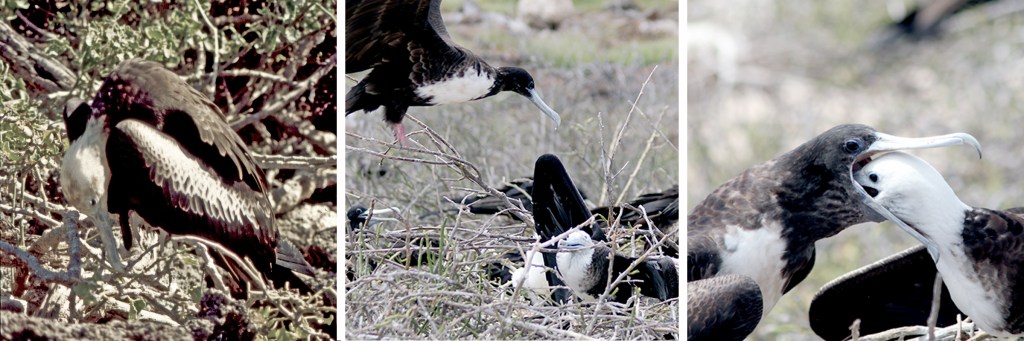
The two species of frigatebird are very similar to one another, the males being particularly difficult to distinguish. The call is one of two ways to tell the males apart. When displaying, great frigatebirds make a “gobbling” sound, not unlike a turkey, while magnificent frigatebirds make a rattling or drumming sound. A second, more subtle way to distinguish the nearly identical males is to look at the scapular feathers, long feathers that cover their back and shoulders. Although the feathers are black, they are iridescent and produce different colors when they refract sunlight. In the magnificent frigatebird the irridescence is purple while in the great frigatebird it is green. However, this character is dependent on sunlight, and the Galápagos, at certain times of the year, are notoriously overcast. And, of course one can determine a male’s species by observing with whom it is associated. It is easier to distinguish the females and juveniles. A summary and photographs of the differences follow:
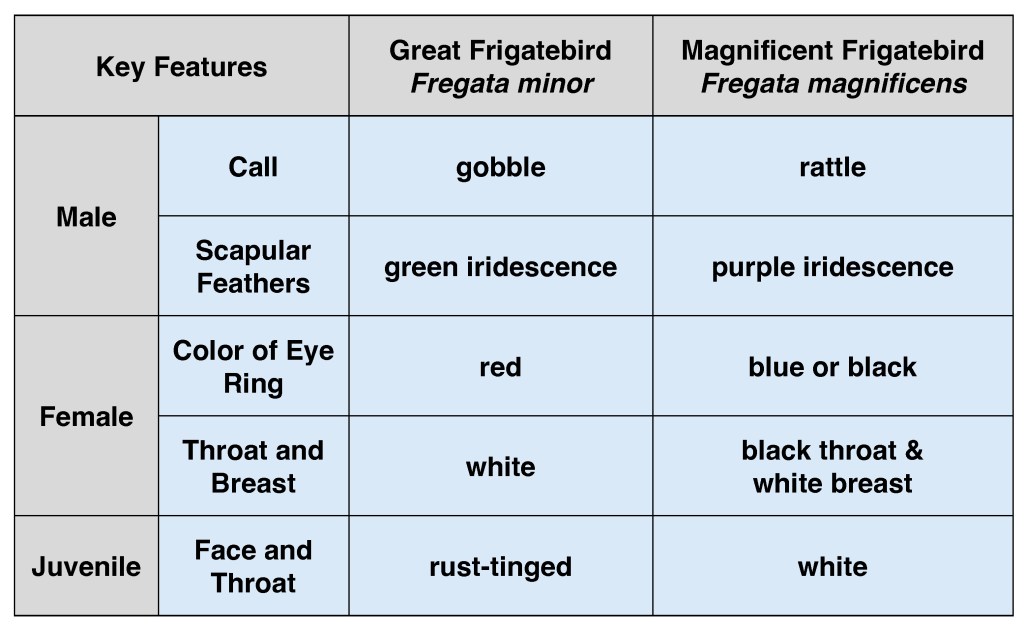
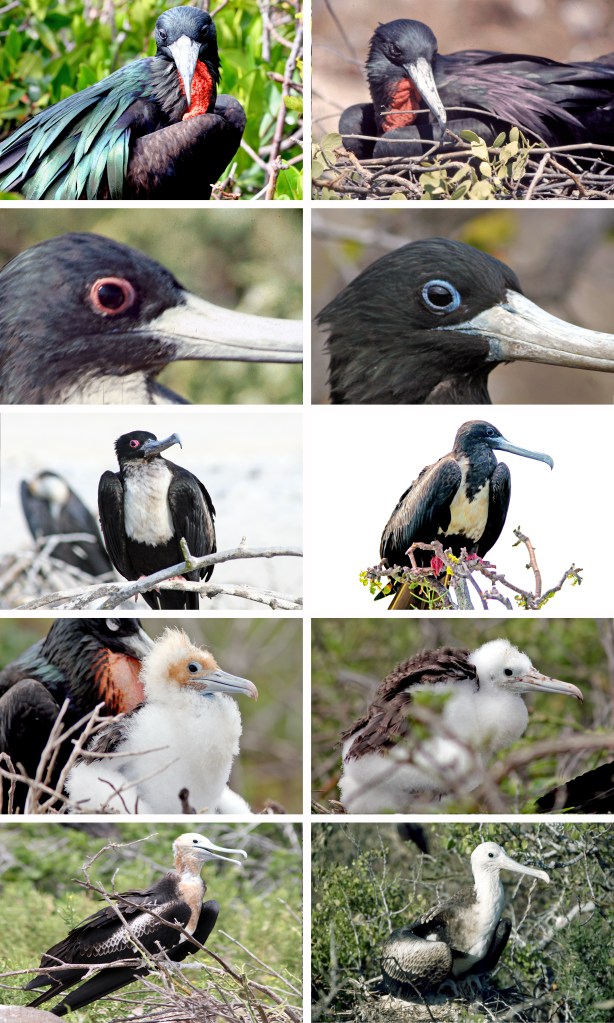
Key characters of F. minor (left column) and F. magnificens (right column)
Row 1: males. Rows 2 & 3: females. Row 4: chicks, Row 5: juveniles
Frigatebirds build nests in low-lying shrubs and produce a single egg. Both parents take turns feeding for the first three months but then only the mother for another eight months. It takes so long to rear a chick that frigatebirds cannot breed every year. It is typical to see juveniles as big as their parents waiting to be fed. When they sit waiting for endless hours in the hot sun, they assume an energy-efficient posture in which their head hangs down, and they sit so still that they seem dead. But when the parent returns, they will wake up, bob their head, and scream until the parent opens its mouth. The starving juvenile plunges its head down the parent’s throat and feeds at last.
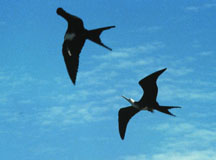
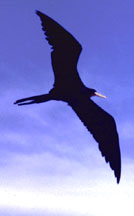
The name “frigatebird” calls to mind the sails of ships and, indeed, frigatebirds sail gracefully in the air currents overhead. Their wingspan is some 7.5 feet and their deeply forked scissor-like tails afford them ultimate maneuverability. Their other common name, however, the “man-o’-war” bird, reflects the way in which they use their consumate flying and maneuvering skill. Frigatebirds are pirates who harass incoming birds, especially boobies until the victim is so upset that it disgorges its catch. The frigatebird then drops with amazing speed and plucks the bolus out of the water, or even catches it before it hits! Not only do frigatebirds harass other species, but other frigatebirds as well. The disgorged bolus may pass through several beaks before it is finally swallowed. In addition to stealing food from boobies and from one another, they steal nesting materials as well. It was this kind of piratical maneuvering that caused the two juveniles to crash into each other and fall into the sea.
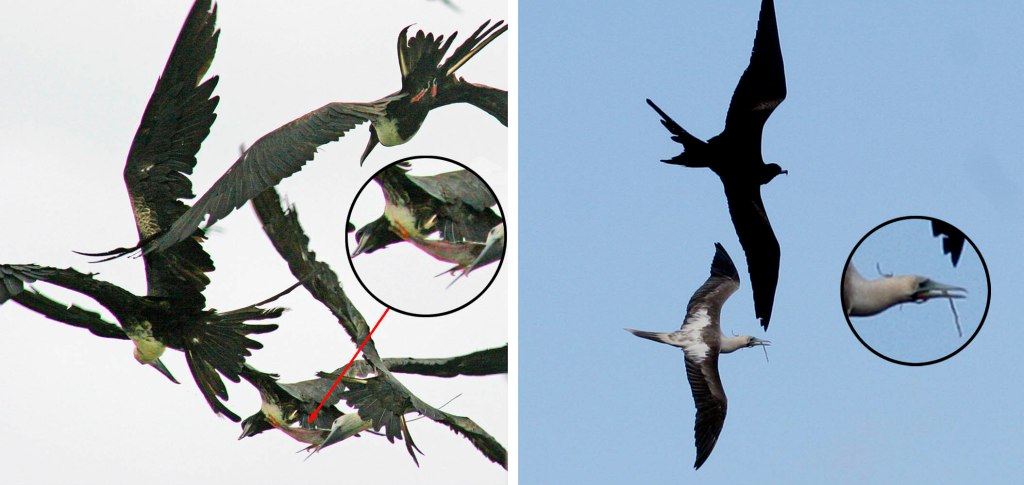
Left: Several magnificent frigatebirds fighting over a fish (see detail). Puerto Lopez, mainland Ecuador.
Right: Great frigatebird harassing a red-footed booby for nesting material. Genovesa.
Their reputation for piracy, however, may be somewhat exagerated. With their great maneuvering skill and their long, strongly hooked beaks, frigatebirds can glide along the surface of the water, swing their head down, and pluck out fish and squid. In a similar manner they can pick up hatchling sea turtles, unprotected chicks, and disgorged food right off the ground. It is also common to see a frigatebird skimming over the surface of El Junco, a rare fresh-water lake on San Cristóbal, or a pond in the El Chato Tortoise reserve on Santa Cruz, dipping its beak down and sipping a drink.
The photographs below highlight the frigatebird’s aerial. skill and agility. There are stories behind two of the photos.
In A we had encountered a nest where a few sea turtles were emerging. Frigatebirds were gathering and it was clear what would happen. I pointed my camera at the nest (just outside the photograph beyond the X) and waited. It happened so quickly that the distance between the bird and the nest marks my slow reaction time. As the frigatebird swooped past me, it nearly took off my ear!
In E it was early morning at Puerto Lopez and the fishing fleet had just returned. Fishermen put the catch into big plastic tubs and ran a gauntlet of frigatbirds while carrying the tubs across the beach to waiting trucks. To discourage the frigatebirds, the fishermen waved sticks over the boxes. At least one plucky frigatebird, however, was able to snag a score.
Another story from that morning at Puerto Lopez attests to the frigatebird’s agility. In addition to the frigatebirds and pelicans, a number of black and turkey vultures were on the beach looking to score a meal. At one point, a knot of five or six vultures were tussling over a fish head when a frigatebird hovered over the melee, dipped its beak in, and came out with the head. The head, however, was too big for it to swallow, so as it flew away, it kept dropping and recapturing the head, apparently to turn it in a more favorable orientation.
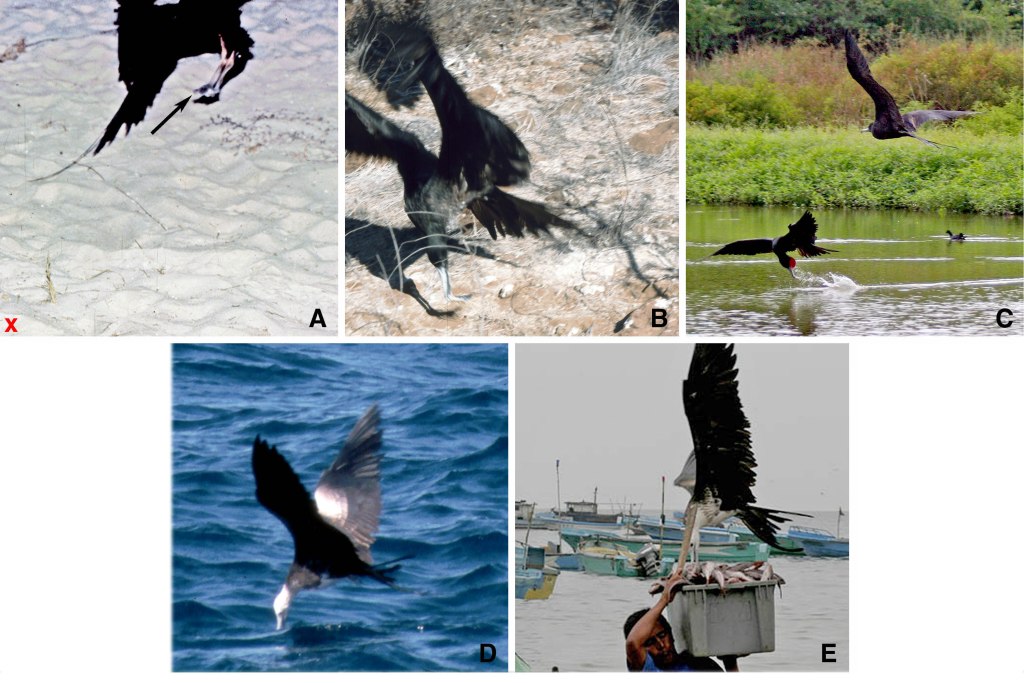
A: Frigatebird snatching a hatchling turtle, Bahia Gardener, Española.
B: Frigatebird picking up a dropped fish. Seymour Norte.
C: Frigatebird catching a drink. El Chato Tortoise Reserve
D. Juvenile frigatebird catching a fish or squid. Seymour Norte.
E. Juvenile magnificent frigatebird snatching a fish from a fisherman. Puerto Lopez, Ecuador.