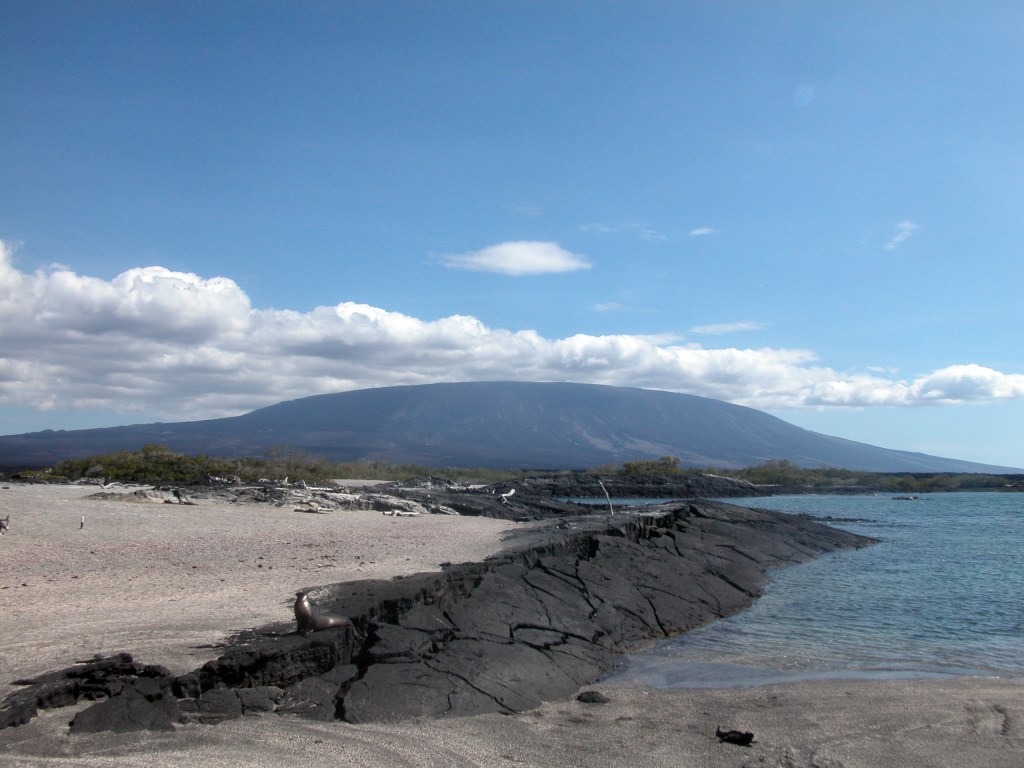
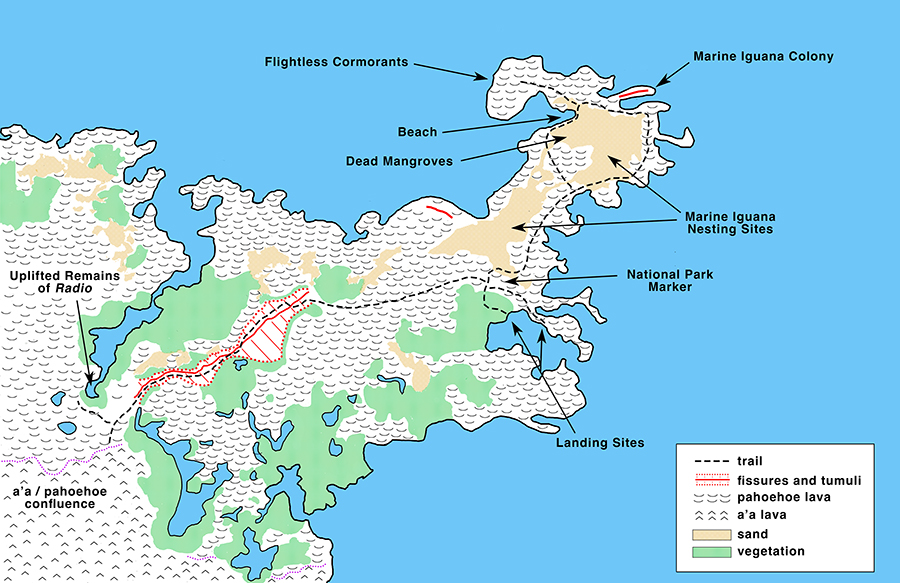
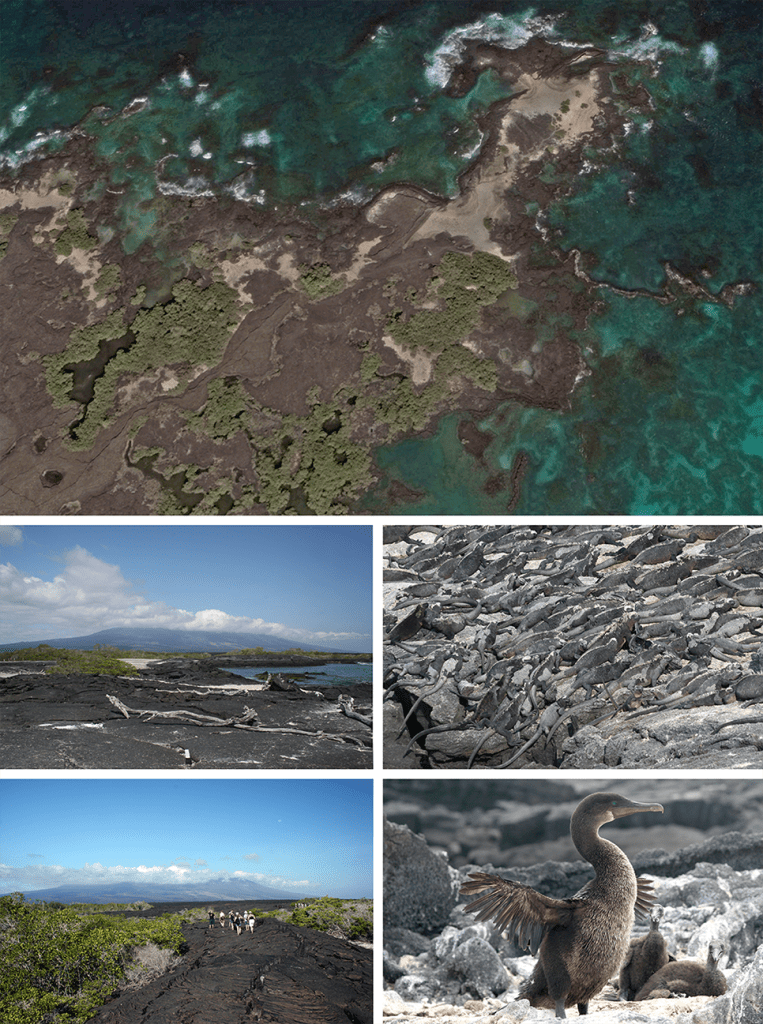
Punta Espinoza, the only visitor site on Fernandina, is the result of several uplifts. The uplift in 1927 was so sudden that two fishing boats that were anchored nearby were nearly caught, while a third actually was stranded. Along the trail one can see the remains of mangroves were lifted high and dry. The trail consists of two parts. The first is a sand-covered pahoehoe lava spit that is the home to one of the largest colonies of marine iguanas in the islands. The visitor can see them swimming just offshore, and basking in tremendous numbers on the black lava rocks. The sandy part of the trail is also an area where marine iguanas dig nests. The highlight of the trail is the colony of flightless cormorants. Here one can find nesting pairs with eggs and chicks. Also, watch for small lava lizards. The lava lizards here are mostly black, but are, in fact, the same species that one sees on nearby Isabela and the central islands. The bright red throats of the females make a startling contrast. One might also see Galápagos hawks or great blue herons stalking marine iguanas and lava lizards. Occasionally green sea turtles crawl up out of the water to rest for a while before returning.
The second part of the trail leads inland across a pahoehoe flow, following a ridge of lava that has fissured along the top. During the eruption that formed this flow lava accumulated underneath the solidifying crust causing it to swell into a ridge (a tumulus) that eventually cracked from the pressure. Near the end of the trail, the pahoehoe flow merges into an aa flow. Along the sides of the trail there are small pools surrounded by mangroves. There are fish in the pools that swam into them when young but are now to big to swim out. One of the pools contains a piece of machinery from a tuna boat, Radio, that sank in 1934, but has since been brought to the surface by uplift.
- Common Animals:
- Marine Iguana (Amblyrhynchus cristatus)
- Galápagos Lava Lizard (Microlophus albemarlensis)
- Flightless Cormorant (Phalacrocorax harissi)
- Galapagos Penguin (Spheniscus mendiculus)
- Blue-footed Booby (Sula nebouxii)
- Green Sea Turtle (Chelonia mydas)
- Galápagos Sea Lion (Zalophus californianus)
- Galápagos Snake (Alsophis dorsalis or A. slevini)
- Galápagos Hawk (Buteo galapagoensis)
- Great Blue Heron (Ardea Herodias)
- Common Plants:
- Saltbush (Cryptocarups pyriformis)
- Galápagos Shore Petunia (Exedeconus miersii)
- Black mangrove (Avicennia germinans)
- Red mangrove (Rhizophora mangle)
- White Mangrove (Labuncularia racemosa)
 Darwin's Galapagos