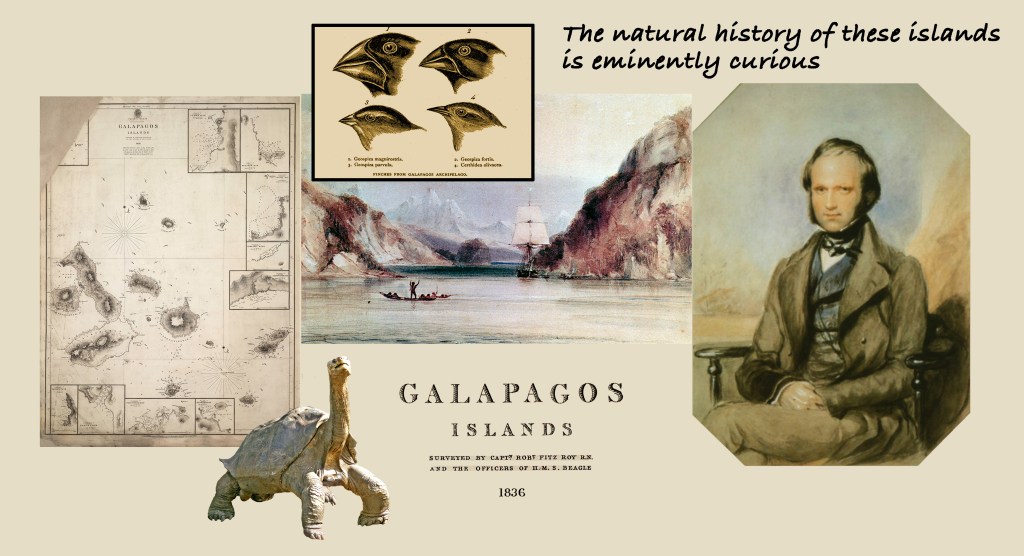
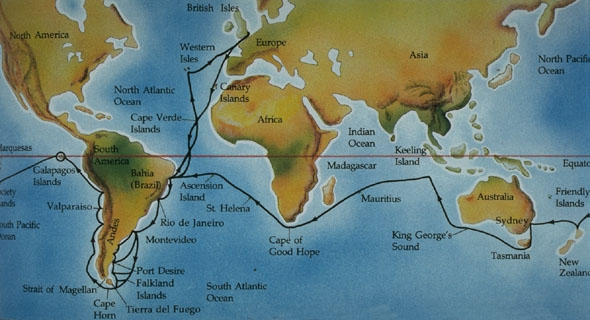
Charles Darwin’s very radical ideas on the structure of the living world transformed biology from a collection of curious but disconnected facts into a vigorous and unified science. His theory of evolution by natural selection originated during a five-year voyage around the world as the de facto naturalist on board HMS Beagle under the command of Captain Robert FitzRoy.
Darwin’s voyage was actually the second voyage of the Beagle. The first began in 1826 as a mission to survey the southern coasts of South America under the command of Phillip Parker King. The survey consisted of two ships, the primary being King’s HMS Adventure and the second, HMS Beagle, captained by Pringle Stokes. During a lengthy stay in Tierra del Fuego, Stokes became depressed by the gloomy weather, troubles with the native fuegians, and the loneliness of a British commander who could have only limited social contact with the crew. In August, 1828, Stokes shot himself in the head. The Beagle’s Lieutenant Skyring brought the ship to Rio de Janeiro where Lieutenant FitzRoy was stationed.
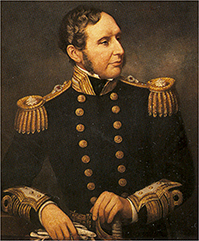
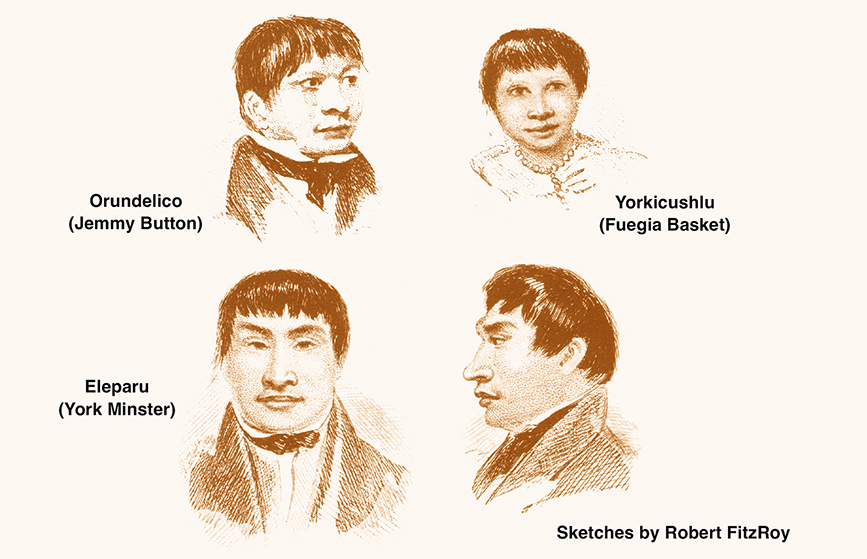
FitzRoy was appointed temporary captain of the Beagle and ordered to return to Tierra del Fuego to resume the survey. Troubles with the fuegians continued, culminating with the theft of one of the Beagle’s whale boats. After a fruitless search to recover the boat, FitzRoy captured four fuegians and held them hostage for return of the boat. This failing, FitzRoy decided to bring the four back to Britain where they could be educated. Fuegians were normally hostile to shipwrecked sailors and FitzRoy hoped that by educating these captives and teaching them British manners, they would ultimately convert their countrymen to developing a friendly attitude towards sailors. The four were a man, about 24 years old, an older boy, a younger boy, and a young girl. They were given the names, respectively, York Minster (Elleparu in their native language), Boat Memory, Jimmy Button (Orundelico), and Fuegia Basket (Yorkicushlu). Both ships returned to Britain in 1830. Sadly, Boat Memory died after being vaccinated for smallpox.
After a year in Britain, it was time to return the three surviving fuegians to Tierra del Fuego, and FitzRoy petitioned the admiralty for a new mission. The voyage had three goals, two official and one unofficial. The official missions were to map the east and west coasts of South America, and to complete a series of chronometric readings while circumnavigating the globe. The chronometric readings are related to the the way in which navigators determine longitude. If a sailor knows what local time corresponds to noon Greenwich time, then he simply takes a sighting on the angle of the sun, knowing that at noon, the sun is directly overhead in Greenwich. It is then a simple calculation to determine how many degrees he has travelled from Greenwich. The unofficial mission was to repatriate the now Anglicized Tierra del Fuegians.
FitzRoy was concerned about the loneliness and isolation that he would face as captain. He was emotionally high-strung and mentally unstable, and his uncle, Lord Castlreagh, had died by suicide in 1822. As captain of a British ship, FitzRoy would be restricted from any close relationships with his crew. He therefore hit upon the idea of inviting a gentleman of appropriate social standing to be his guest and companion. In return, the companion would have a rare opportunity to visit exotic locales and see new and wonderous sights.
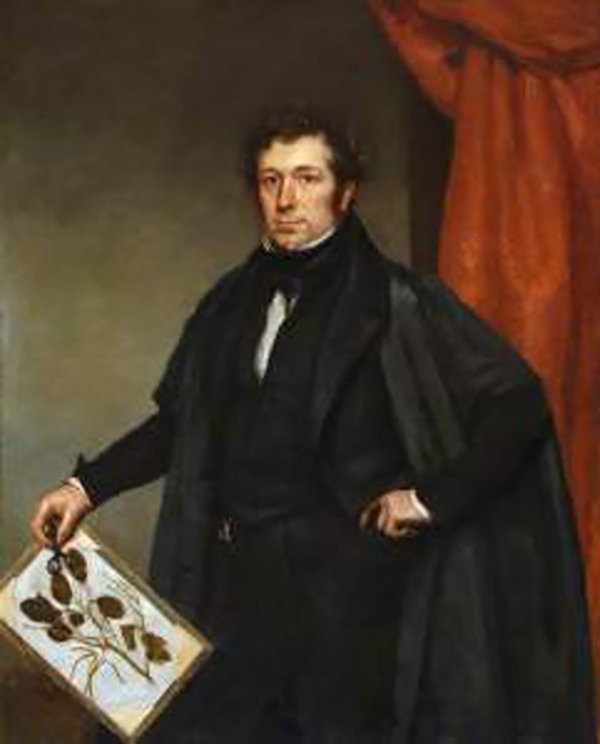
The position was offered to John Stevens Henslow, a famed botanist and clergyman, who declined because of his family situation. Henslow, in turn, offered the position to his brother-in-law, the naturalist and clergyman Leonard Jenyns, who declined because of his parish responsibilities. Finally, Henslow, who was also Darwin’s friend and mentor, recommended Darwin as the best qualified person who would be likely to accept.
Darwin’s father, Robert, was most unhappy about the situation and forbade him from accepting the offer. But he did leave an out by saying that if Charles could find one reasonable man to convince him otherwise, then he would allow Charles to go. Darwin enlisted the aid of his uncle, Josiah Wedgewood, and finally received his father’s blessing. The Beagle departed on 27 December 1831 on what was meant to have been a two-year voyage, and returned on 2 October 1836. On 16 September 1835 the Beagle reached the Galápagos Archipelago, a cluster of islands on the equator 600 miles west of South America.
During his five weeks in the Galápagos, Darwin found the giant tortoises that differed from one another so greatly that anybody with half an eye could immediately say which island they came from. Two types of iguanas lived in the islands. The land iguana, Conolophus, was adept at living on the arid islands and feeding on the sharp-spined Opuntia cactus, while the marine iguana, Amblyrhynchus, used its flattened tail for swimming, its strong claws for hauling itself out on the water, and its blunt, shortened snout for scraping algae off of rocks. “Its habits of life,” Darwin noted, “would turn out very peculiar, and different from those of its nearest ally, the Iguana.” Many of the birds that Darwin found, especially the land birds, were endemic species found nowhere else on earth. Here were thirteen different types of finches whose beeks were modified to different sub-environments on the islands.
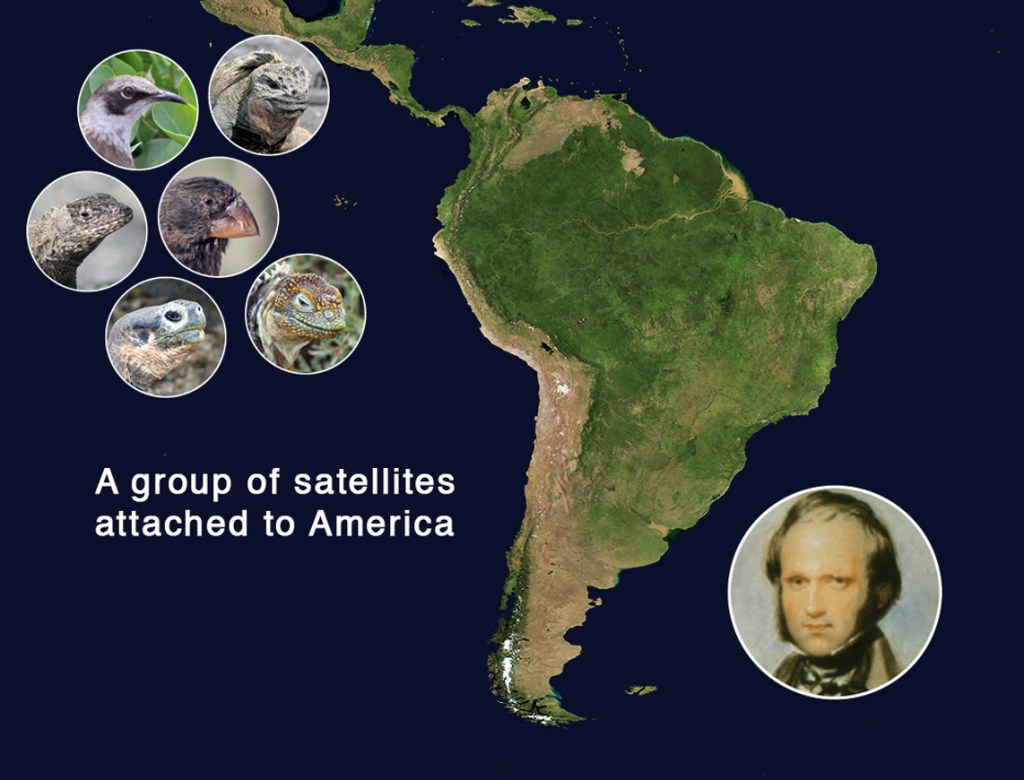
The Galápagos islands were volcanic in nature and relatively recently formed, Darwin reasoned, and the animals that dwelt there had to have come from someplace else. Those most closely resembling the Galapagos community were the animals that lived closest to the islands on the mainland. To Darwin, the Galápagos were:
“a little world within itself, or rather a satellite attached to America, whence it has derived a few stray colonists, and has received the general character of its indigenous productions.”
But they were not the same animals. Why?
Why? That was the question that plagued Darwin. Why? Eight years after his return, Darwin wrote to his close friend and colleague, Sir Joseph Hooker:
“At last gleams of light have come, and I am almost convinced (quite to the contrary to the opinion I started with) that species are not (it is like confessing a murder) immutable.”
According to Genesis, God created all plants and animals, and they have not changed significantly since that time. Yet the only way that Darwin could explain all of his observations was that they had indeed changed. The pivotal role of the Galápagos islands in shaping Darwin’s new world view is clear from a passage in his ornithological notebooks:
“If there is the slightest foundation for evolution, the zoology of the Galapagos will be well worth examining…”
 Darwin's Galapagos