These islands appear paradises for the whole family of Reptiles. Besides three kinds of Turtles, the Tortoise is so abundant; that [a] single Ship’s company here caught from 500–800 in a short time.—The black lava rocks on the beach are frequented by large (2–3 ft) most disgusting, clumsy Lizards.
—– Charles Darwin, September 17, 1835
—– Charles Darwin’s Beagle Diary
This archipelago seems a paradise for the reptile order, (as much as the [British] islands in the time of the Lias were) the land may be said to swarm with huge tortoises, the terrestrial amblyrhyncus [sic], small lizards & snakes — whilst the salt-water, with our hideous friends the aquatic Amby: & several species of tortoises.
—– Charles Darwin to William Buckland, June 15, 1837
—– The Correspondence of Charles Darwin
Reptiles are central to the mystique of the Galápagos Islands. Considering the prominent role that they have played in the history of the Galápagos, and the popular and scientific attention that they have garnered, it is surprising that so little information about them is readily available to the public. The scientific literature on these animals is vast, but very little of it has found its way into the popular literature. The only generally available information is limited to a handful of Galápagos guidebooks. The goal of this book, then, is to rectify this situation.
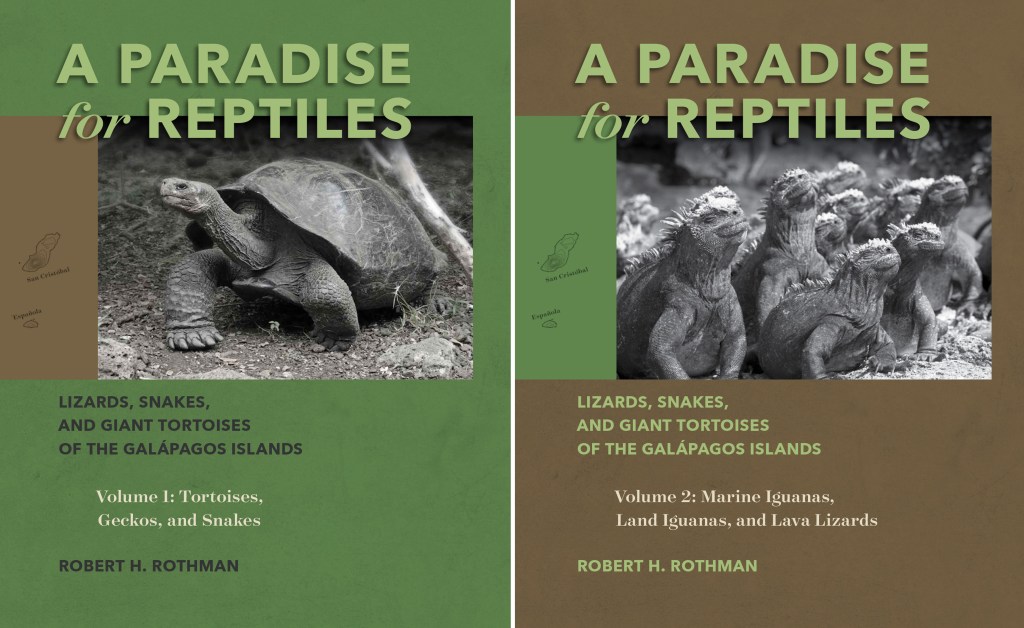
A Paradise for Reptiles: Lizards, Snakes and Giant Tortoises of the Galápagos Islands tells the story of these iconic animals. The two volumes are a synthesis of the history of, and research on the Galápagos herpetofauna, beginning in 1535, when the islands were first discovered, up until the present day. Each chapter surveys the scientific literature about each major group of reptiles — tortoises, marine iguanas, land iguanas, lava lizards, geckos and snakes.
Volume 1 covers the legendary giant tortoises and the lesser-known geckos and snakes. It also presents an overview of the complex geological history of the islands, essential for understanding the course of colonization and evolution of reptiles in the archipelago. Volume 2 continues the story of Galápagos reptiles with accounts of marine and land iguanas, and lava lizards.
Each volume details the early encounters with each species, including the route by which they were scientifically recognized and named. The two volumes present accessible, comprehensive accounts of research on the natural history, physiology, genetics, behavioral ecology, evolution, and conservation of each major group.
The books are supplemented with thirty years of photographs taken during my annual trips to the Galápagos.
View the Table of Contents


 Darwin's Galapagos