Perhaps no member of the Galapagos fauna has met with as much revulsion by historic visitors as the marine iguana, Amblyrhynchus cristatus. In 1798, for example, Captain James Colnett wrote:
The guanas are small, and of a sooty black, which, if possible, heightens their native ugliness. Indeed, so disgusting is their appearance, that no one on board could be prevailed on, to take them as food.
Indeed, even Darwin himself was much repulsed by it, calling it “a hideous-looking creature, of a dirty black colour, stupid, and sluggish in its movements.” In his diary, he noted that :
The black lava rocks on the beach are frequented by large (2-3 ft) most disgusting clumsy lizards. They are as black as the porous rocks over which they crawl & seek their prey from the sea. Somebody calls them ‘imps of darkness.’ They assuredly well become the land they inhabit.
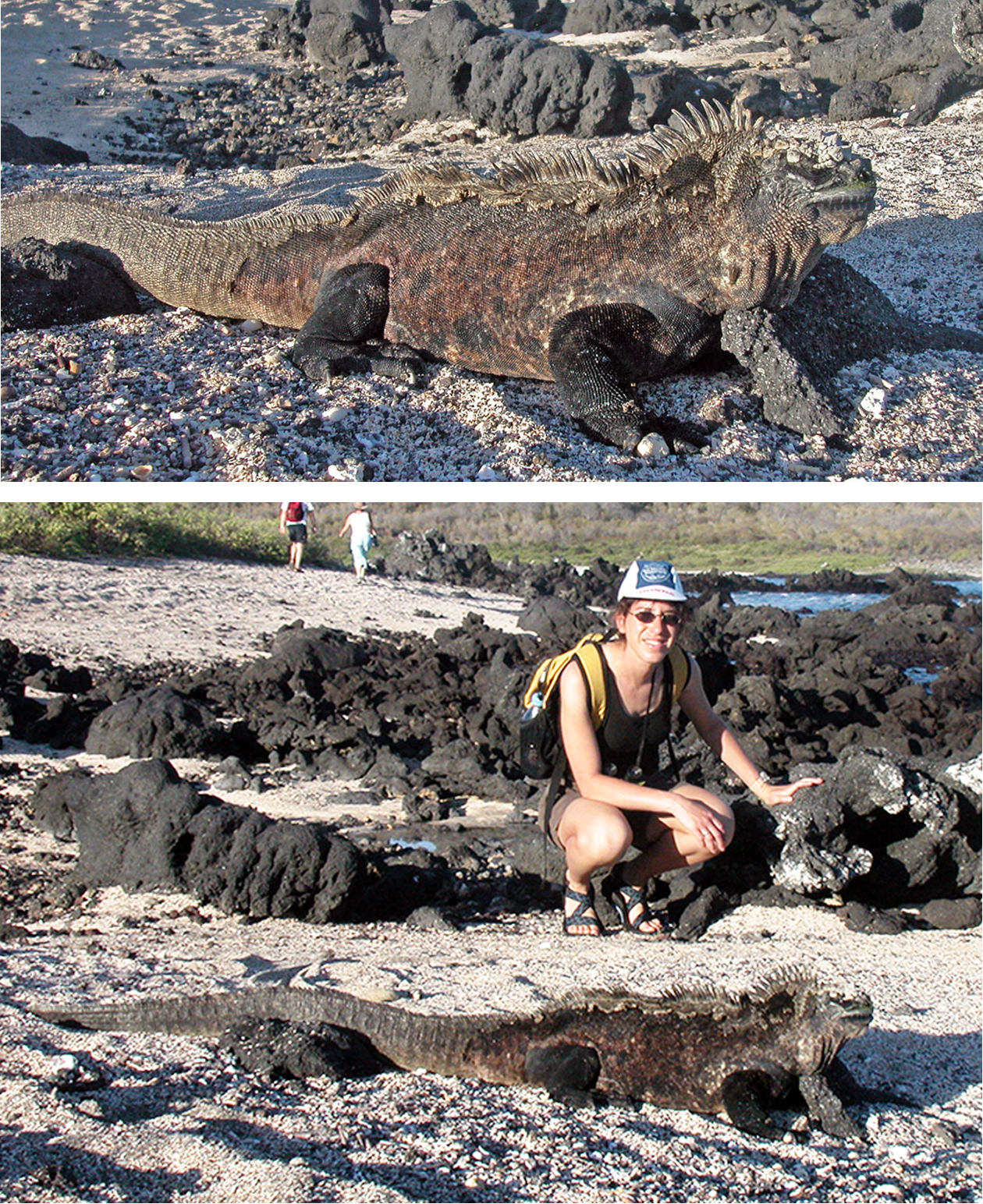
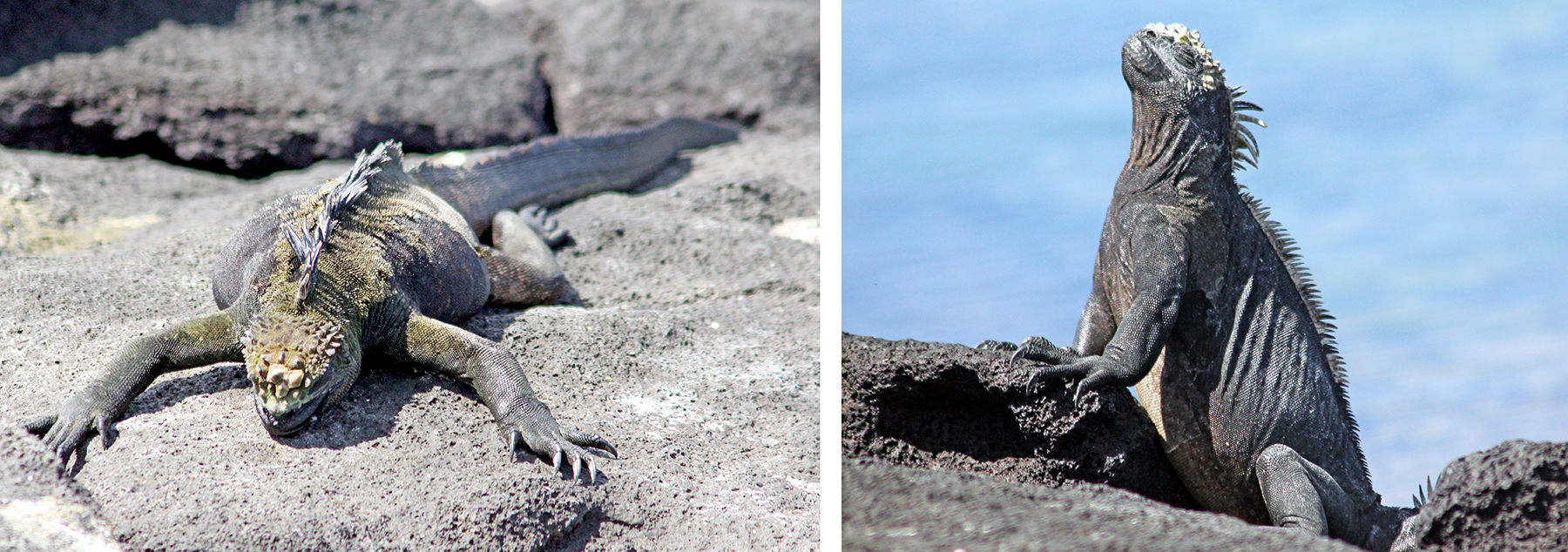
Marine iguanas are widely distributed throughout the islands. Although individuals vary in size and color from one population to another, they are all considered to be a single species. Nevertheless, according to recent genetic analysis, each island has its own resident subspecies. The smallest iguanas are found on Genovesa, and the largest on Fernandina and Isabela. The iguana in the photographs below from Bahia Urvina, Isabela is among the largest I have ever seen. My daughter provides a sense of scale.
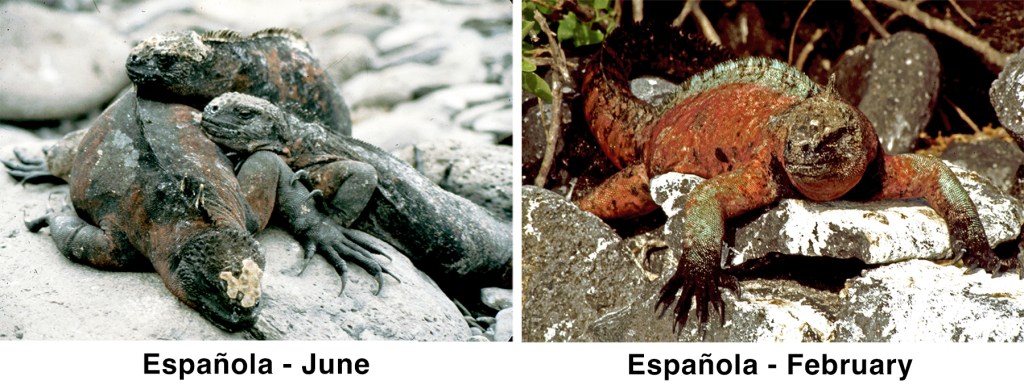
Española boasts the most differentiated, colorful iguanas. These iguanas develop blotches of coppery green and red. The red pigment comes from a particular seaweed that blooms during the summer months, which also coincides with the iguanas’ mating season, while the green is related to testosterone production. It is not clear whether or not the color change is related to mating.
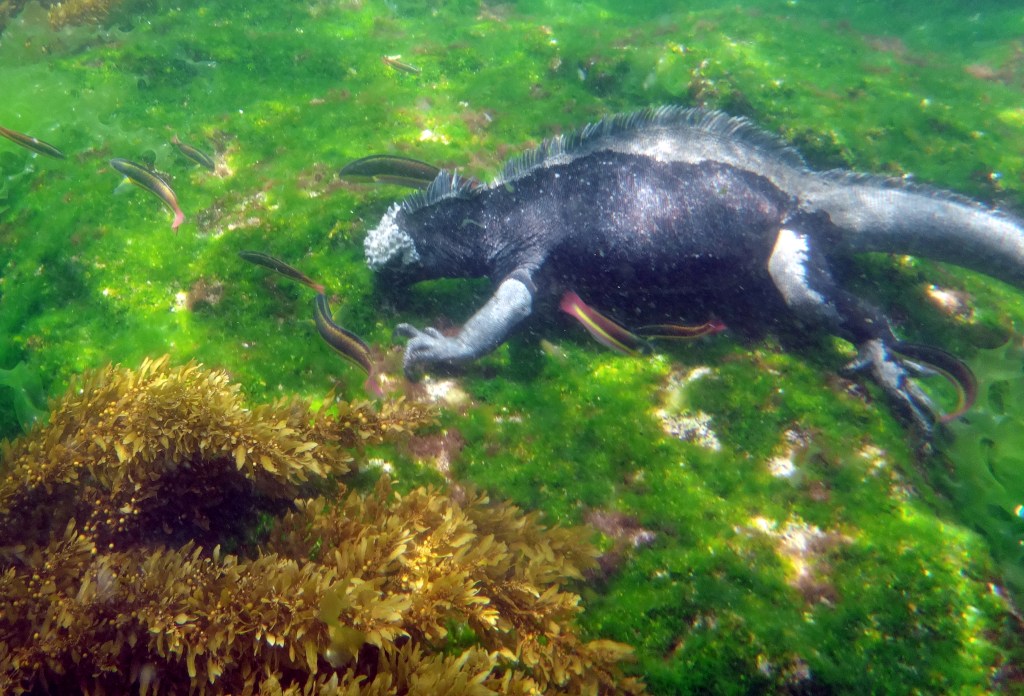
Marine iguanas are vegetarians, feeding primarily on sea weed in the intertidal zone. The biggest individuals, typically males, however, will swim out past the breakers and feed underwater. Their dives are typically shallow, 1.5 – 5 m, but large adults can dive to depths of 15 m or more. Dive times are usually only a few minutes long, but there are records of iguanas being submerged for more than half an hour. Darwin described how a sailor tied a rock to an iguana on a line and threw it into the water. When he pulled it out an hour later, the iguana was still alive.
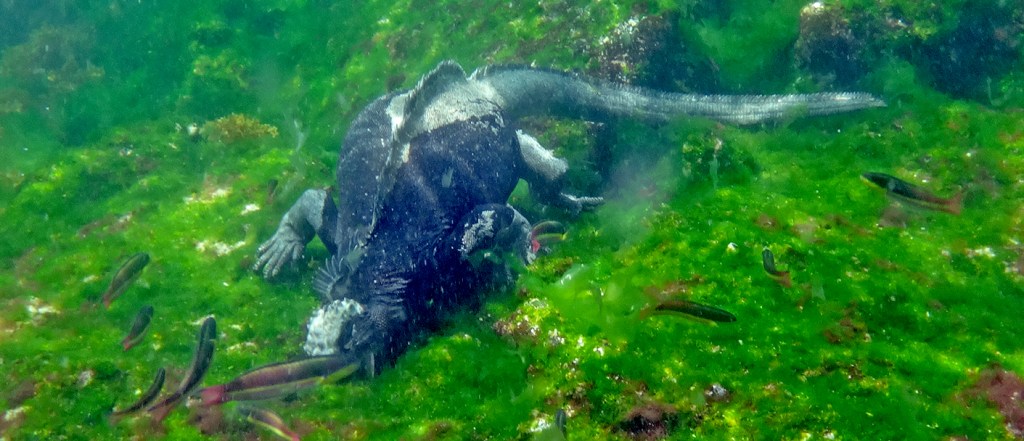
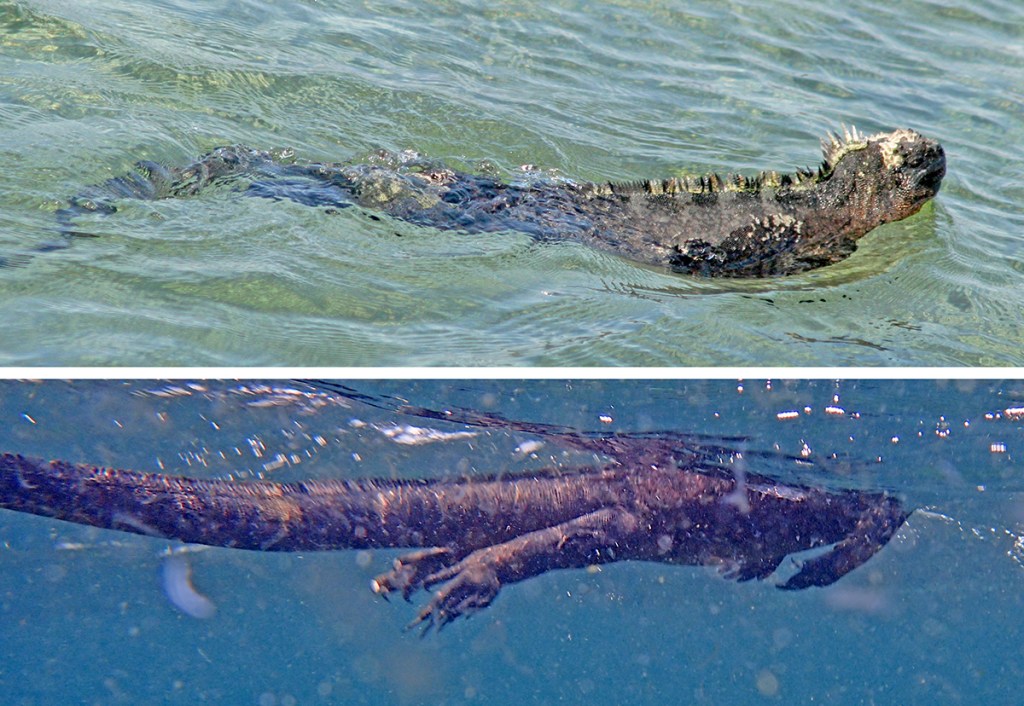
Marine iguanas possess a variety of physical and physiological characteristics that permit their unusual feeding habits. Iguanas in general have considerable swimming abilities, which are improved upon in the marine iguana. Their tails are flattened and they swim by lateral undulation of their bodies, with their limbs held to the side (check out the underwater scene in the TriStar Pictures 1998 version of Godzilla staring Matthew Broderick in which Godzilla is imagined as a giant mutated marine iguana).
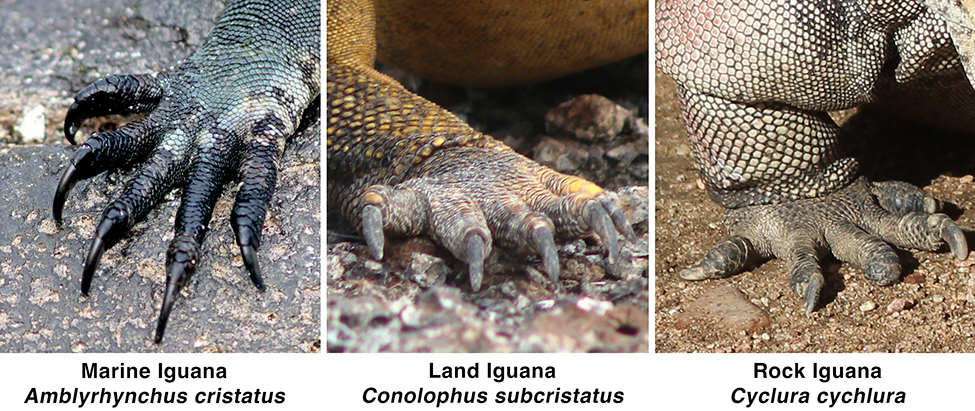
Their claws are long and sharp by comparison to the land and other iguanas, allowing them to cling to their underwater feeding sites and enabling them to hang on to the rocks along the shore to resist being pulled away by heavy waves.
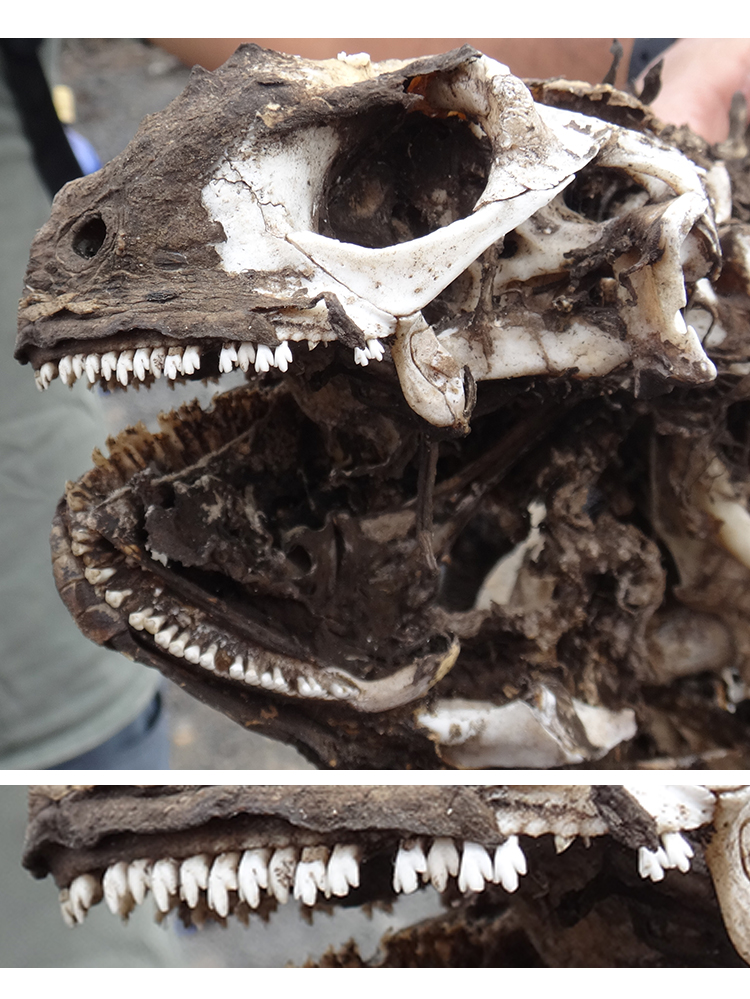
The genus name of the marine iguana, Amblyrhynchus (ambles = short, rhynchos = nose) is derived from the characteristically blunt snout that allows them to more efficiently scrape algae of the rocks with their razor sharp, three-cusped teeth. The teeth of most other iguanas are serrated.
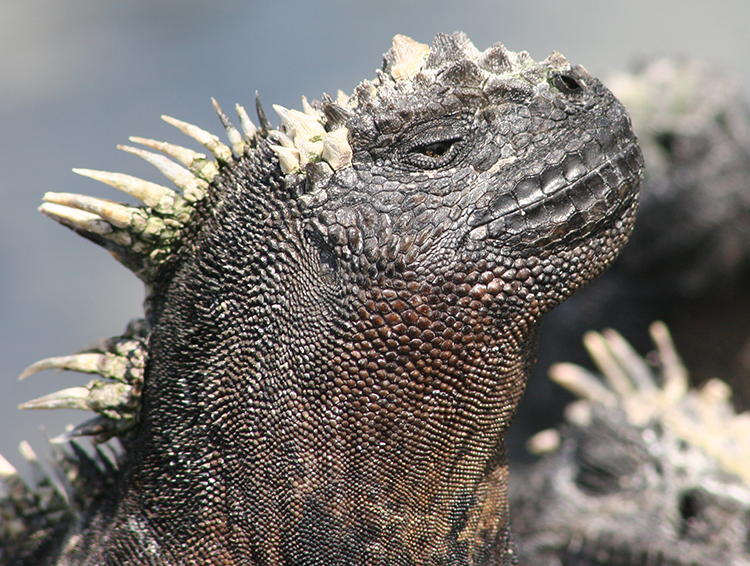
During the course of their feeding, marine iguanas ingest large amounts of salt water. They, like other iguanas, possess salt glands, located between their eyes and nostrils, which concentrate and remove salt. The salt is deposited in the nostril where it is subsequently ejected by a “sneezing” action. This ejection occurs periodically, and is also used to warn off intruders, especially over-inquisitive tourists. The spray often shoots up into the air and then falls back on the head, where it forms the white “wig” often seen on marine iguanas.
For ectothermic animals like marine iguanas, temperature regulation in a diving animal is problematic. On land, iguanas strive for an optimum 35.5 C body temperature but in the cold Galápagos waters, body temperatures can fall by as much as 10 C. Only the largest males dive because larger animals have proportionally smaller body surface areas than smaller animals and are therefore more resistant to the loss of body heat at the surface. Marine iguanas exhibit aspects of diving physiology found in other diving animals. They can shunt blood away from the surface to conserve heat, and they can drastically reduce their heart rate.
Upon returning from the sea, marine iguanas prostrate themselves on the black rocks to absorb heat. At night they often sleep in large huddles to conserve heat. Overheating can also be a problem and the iguanas have a variety of behaviors to prevent this. It is typical to see an iguana sitting on a rock, facing the sun, with its body elevated. In this manner, it presents a minimum amount of body surface to the sun, and the breeze circulating beneath the body has a cooling effect. If this posture is not effective, the iguanas will find a shady spot or crawl into a crack in the rock to hide from the sun..
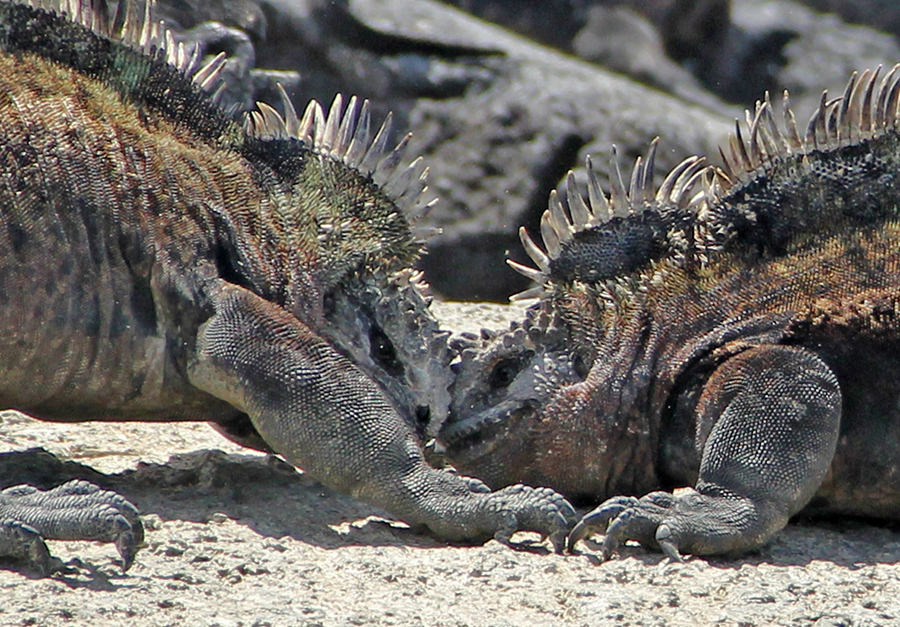
Marine Iguanas live in large colonies throughout most of the year, becoming territorial only in the breeding season – beginning in January on Española and a month or so earlier elsewhere. Males vie to establish and maintain the best territories which appear to be in the dry region above the intertidal zone and adjacent to the nesting grounds.Territorial fights, which can last for 5 hours, begin with a head bobbing display, with their mouths wide open. Eventually the males charge each other, locking heads by means of the pyramidal scales on the top of their heads, and then pushing and shoving, interspersed with breaks for more head-bobbing. The loser is either driven away or shows submission by flattening down on his belly.
With territory established, the male waits until a female passes through. He will approach her from the rear or side, and then mount her, holding the nape of her neck in his mouth. Then he wraps his tail around hers, bringing their cloacas together, and finally they copulate. The females move off and finds a soft, sandy spot to lay their eggs, some five weeks later. They dig the nest with their fore-legs, pushing the dirt back, and finally out with their hind legs. During nesting, the females become aggressive towards one another, and they will guard the nest for some time after laying.
Find out more about marine iguanas in Volume 2 of A Paradise for Reptiles.


 Darwin's Galapagos