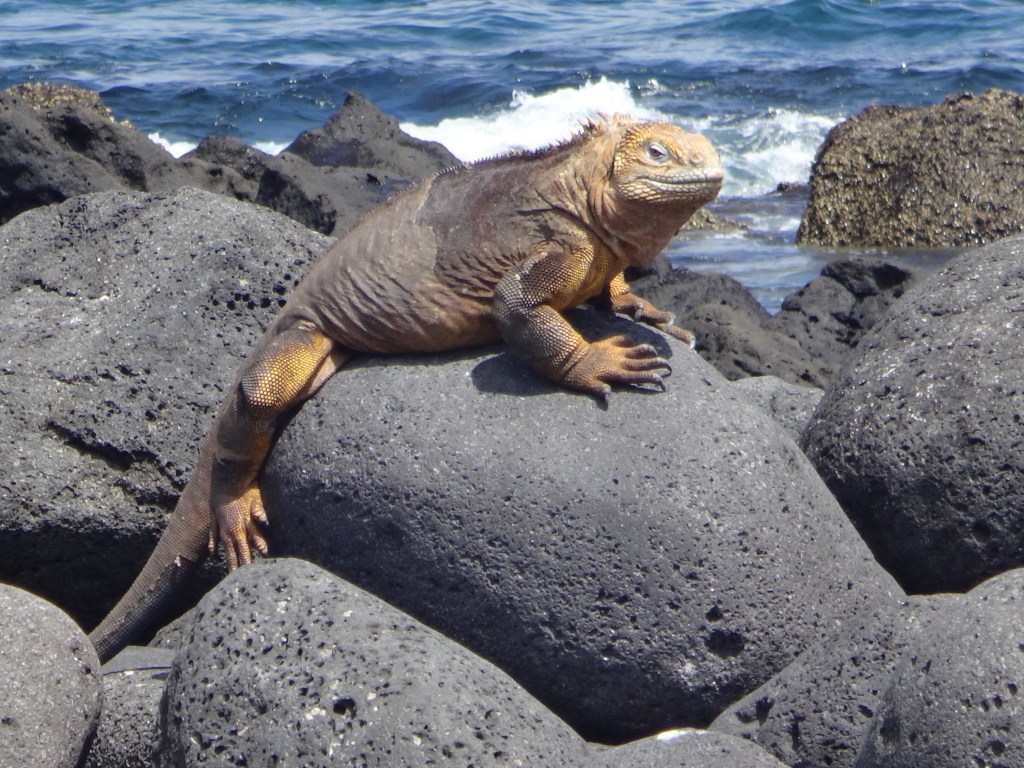
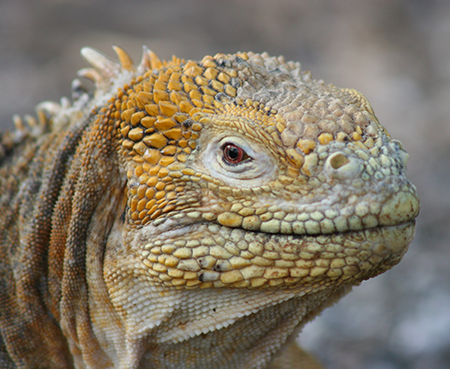
Darwin was not much impressed with the land iguana:
“…they are ugly animals, of a yellowish orange beneath, and of a brownish-red colour above: from their low facial angle they have a singularly stupid appearance.”
Land iguanas historically have been divided into two species, Conolophus subcristatus and Conolophus pallidus, although there are some data to suggest that the later is merely a local variant, a subspecies, of the former. C. subcristatus is more widespread throughout the archipelago, being found on the central and western islands, while C. pallidus is restricted Santa Fe. C. subcristatus is pretty much as Darwin described it, but since he had not visited Santa Fe he never saw C. pallidus, which is much more uniform and paler in color, and possesses a more pronounced ridge of spines.
Quite surprisingly, a third species of Conolophus, C. marthae, was discovered by Galápagos National Park Rangers in 1986 on the northwest slopes of Volcán Wolf, the northernmost volcano on Isabela. Before it was finally studied and named in 2009, this new land iguana was informally referred to as the rosado, the pink iguana. Unlike the other two species, it is pink with black stripes. Rather than a pigment, the pink color seems to be the result of blood seen through colorless scales. The most surprising feature of the new iguana is that its split from the other two species is much older than the split between C. subcristatus and C. pallidus, yet they are found on the youngest island. It may be that they were once more widely spread across the archipelago and now remain as a relict population. They share their limited range with a small population of C. subcristatus. It is not clear to what extent, if at all, the two species compete with one another. Their population is small and they are considered to be highly endangered.
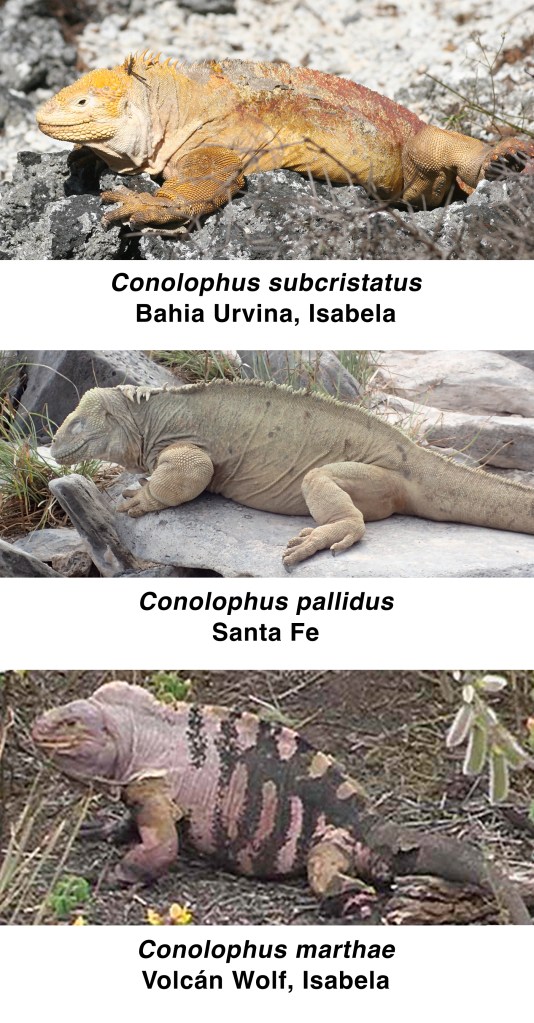
(copyright Zootaxa, http://www.mapress.com/j/zt)
C. subcristatus once had a much broader distribution and higher population numbers than it does today. In 1835 Darwin was impressed with their numbers, remarking that:
“…when we were left at James [Santiago], we could not for some time find a spot free from their burrows on which to pitch our single tent.”
Today, there is not a single land iguana to be seen on Santiago. They have become extinct at the hands of man, or man’s introduced animals. C. subcristatus can be found on Santa Cruz, Isabela, Fernandina and, most dramatically, on Plaza Sur. Plaza Sur is a very tiny islet that surprisingly supports a large population of iguanas. Visitors are often disappointed by the size before disembarking but are always surprised by the richness of the islet, especially the iguanas.
There is also an introduced population on Seymour Norte. In the early 1930’s G. Allan Hancock visited the Galápagos and was surprised to find no land iguanas on Seymour Norte while just a few hundred yards across a narrow channel, Baltra supported a large population. Since he could see no difference between the two islands, he tried the experiment of transplanting (gasp!) some Baltra iguanas to Seymour Norte. The disappearance of the Baltra population after World War II is generally blamed on US air force and navy personnel who were stationed there to protect the Panama Canal. According to the standard story, the sailors were desperately bored, and would shoot at iguanas for ammusement. However, military personnel were given strict orders not to harm animals. Early visitors such as William Beebe reported finding only large iguanas on Baltra. There had obviously been no recruitment into the population for many years and the Baltra iguanas were already dying out for unknown reasons well before there was a military base there. The Baltra iguanas still thrive on Seymour Norte. In my earlier trips to Galápagos land iguanas could occasionally be seen if you were lucky. However, after a hiatus in my trips between 2009 and 2015, I was stunned to see that the land iguana population had exploded. But a few trips later, there were few to be seen. The population boom was overtaxing the environment, so the National Park Directorate had transferred some 1500 iguanas to. Santiago. Recently, conservationists at the Darwin Station have reintroduced iguanas back to Baltra where they can be seen hanging around the airport.
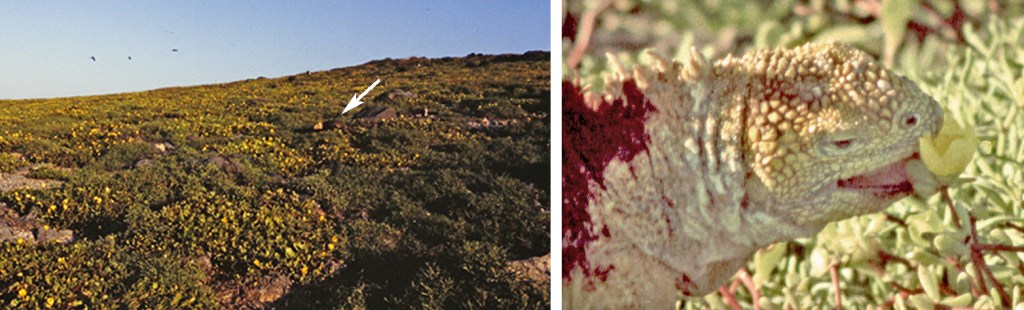
Land iguanas, like all iguanas, are vegetarians, subsisting mostly on the fruit and pads of Opuntia cactus. It is not unusual to see them sitting under a cactus, waiting for pieces to fall. They normally use their front feet to scrape the larger thorns from the pads, but they don’t seem to mind the smaller thorns. Usually they will gulp down a cactus fruit in just a few swallows. I once watched an iguana dislodge a thorn from its tongue by sticking the tongue out and dragging it back across its teeth several times.
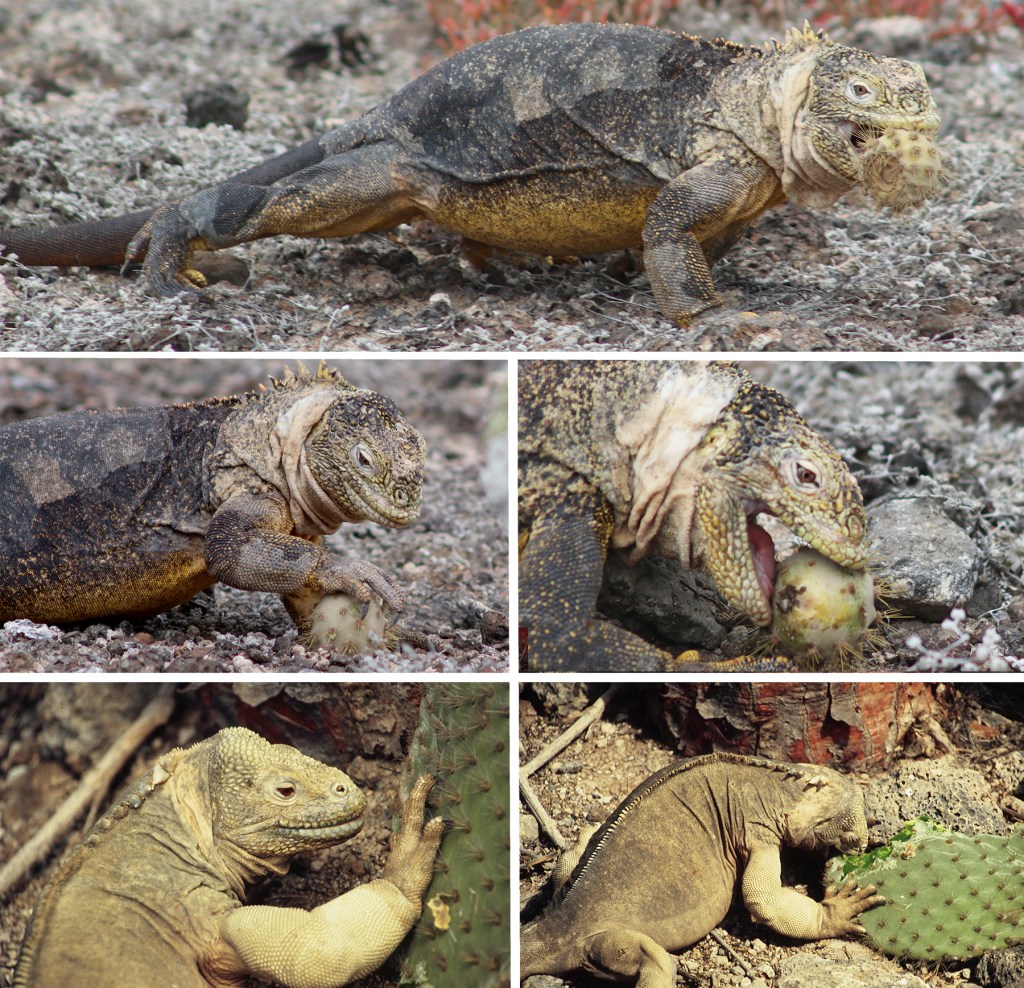
Bottom: C. pallidus scraping spines off an Opuntia Pad
In addition to cactus, they also eat a variety of other plants including Cordia, Lantana, Castela, Alternanthera, Tiquilia, and Portulaca. Portulaca is a low-growing plant that is found in abundance on the western part of Plaza Sur. After a wet period, they blanket the island in yellow flowers. The flowers, however, last only a few days because they are eaten by the iguanas. For reasons unknown, land iguanas love anything yellow and they will bypass food that may be richer in nutrients in preference for a yellow flower such as is found on prickly pear cactus as well as on a number of other plants.
Occasionally land iguans will dine on carrion or arthropods that crawl in their burrow. Again like other iguanas, the juveniles feed primarily on insects.
Unlike marine iguanas, which are highly gregarious outside of the breeding season, land iguanas live solitary lives. Males establish home ranges that can vary in size with season and food availability. These ranges are so big that a territory holder cannot see the entire area at the same time, so there is some overlap, especially with the smaller female territories. Land iguanas signal their ownership with a species-specific sequence of head bobs. As the breeding season approaches, males move to areas that provide soil soft enough to dig a burrow, contains an ample food source, and areas for thermoregulation. During this period, males usually fast, but the food is important to females who are directing their metabolism to preparation for reproduction. A few weeks later females arrive, establish their own territories, and inspect the male territories. Eventually the females will settle with one male. She may then move to another male’s territory and copulate a second time. Following copulation, the females migrate to nesting areas where they dig a nest in which to bury a clutch of up to 25 eggs. On Fernandina, the migration from the mating area to the nesting grounds is epic; they climb to the rim of the volcano and then descend into the caldera where their eggs are warmed by the hot volcanic soil.
On Plaza Sur land iguanas occasionally hybridize with marine iguanas. My friend Galápagos naturalist guide Walter Campoverde told me that male marine iguanas, in a mating frenzy, have occasionally been seen attacking and forcefully copulating with female land iguanas. Molecular studies on the hybrids would seem to bear this out. While offspring get half of their nuclear DNA from each parent, their mitochondrial DNA, found in the cytoplasm, comes only from the mother. The mitochondrial DNA in the hybrids matches the land iguana. In general form, the hybrids, such as the one below, resemble the land iguana and seem to live the land iguana lifestyle. Their coloration, however, is very dark, like the marine iguana, and they exhibit dorsal striping which is characteristic of juvenile marine iguanas, but not juvenile land iguanas. There are only a few hybrids and nobody knows if they are fertile. Hybrids have not been seen on any other island, and this makes sense. Marine iguanas rarely are found more than 10 m from the shore while land iguanas are found much farther inland. But Plaza Sur is so small that there is no separation between the two species.
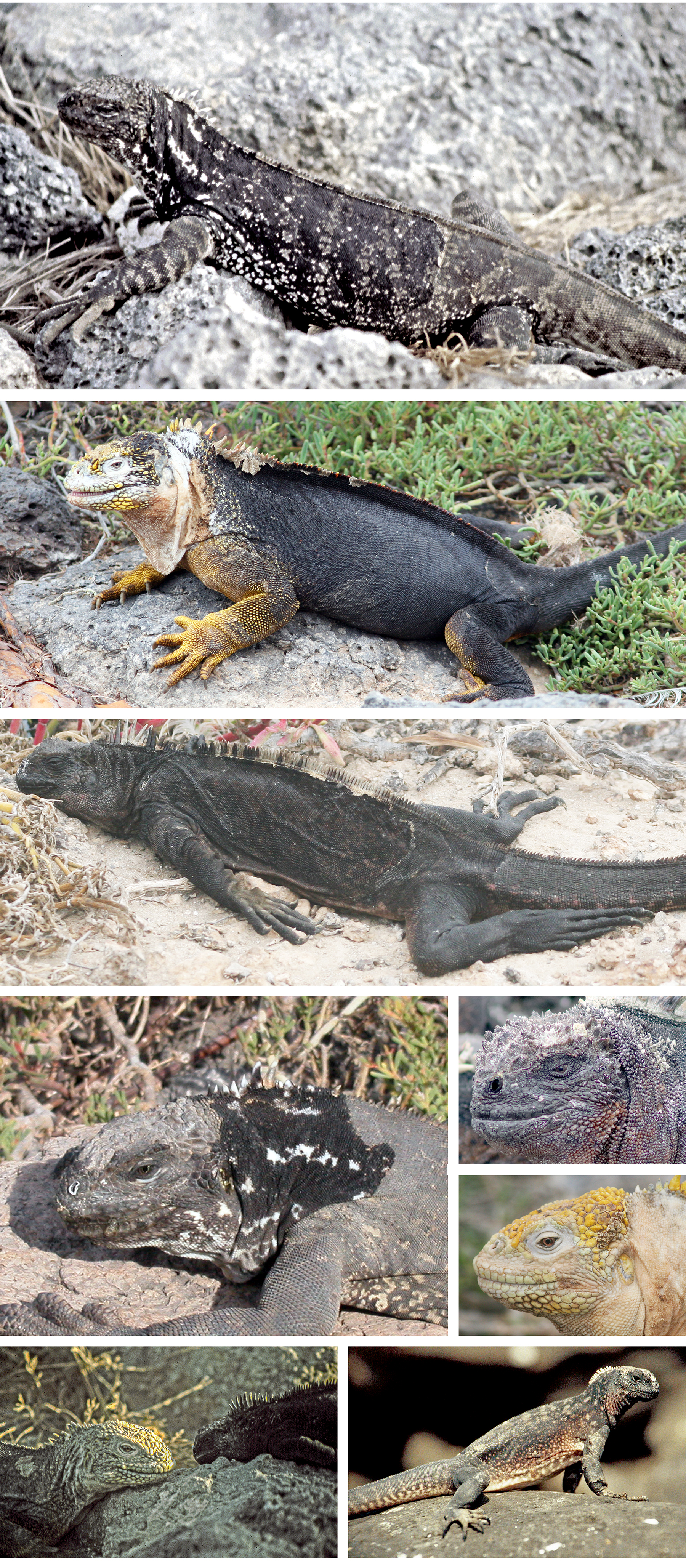
Row 1: Hybrid iguana; Row 2: Land iguana; Row 3: Marine iguana
Row 4: Comparison of heads of hybrid, marine, and land iguanas
Row 5 Left: Plaza Sur is the only island where both iguanas live in proximity
Row 5 Right: Young marine iguana showing juvenile striping pattern
The fact that there is crossbreeding between Conolophus and Amblyrhynchus raises interesting questions about the evolutionary relationship between the two. Standard definitions of the term “species” include the presence of a fertility barrier. Some closely related species can hybridize to form viable, fertile offspring, as is the situation among Darwin’s Finches. Less closely related species can interbreed, such as horses and donkeys, but their offspring are infertile.
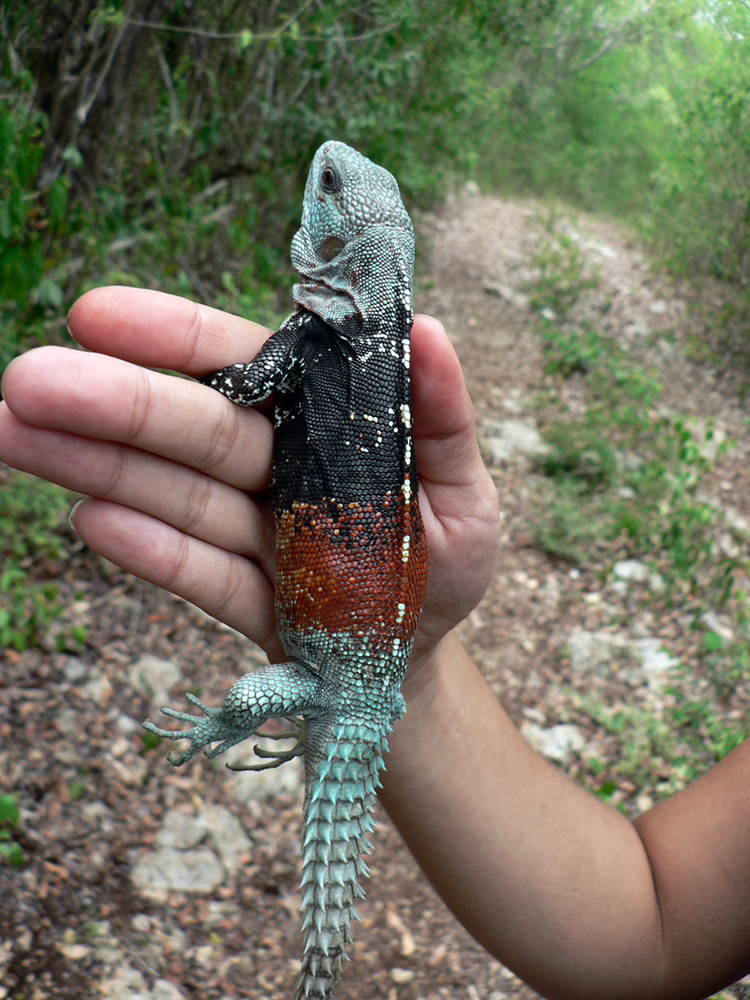
It has often been suggested that the marine iguana evolved from the land iguana, but DNA analysis does not support this relationship. Rather, the land and marine iguanas are sister genera, closely related, but not in an ancestor/descendant manner. It appears that the closest mainland relative of the Galápagos iguanas is the Central American spiny-tailed iguana, Cachryx.
Molecular clock studies suggest that these iguanas diverged from other iguanas around 8 million years ago. The oldest Galápagos island, however, is only around 4 million years old. Either the Galápagos iguanas originally evolved on the mainland and colonized the islands in their present form, or they evolved on older Galápagos Islands that have now sunk beneath the waves. Indeed, the presence of older, now submerged islands have been found along the Carnegie Ridge to the east of the Galápagos.
Find out more about land iguanas in Volume 2 of A Paradise for Reptiles.


 Darwin's Galapagos