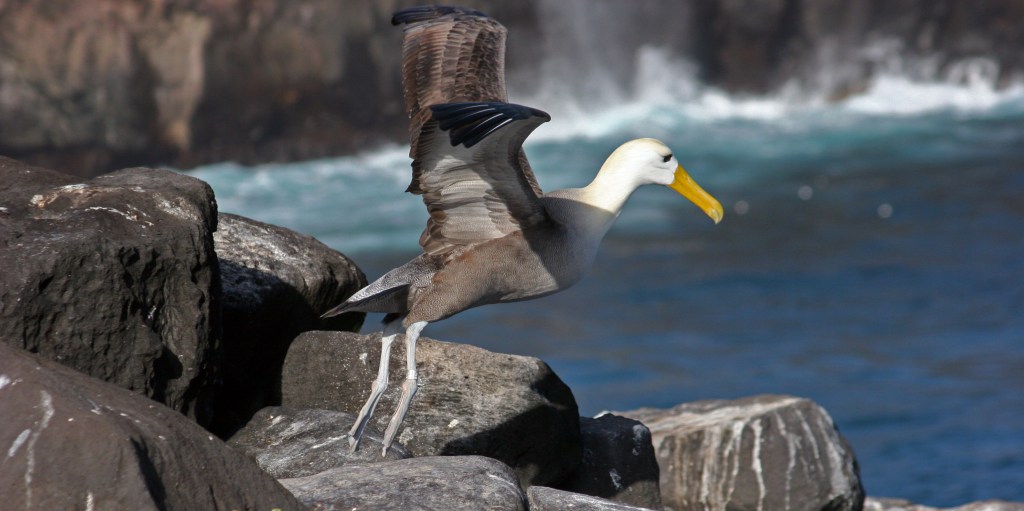
With a wingspan of 7-8 feet and a weight of 7-11 pounds, the waved albatross (Phoebastria irrorata) is the largest Galápagos bird. On land they walk with a waddle and appear to be very clumsy, but in the air, they are among the most graceful of sea birds. Although considered endemic not just to the Galápagos, but specifically to Española, where they exist in colonies of some 35,000 individuals, about 12,000 pairs. A very small colony has recently established itself on Isla de la Plata, off the coast of Ecuador.

On Española they congregate in two major colonies, one at Punta Cevallos, and the other at Punta Suarez, a visitor site. Like other birds that primarily glide, waved albatrosses rely on a strong headwind to take off. This, they find at Punta Cevallos. They run down the sloping beach with spread wings. Once they catch the head wind, they are aloft. The Punta Suarez colony is at the top of a sea cliff, to which the birds can walk. There they take flight simply by jumping off. It is typical to find large rafts of albatrosses sitting just off shore. When taking off from water, the albatross runs over the surface until it catches enough wind to provide lift.

Waved albatrosses, like other albatrosses, spend part of their year at sea. The waved albatross, does not travel very far, however, nor is it gone for a very long time. From January through March, they are found in the Pacific east of the Galápagos, and along the coasts of Ecuador and northern Peru. Many often congregate in the Gulf of Guayaquil. They begin to return in mid-late March, the males arriving first.Waved albatrosses mate for life, so the male returns to the previous year’s breeding territory and waits for his partner.
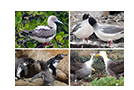
Waved albatrosses, like other albatrosses, engage in a very lengthy, noisy, and complex courtship ritual. Some of the basic steps are illustrated in the strip to the right. The dance involves bill-fencing, in which the partners bend, face each other, and rapidly slap their bills back and forth. In another step each faces the other in an upright posture, sometimes poising with bill wide open. The bills are then shut with a loud clap. Sometimes the birds will clatter their bills rapidly. The dance also involves bowing, and parading around one another with the head swaying side to side in an exagerated sway, accompanied by a nasal “anh-a-annhh” sound. These steps are interspersed frequently with bouts of bill fencing. The dance is longer and more involved in new pairs, or in pairs that failed to breed in the previous season. For visitors lucky enough to see it, the courtship dance of the waved albatross is a highlight of any Galápagos trip.

Between mid-April and July the pair produces one egg, which is incubated by both parents for about two months. Early in incubation, each parent takes long stints, as much as three weeks, but as hatching nears, the stints become shorter. The albatross does not build a nest, but rather, lays the egg on the ground. During incubation the parents frequently roll the egg about, covering distances as much as 40 m. The reason for this behavior is unclear, but its value appears to be obvious since it seems to be correlated with a higher success in hatching.

The chick is dark brown, and covered with curly dark brown downy feathers. For the first few weeks after hatching, one parent guards the chick while the other forages for food, but after that, the chicks are left in unguarded nursery groups while both parents spend longer times at sea looking for fish and squid which they catch on the surface or taken in a shallow dive. Whatever food is captured by the parents is held in the stomach, where it is converted to an oily liquid. The parent can hold this liquid in its stomach without digesting it for a considerable amount of time, making its hunting expeditions more efficient as it doesn’t have to return frequently. Upon returning to the colony, the parent finds its offspring and then pumps the liquid into the chick’s stomach. As much as 2 kg of liquid can be forced into the stomach at one feeding, making the chick swell and look like an over-inflated brown bag. It can barely move until the oil is digested.
By the end of December, the chicks have fledged, and they leave their nurseries with their parents and head for the eastern Pacific. Although their parents return to Española the following year, the fledglings remain away for five to six years, at which time they also return to Española to begin breeding for the first time.
Gallery