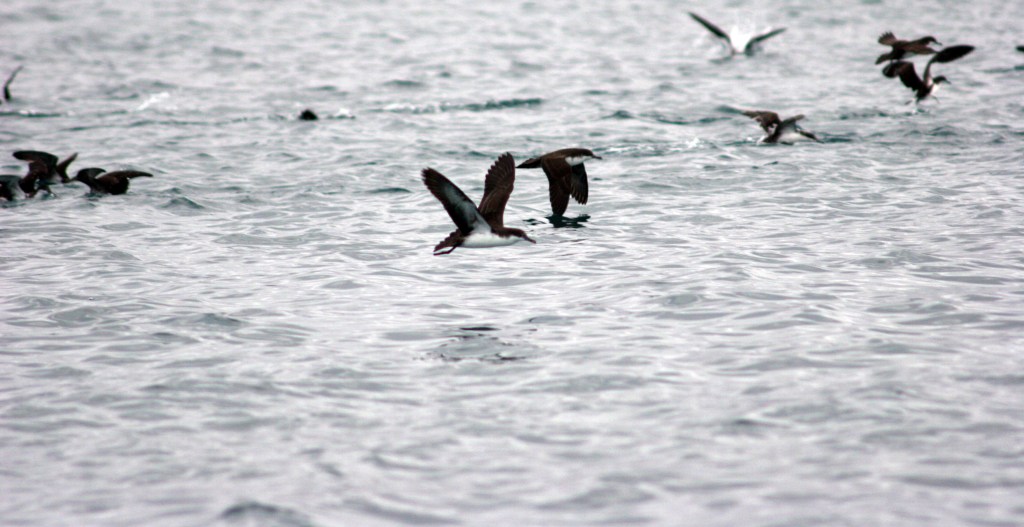
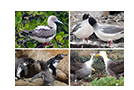
The Galápagos shearwater is a medium sized sea bird commonly seen from yachts. Typically, they skim close to the water, with intermittent periods of flapping and gliding. Shearwaters always seem to be on the move, either individually or in flocks, and it is not often easy to get a good sighting, let alone a good photograph. They are often encountered resting on the water, and as a yacht advances towards them they scatter. Most of my photos, accordingly are disappointing. However, it is not uncommon to see them fishing in large flocks, or in mixed flocks with pelicans and brown noddies, and then it is possible to approach them. In the case of photos below, we encountered a feeding frenzy of shearwaters, blue-footed boobies, frigate birds, pelicans, and a few penguins, and were able to quietly approach in a panga (the Ecuadorian term for a dinghy).
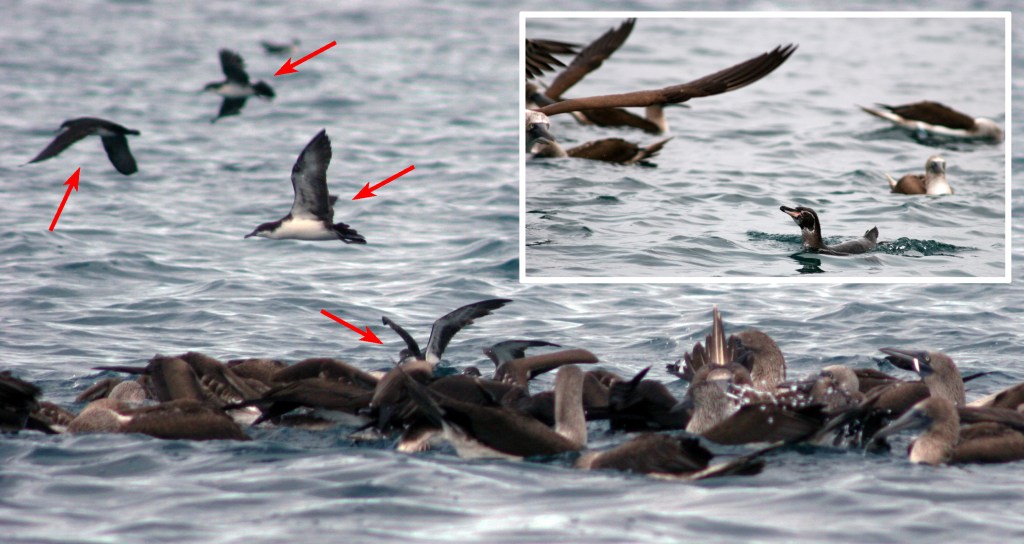
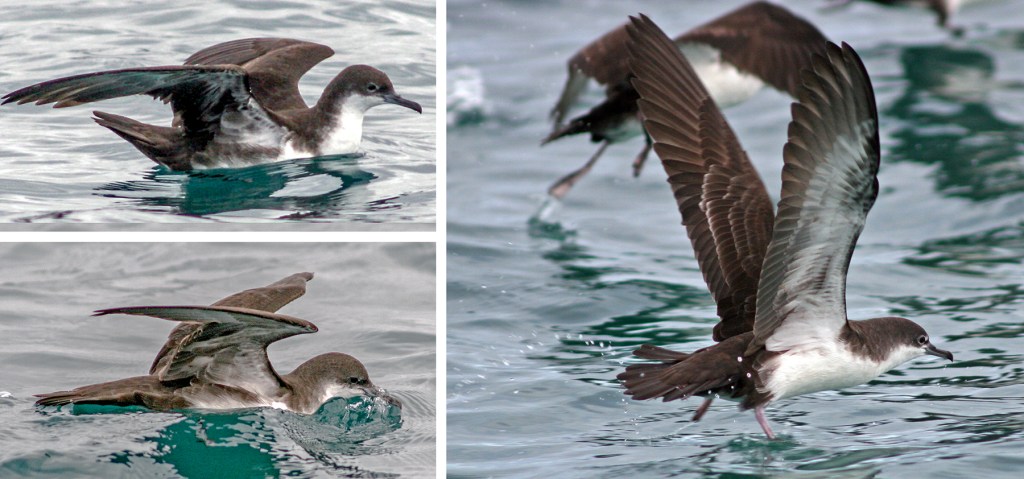
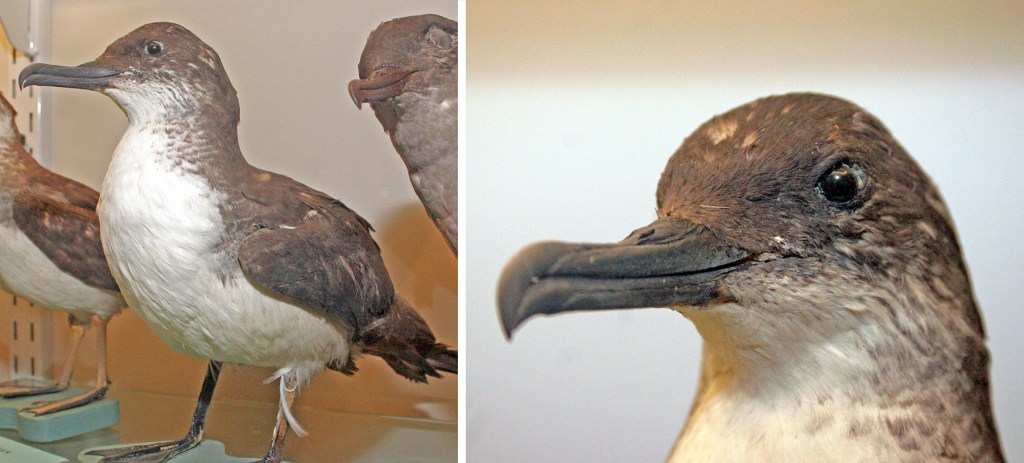
As can be seen in the photos, Galápagos shearwaters have white bellies with dark brown wings and back, and a dark brown head with a white throat. They are most easily confused with the larger, less common Galápagos petrel (Pterodroma galalpagensis). Apart from size, the forehead and face of the Galápagos petrel is white. Much to my regret, I have never seen one.
The Gallápagos shearwater was formerly identified as Audubon’s shearwater (Puffinus lherminieri). Audobon’s shearwater has a worldwide distribution, with populations, in addition to the Galapagos, in the western and central Pacific, the Philippine Sea, the Indian Ocean, and the Caribbean (it was once, but no longer, present in Bermuda). The Galapagos population was considered to be an endemic subspecies, but has since been raised to full species status as Puffinus subalaris. Many ornithologists consider other Audobon’s shearwater populations to also be independent species.
Galápagos shearwaters are encountered throughout the archipelago, most frequently near the cliffs where they nest. They feed on small planktonic crustaceans and fish larvae, which they take from the surface, and on small fish, and squid, which they catch by plunge diving to depths of about six feet.
Galápagos shearwaters lay a single egg in holes in the sea cliffs. The average hatching time is 51 days, during which both parents incubate the egg. Both parents also feed the chick until fledging, about two and a half months later. They breed throughout the year and a successful pair can produce a chick about every 9-10 months.



 Darwin's Galapagos