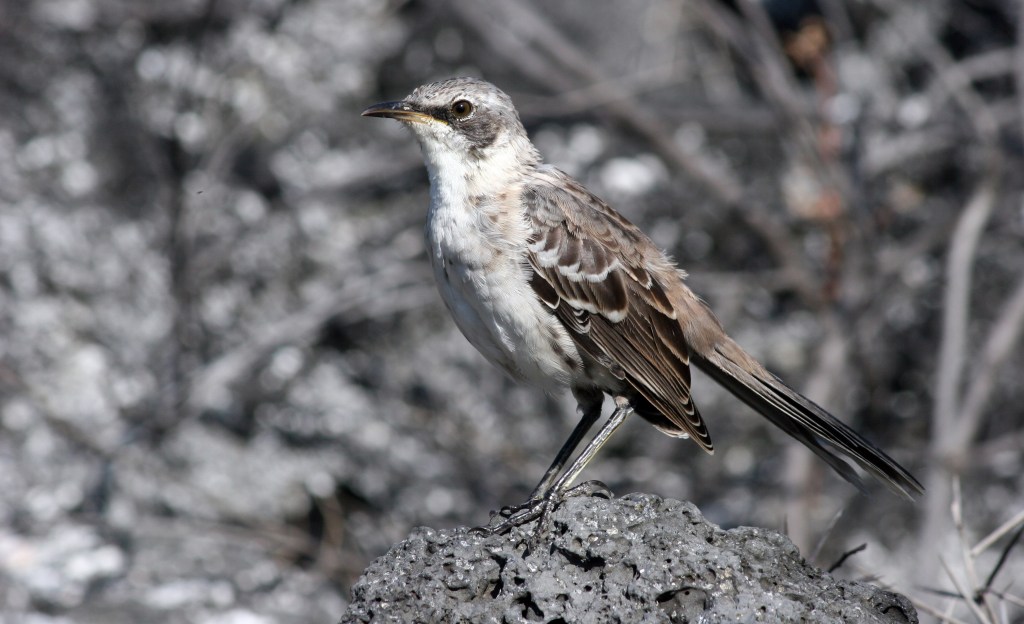
Although tortoises and finches are the organisms that most commonly come to mind when thinking of Darwin, the Galápagos, and evolution, it was the mockingbirds, or mocking-thrushes as Darwin called them, that first drew Darwin’s attention to the strange diversity of species within the archipelago. By the time he left the Galápagos he understood that individual islands contained different but closely allied species.
The environments of the various islands were similar enough that any one of the species, Darwin thought, would have done well on any of the islands. He had been told this about tortoises by the acting governor of the island but he could not make the case based on his own observations. Although he had brought back specimens from three different islands, they were all young and did not show the island-specific morphologies that would become manifest later in life. At the time, the land and marine iguanas were presumed to be two species of Amblyrhynchus, and moreover, he had been told by French herpetologist Gabriel Bibron that there were probably at least two species of the marine kind. Darwin recognized the importance of the finches, but his collections were mixed and the relationships were too complex. They had to wait until the late 20th century before genetic analysis could be applied. It was the mockingbirds that allowed Darwin to make this key observation for himself.
“It will be seen,” he wrote in the bird volume of Zoology of the Beagle “that
the three last species of the genus Mimus [Darwin had collected other species of mockingbirds on the mainland], were procured from the Galapagos Archipelago; and as there is a fact, connected with their geographical distribution, which appears to me of the highest interest, I have had these three figured.
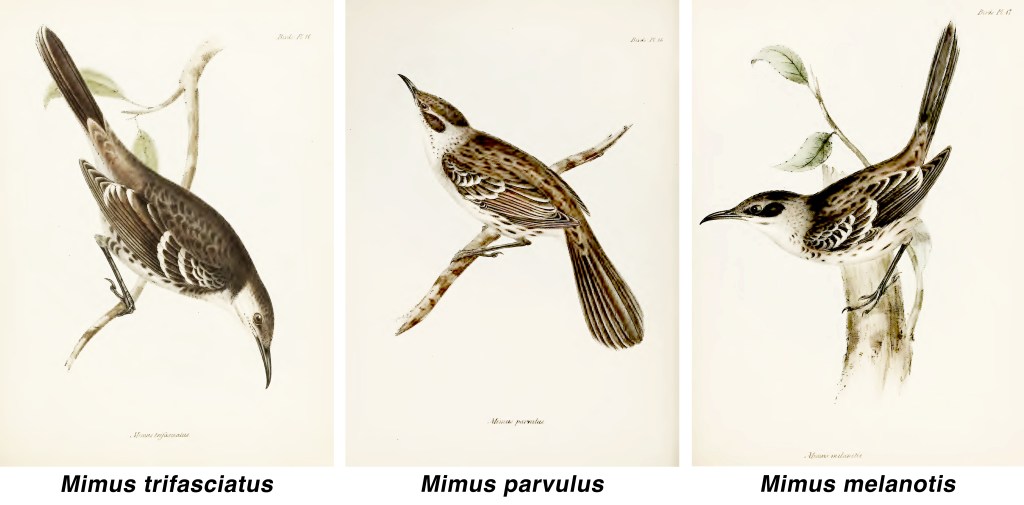
There are five large islands in this Archipelago, and several smaller ones. I fortunately happened to observe, that the specimens which I collected in the two first islands we visited, differed from each other, and this made me pay particular attention to their collection. I found that all in Charles [Floreana] Island belonged to M. trifasciatus; all in Albemarle [Isabela] Island to M. parvulus, and all in Chatham [San Cristóbal] and James’s [Santiago] Islands to M. melanotus. I do not rest this fact solely on my own observation, but several specimens were brought home in the Beagle, and they were found, according to their species, to have come from the islands as above named.
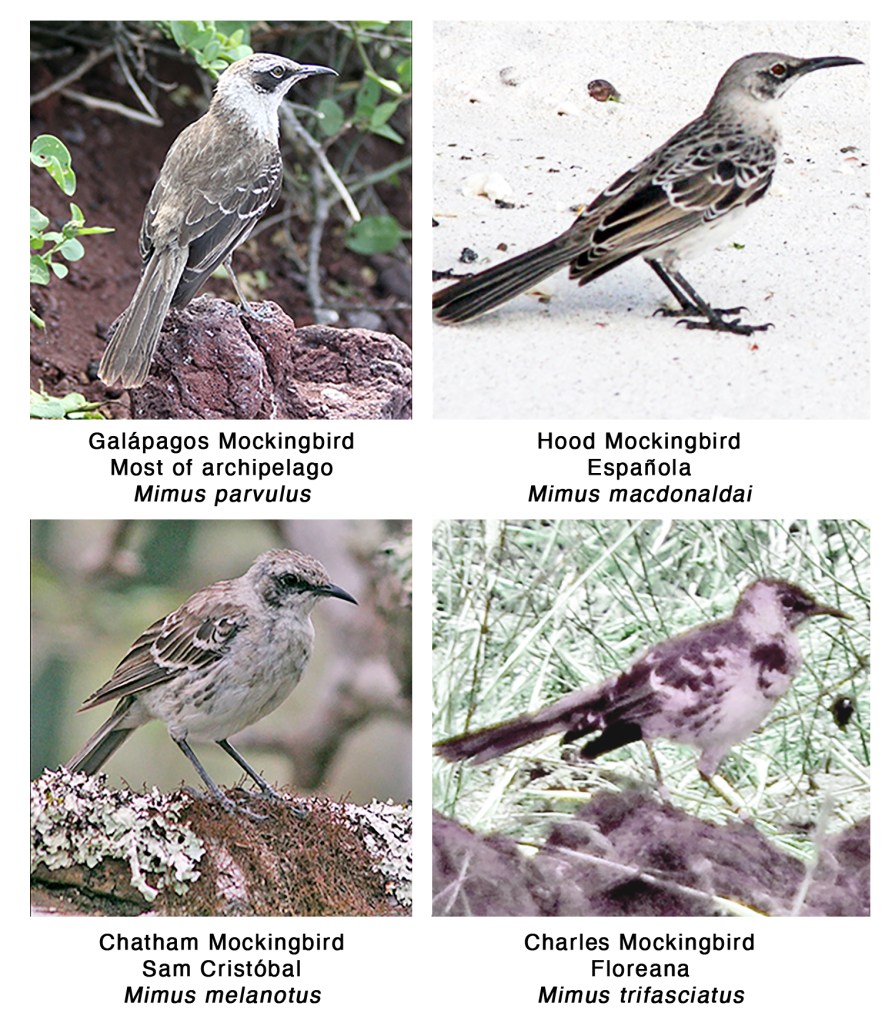
Actually, M. melanotus is limited to San Cristóbal; the species found on Santiago is M. parvulus, the Galápagos mockingbird. Perhaps this error is understandable. John Gould, who analyzed Darwin’s bird specimens and wrote the bird volume of the Zoology of the Beagle had only a few specimens to work with. Darwin wrote that while M. melanotus and M. parvulus were similar enough that some ornithologists might consider them merely to be local varieties, M. trifasciatus was distinct enough to be considered a different species altogether.
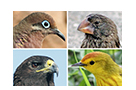
Although Captain FitzRoy assigned two officers to survey Hood Island (Española), Darwin himself was not put ashore there. Had he been, he would have realized that there is a fourth species, M. macdonaldai. Of the four, M. trifasciatus is the most difficult for visitors to see. Floreana was the first island to be colonized by humans and the mockingbirds there are extinct, but they still survive on the satellite islets of Champion and Gardner-near-Floreana (there is also a Gardner-near-Española), which are closed to tourists. However, it is possible to cruise around Champion and see them from the boat. I have tried this several times with bitterly disappointing results. But on my very last attempt I succeeded! The photographs below show the four species. M. trifasciatis was shot from a great distance and, accordingly, the photo is not as crisp as the other photos, but it clearly shows the difference. The Galápagos National Park Directorate is working to restore Floreana by removing introduced species, returning tortoises, and releasing captive-bred mockingbirds back to their home island.
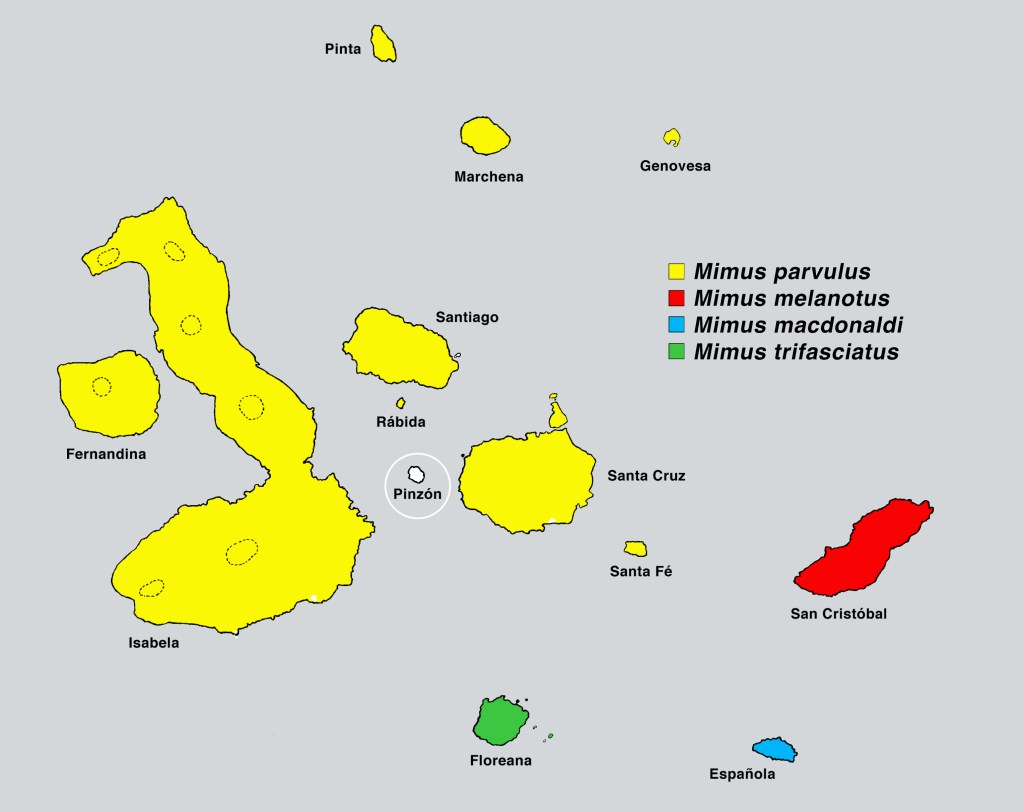
The map below shows the distribution of mockingbirds in the archipelago. Darwin was surprised that similar islands, within sight of one another, would have different yet related species:
The fact, that islands in sight of each other, should thus possess peculiar species, would be scarcely credible, if it were not supported by some others of an analogous nature, which I have mentioned in my Journal of the Voyage of the Beagle.
San Cristóbal, Española, and Floreana, which are isolated by wind and current if not by distance, each have their own unique species, while only a single species, the Galápagos mockingbird, M. parvulus, is distributed throughout the remainder of the archipelago. Some ornithologists, however, consider the various M. parvulus populations to be different subspecies. The one surprising anomaly to the distribution of M. parvulus is that Pinzón, in the center of the archipelago does not have a resident mockingbird population.
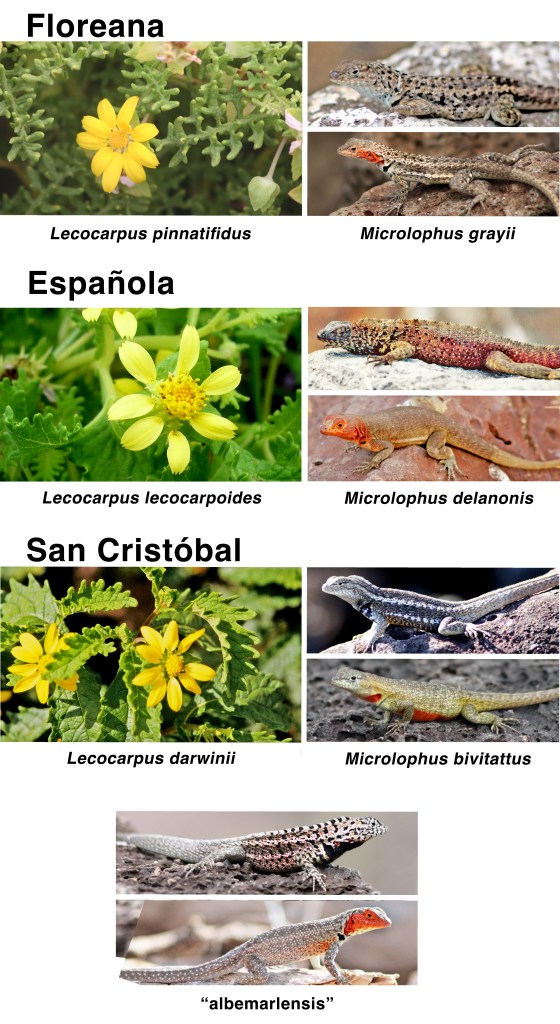
The distribution of mockingbirds correlates well with the distribution of other Galápagos species. Lava lizards have a similar distribution as mockingbirds, although the situation is complicated. San Cristóbal, Española, and Floreana, each have their own unique species. The remaining islands possess morphologically similar species that were originally conflated as one, Microlophus albemarlensis. However, intense genetic analysis indicates that these morphologically similar lizards represent different species, much as some consider the mockingbirds on these islands to be different subspecies. I discuss this complicated relationship in volume 2 of A Paradise for Reptiles, and will soon add a lava lizard page to this website. Interestingly, while Pinzón lacks any species of mockingbird, it does possess an endemic lava lizard, Microlophus duncanensis. Among plants, the flower Lecocarpus is found only on Floreana, Española, and San Cristóbal, and each island has its own unique species.
The photographs below illustrate the endemic Lecocarpus and lava lizard species found on Floreana, Española, and San Cristóbal. For the lava lizards, the male is in the top panel and the female in the bottom. The last pair of lava lizards, “albemarlensis,” is not an actual species. Rather, it represents all of those species that overlap with the distribution of M. melanotus. The actual species pictured here is Microlophus indefatigabilis from Santa Cruz. Microlophus albemarlensis is found on Isabela and Fernandina.
I have only seen L. pinnatifidus and L. darwinii. It is not possible for visitors to see L. lecocarpoides. The photograph of L. lecocarpoides here was taken by Dr. Patricia Jaramillo Díaz and was downloaded from a news story posted by the Charles Darwin Foundation in 2022. The last sighting of this plant was at Punta Manzanillo, Española, which is not a visitor site, in 2012, and it was thought to be extinct. Scientists at the Charles Darwin Foundation were able to germinate some plants from seeds stored in the CDF Herbarium, and when they returned to Española in 2020 to repatriate the new plants, the team was surprised to find 24 small living plants. For more about this important step in the restoration of the Galápagos, check out the initial news report from The Charles Darwin Foundation. The actual journal article by Tye and Jaramillo Díaz can be found here.
Darwin described the behavior of mockingbirds in the Zoology of the Beagle:
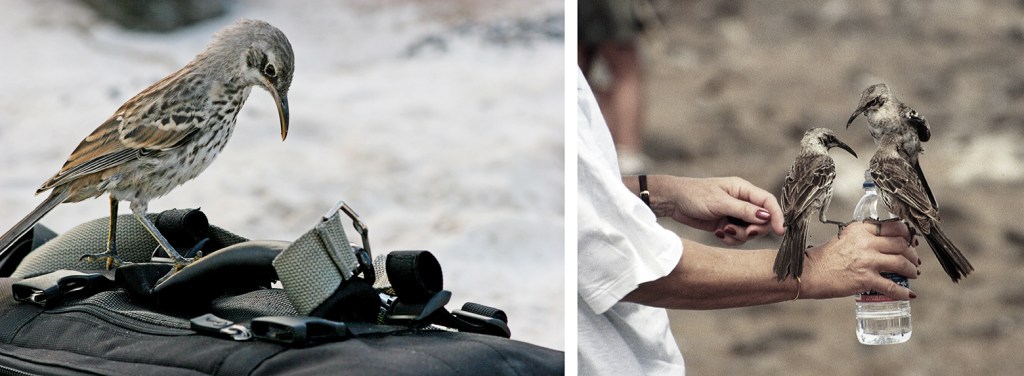
The habits of these three species are similar, and they evidently replace each other in the natural economy of the different islands ; nor can I point out any difference between their habits and those of M. Thenca of Chile; I imagined, however, that the tone of their voice was slightly different. They are lively, inquisitive, active birds, and run fast ; (I cannot assert, positively, that M. Thenca runs). They are so extremely tame, a character in common with the other birds of this Archiplago, that one alighted on a cup of water which I held in my hand, and drank out of it. They sing pleasantly ; their nest is said to be simple and open.
Unlike the other three, the Española mockingbird is VERY inquisitive and extremely aggressive. It is not uncommon for them to land on a visitor’s head and they will explore any unknown object, always looking for food or drink. A lady on one of my trips stopped to open her water bottle to take a drink and she was immediately mobbed by three mockingbirds who greedily dipped their beaks into the bottle. There was another group nearby and they were yelling at my passenger not to feed the birds. The poor woman, however, was totally flustered. On another occasion, I was sitting on a log at Bahia Gardner when a mockingbird landed next to me and for a few minutes we looked at each other, curious, at least on my part, to see what the other would do. Suddenly it reached out and gave me a hard peck on the arm. It sat a bit longer and then pecked again and drew a little blood. Then, after another pause, it flew off. My wife thought I was nuts to let it peck me a second time. But it’s the Galápagos! Oh well. To tourists they are amusing, but to scientists who work in the Galápagos, they can be a major nuisance.
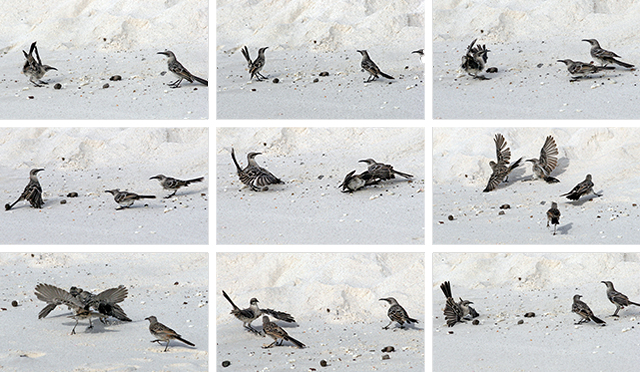
Mockingbirds form family groups consisting of the parent pair and several generations of offspring. It is not uncommon to see territorial disputes such as the one below on Española. The birds try to intimidate each other by striking formalized poses. Usually this is enough, but sometimes the encounter erupts into a fight.
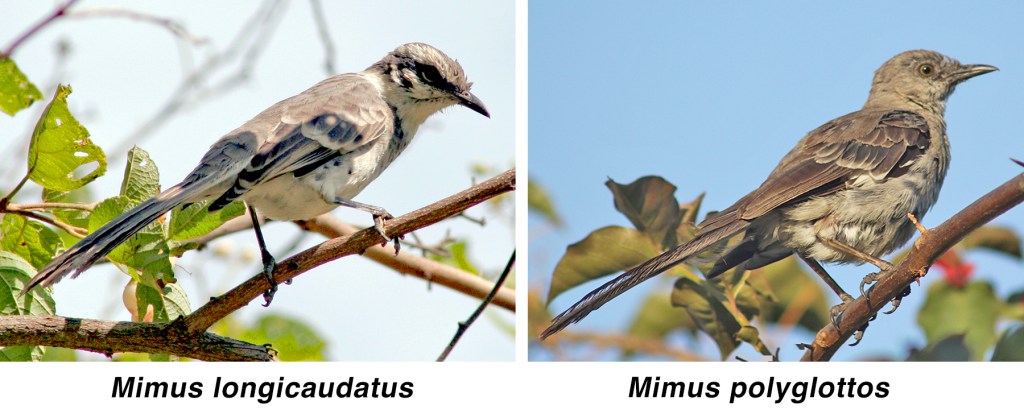
The Galápagos mockingbirds had long been thought to be most closely related to the Ecuadorian long-tailed mockingbird, Mimus longicaudatus, the closest mainland mockingbird to the Galápagos. However, recent genetic analysis indicates a close relationship with the most common mockingbird of North America, the northern mockingbird, Mimus polyglottos.

 Darwin's Galapagos