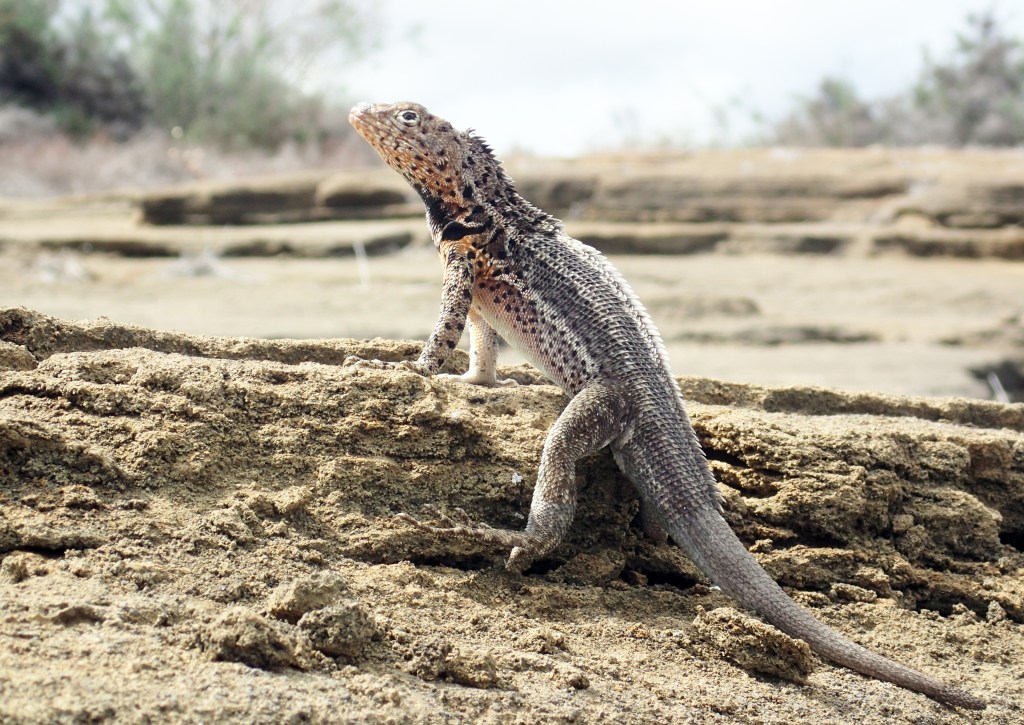
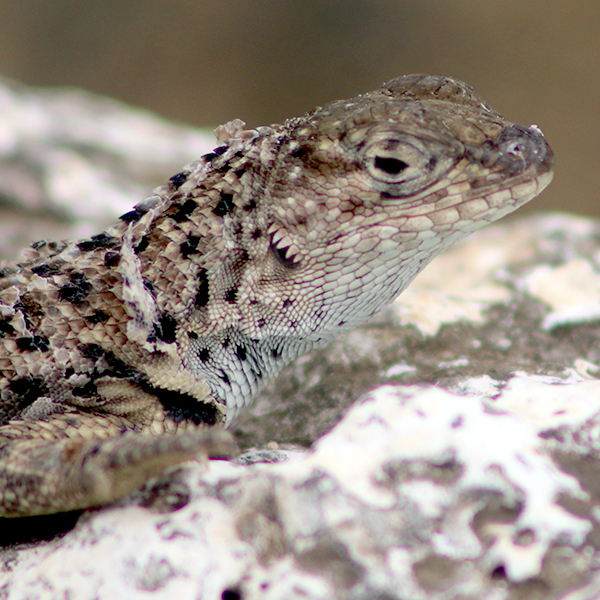
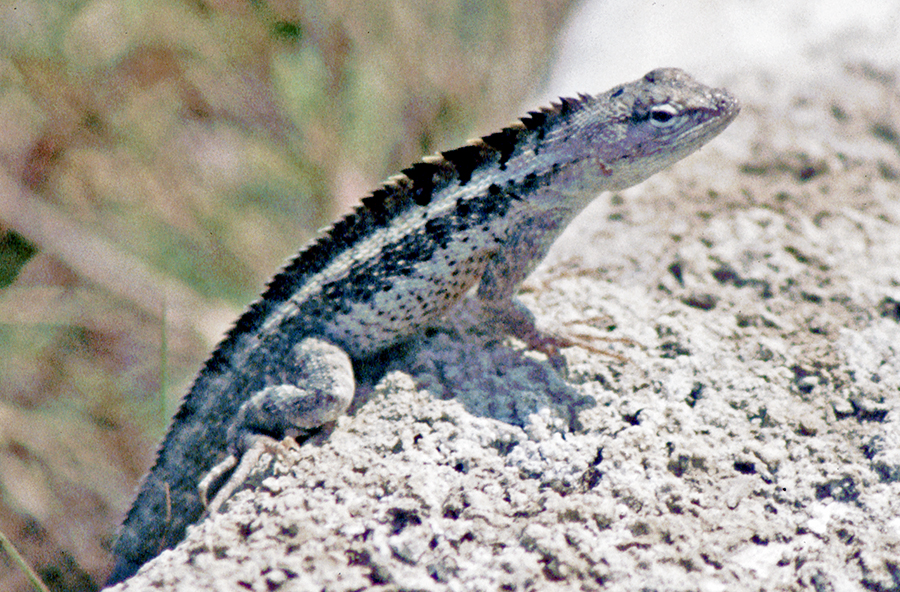
Lava lizards (Microlophus spp.), probably the most frequently encountered reptile in the Galápagos, are found along most of the shores of all the islands except Genovesa. Small and not particularly noteworthy, especially compared to the marine iguanas with whom they share the beaches, they are generally ignored by visitors and are barely mentioned in historical accounts. Even Darwin himself scarcely noticed them. In the first edition of his Journal of Researches (1839) he mentioned the presence of “possibly two species of the South American genus Leiocephalus [now Microlophus],” and in the second (1845), “a small lizard belonging to a South American genus.” And that was about it. Thomas Bell, who wrote the reptile volume of Darwin’s Zoology of the Voyage of the Beagle, noted that Darwin had brought back many specimens, quoted Darwin’s notes on color, and included an illustration. To Bell, they were “one of the numerous interesting novelties obtained by Mr. Darwin in the Galápagos.” Yet, to my mind, they are the most important animal in the Galápagos. If any animal deserves to be called “Darwin’s,” I would vote for Darwin’s lava lizards!
Bell assigned Darwin’s specimens to the genus Leiocephalus, a name that had been coined to describe a specimen from the West Indies. However, Leiocephalus was a junior synonym of the genus Tropidurus, a name that had been applied earlier to describe a lizard from Brazil. Eventually, Tropidurus came to be seen as a species-rich genus of lizards that ranged across South America, and the Galápagos. Thus, Tropidurus became the accepted genus name for lava lizards in the older literature. However, by the 1990’s enough differences between lizards on opposite sides of the Andes were identified to consider them separate genera. The name Tropidurus remained with the lizards east of the Andes and a new name, Microlophus, was applied to the lizards west of the Andes and the Galápagos.
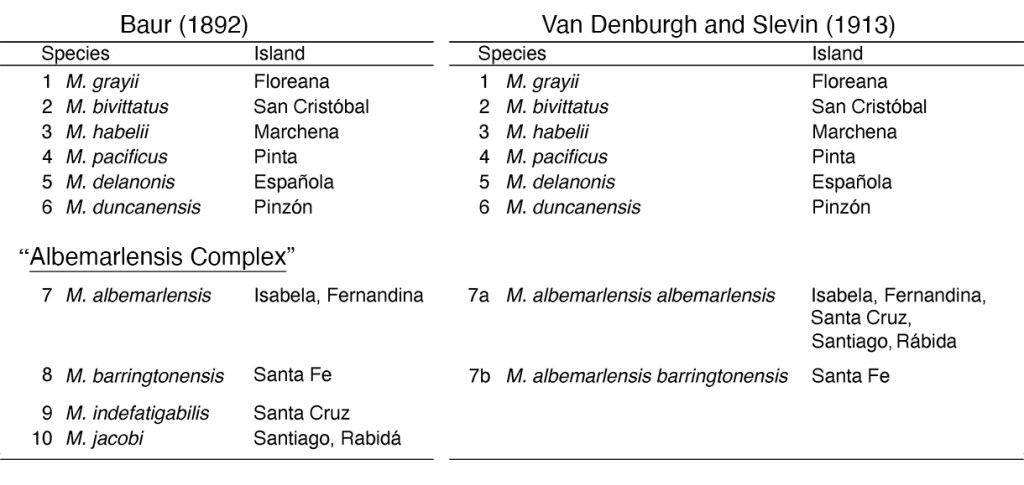
For most of the 19th century, lava lizards were considered to be a single archipelago-wide species, Microlophus grayii (here, I am switching to the modern name). However, as the century progressed, naturalists began to find differences between the different island populations and by the turn of the 20th, two competing lists of species had emerged. Georg Baur proposed 10 species in 1892 whereas John Van Denburgh and Joseph Slevin proposed 7 in 1913. While all agreed that San Cristóbal, Floreana, Española, Pinzón, Marchena, and Pinta each hosted an endemic species, they differed over the status of the lava lizards on the central and western islands, Santa Fe, Santiago and its satellites, Santa Cruz and its satellites, Isabela, and Fernandina. Van Denburgh and Slevin grouped all these lava lizards into the single species Microlophus albemarlensis, but Baur limited M. albemarlensis to Isabela and Fernandina, and divided the lava lizards on the remaining islands into three additional species, for a total of 10. Both proposals were based on anatomy, and for most of the 20th century the Van Denburgh and Slevin was considered authoritative. However, modern genetic analysis has confirmed Baur’s 10 species.
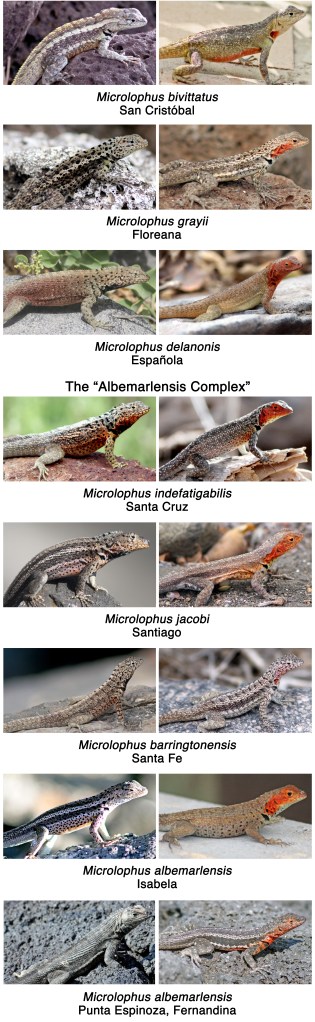
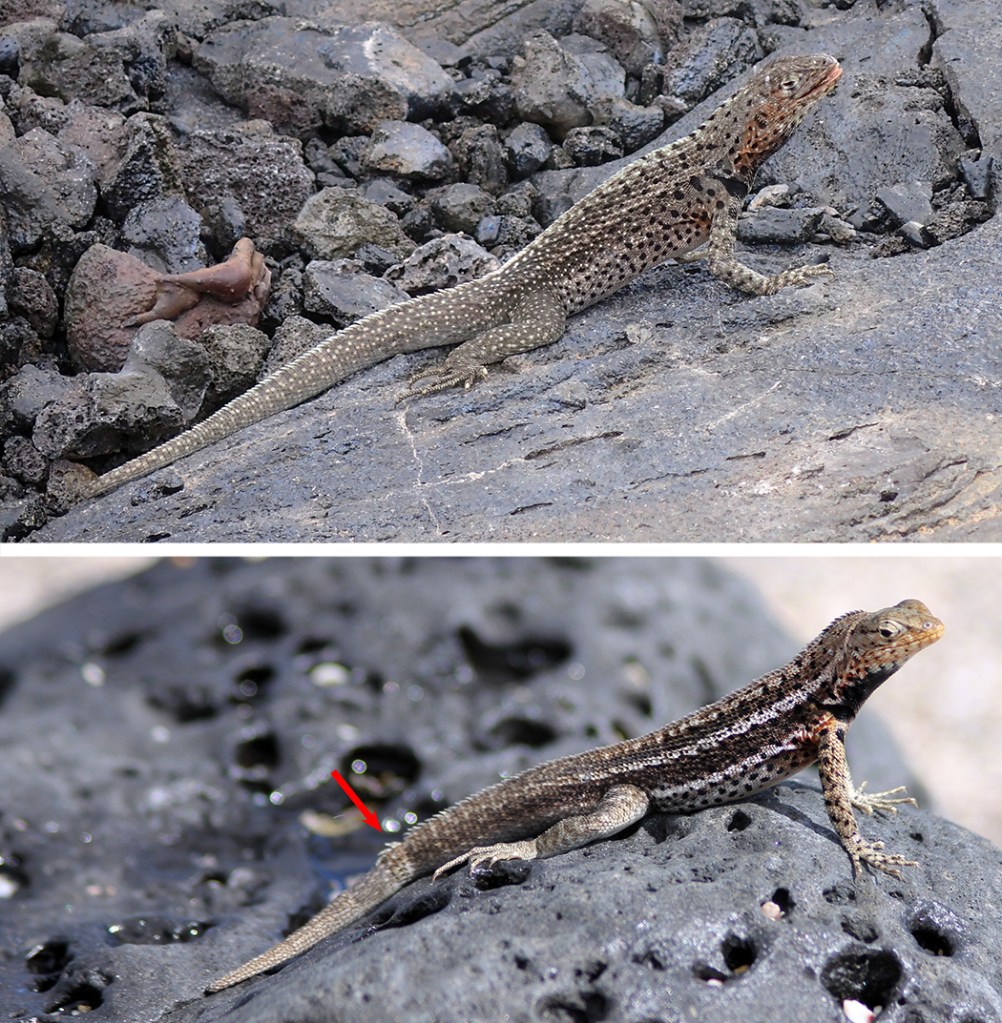
Of the 10 species, it is possible to see 7. Pinta, Marchena, and Pinzón are closed to visitors. In the photographs below, males are in the left column and females in the right. The lava lizards that Van Denburgh and Slevin called M. albemarlensis are grouped as the “Alberxmarlensis Complex,” but the individual names are Baur’s and the ones currently recognized. It should be obvious that despite individual variation and age, these lava lizards look very similar. Also, their species-specific display behavior (see below) is the same, and different from the first three lizards. Although their pigmentation is different, the lava lizards from Isabela and Fernandina are indeed M. albemarlensis, both behaviorally and genetically. However, the lizards from Fernandina live on the black lava field of Punta Espinoza and consequently they are protectively colored. The same is true of lava lizards from Islote Tintoreras, a tiny lava-covered islet near Puerto Villamil, Isabela,
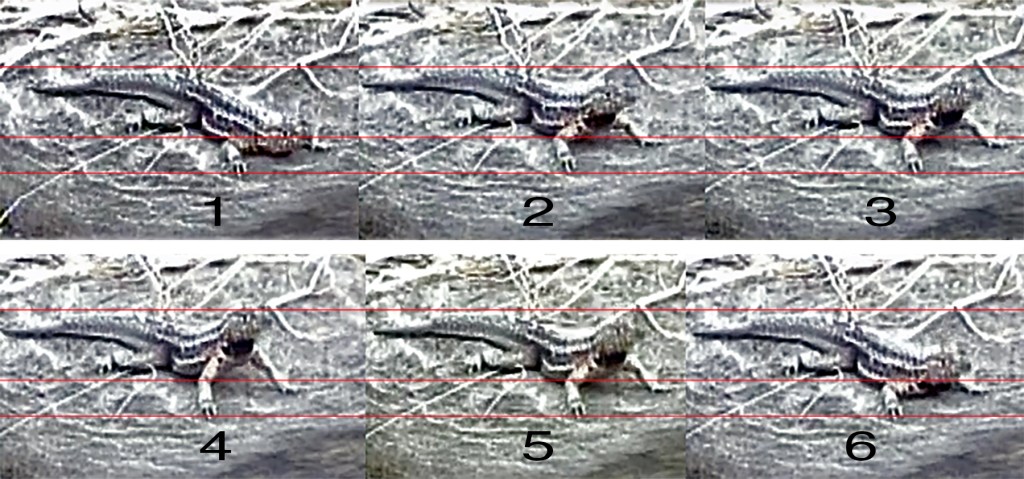
Both males and females maintain territories, the former bigger than the latter, that provide food, shelter, and areas for thermoregulation. Within the territory are a number of high points where the owner can pause while patrolling the territory and climb up to survey the area and also to be seen by potential intruders. It is common to observe lava lizards on these vantage points standing alert on raised forelimbs or performing an assertion display, a series of pushups in a species-specific sequence. When confronted with an intruder, the assertion display intensifies and the owner postures to look more intimidating by bloating its belly, intensifying its scale color, and extending its throat sac. If this doesn’t drive off the intruder, a fight can ensue.
Reproduction usually begins in January at the start of the warm/wet season, and the length depends upon the amount of rain in any given year. High rainfall leads to an increased amount of prey and hence an extended reproductive season. During times of high environmental productivity lava lizards can undergo multiple rounds of mating and nesting. About one and a half to two weeks after copulation females migrate to nesting colonies where the soil is easy to dig and begin excavating nests. Nests are usually dug on sandy beaches well above high tide level, but on beaches which also house sea lion rookeries, nests are situated under rocks or bushes. It takes from 4 hours to 4 days to dig a nest, and the female will lay a clutch of 2-3 eggs. The Española species, M. delanonis, is by far the largest of the lava lizard species, and those females lay clutches of 4-5 eggs. Hatchlings emerge after an incubation period of 2.5 – 3 months. They are very small, dark with white markings. They go into hiding immediately, never to be seen again until they become small juveniles. Indeed, in more than 30 years, the only hatchling I have ever seen was one that was being cannibalized by an adult female.
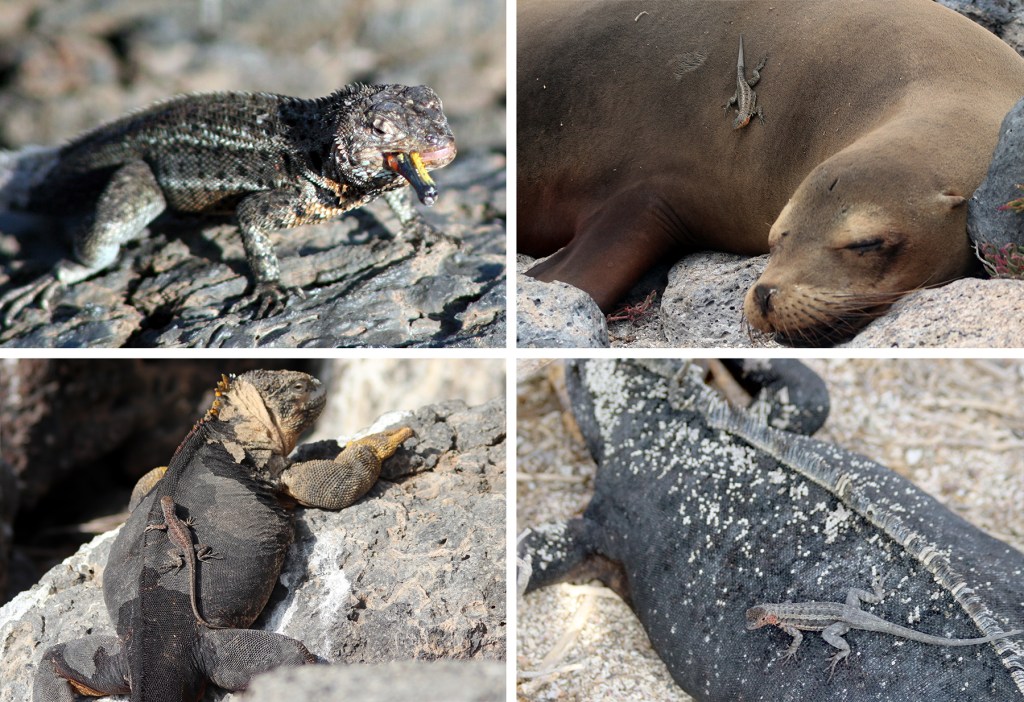
The type of food that an iguanid consumes varies with size across a broad range of iguanid species. Small species tend to be insectivores while large ones are herbivores. Land and marine iguanas are on the large end of the spectrum and primarily consume plant material, although they will take animal protein if they can get it. The transition from insectivory to herbivory is abrupt and occurs around 100 mm snout-vent length. This is exactly the size range of lava lizards. Consequently, their diet is about half plant and half animal. It is not uncommon to see lava lizards climbing on sea lions and land and marine iguanas where they feed on the flies that continually annoy them.
Given their small size, lava lizards are tempting targets for mockingbirds, Galápagos hawks, owls, and the various herons and egrets. Like many lizards, lava lizards are capable of caudal autotomy, the ability to detach a part of their tail to detract predators while they make their escape. In lava lizards the break occurs at a fracture plane in a caudal vertebra. Once the break occurs a sphincter muscle closes off the caudal artery and a flap skin covers the wound. Eventually the missing piece is regenerated with cartilage. The scale pattern is different from the original segment and is easy to detect. Mockingbirds are particularly adept at pulling and pecking at lava lizard tails to make the tail detach for an easy meal. Lava lizards who have undergone caudal autotomy are extremely common, nearly 50% or more on many islands.
So, why do I consider lava lizards worthy of Darwin’s name?
One of Darwin’s key observations in the Galápagos was that each island possessed its own endemic species of an archipelago-wide genus. He tried to make the case with the tortoises, but he relied on vice governor Lawson’s claim that he could tell frame which island a tortoise came merely by looking at it. While Darwin described tortoise behavior in some detail, he did not describe the morphology on which Lawson’s statement was based. Captain FitzRoy had numerous tortoises brought aboard the Beagle for food, but the remains were discarded. The four tortoises that Darwin did bring back were too young to show their unique island characteristics. While he recognized the importance of the finches, their distributions and relationships were too complicated for him to understand. Indeed, their relationships are still being unraveled today. Darwin was mistaken about the relationship between the marine and land iguanas, and he had only hearsay evidence about multiple marine iguana species. His best evidence was the distribution of mockingbirds. He saw that San Cristóbal and Floreana each had their own distinct species, but the third species that he recognized was distributed across the remainder of the archipelago. His case could have been strengthened had he been put ashore on Española where he would have seen a third island-specific species (see Mockingbirds for more about lava lizard distribution).
A second key observation was his recognition that each island was
“a little world within itself, or rather a satellite attached to America, whence it has derived a few stray colonists, and has received the general character of its indigenous productions.”
Darwin was saying that ancestral forms arrived in the Galápagos from the South American mainland and then diversified into the modern species. Although it took nearly a century to recognize 10 morphologically different species of lava lizard, each confined to its own island, it took modern genetic analysis to confirm this. Not only does genetic analysis confirm the 10 species, but it also reveals a sold South American connection. Moreover, according to genetic analysis, the current distribution of lava lizards is the result of two independent colonizations of the Galápagos, one 4.54 – 1.68 million years ago (Ma) and the other 2.8 – 2.09 Ma.
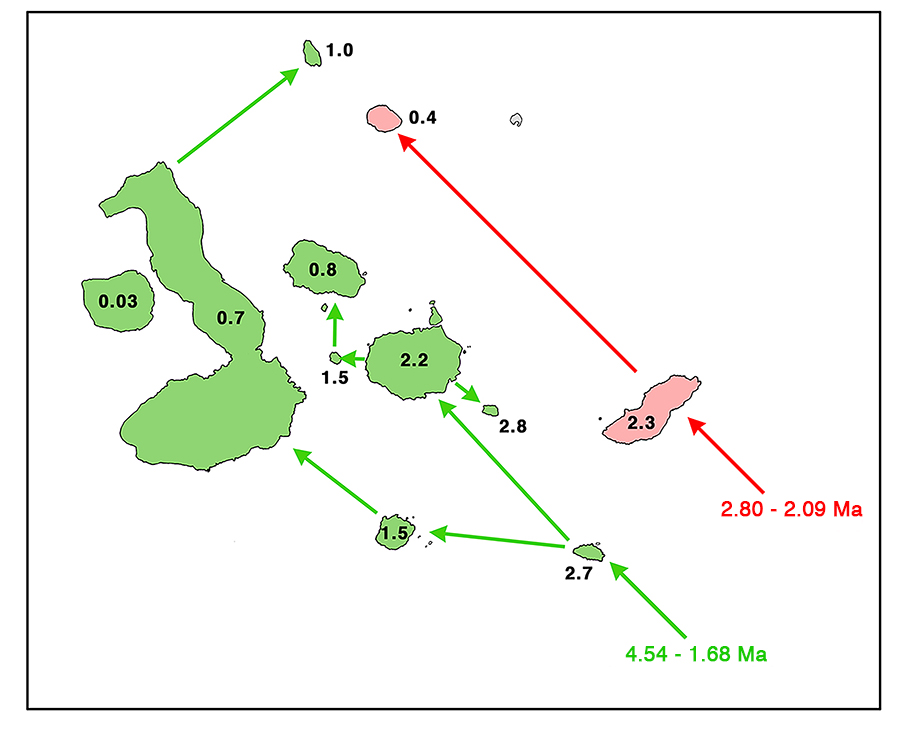
There is a string of Microlophus species up and down the coast of Ecuador, Peru, and Chile. Genetic analysis strongly links the Ecuadorian species, Microlophus occidentalis, to the more recent colonization from Ecuador to San Cristóbal and then Marchena.
The second colonization is linked most likely to one of the Peruvian species, but the connection is less clear. A look at the map indicates that colonization involved a combination waif dispersal and vicariance (separation of a single wide-spread species into isolated populations by some geological event. Waif dispersal, transport over some 600 miles of open ocean probably by floating mats of vegetation, is surely responsible for the San Cristóbal – Marchena colonization and for the colonization of Española. The Española species, Microlophus delanonis, is the sister to all the remaining lava lizards. At times of low sea level during the ice ages, the central and western islands would have been combined into a single land mass that would allow lava lizards to spread to each of what would become separate islands after the ice age. It is not clear why there are no lava lizards on Genovesa. Perhaps the island was not emergent when Marchena was colonized, or maybe it was uninhabitable at that time. Or, perhaps, the prevailing currents bypassed the island.
Thus, lava lizards are solid confirmation of everything that Darwin said about evolution in the Galápagos. ‘Hence, Darwin’s lava lizards”
Find out more about lava lizards in Volume 2 of A Paradise for Reptiles.


 Darwin's Galapagos