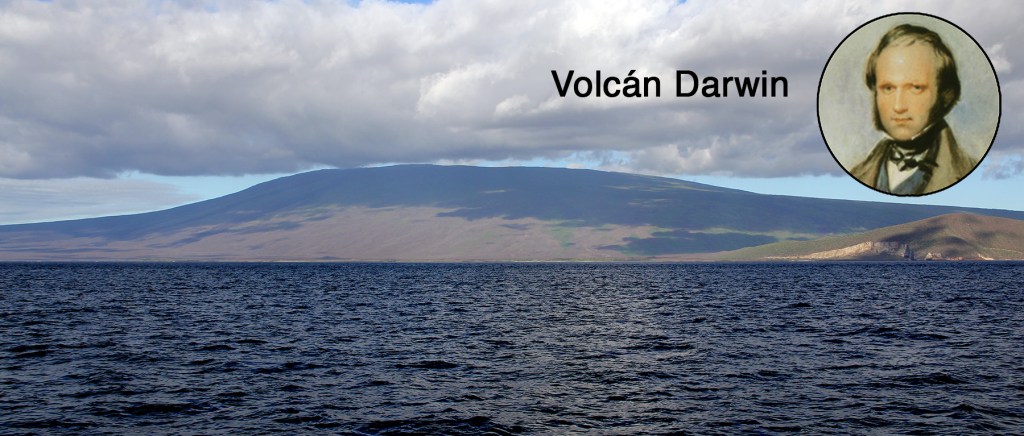
Darwin is so famous for his work on evolution that it is sometimes forgotten that his initial interest during the voyage of the Beagle was geology. He learned the basics of practical field geology during a two and a half week field trip to North Wales with Cambridge Don and founding geologist Adam Sedgwick, and it was upon his return home that he found the invitation to join the Beagle waiting for him. The Beagle’s first significant landfall was in the Cape Verde Islands where Darwin spent his time studying the geology of St. Jago, the archipelago’s largest island. This experience, Darwin wrote in his autobiography, first led him to think that he, himself, might write a book on the geology of the countries visited during the voyage. Indeed, in addition to his Journal of Researches, and the five volumes of The Zoology of the Beagle that he edited, he wrote three books on the geology of the voyage: The Structure and Distribution of Coral Reefs, Geological Observations on the Volcanic Islands Visited During the Voyage of H.M.S. Beagle, and Geological Observations on South America.
Just before leaving Peru for the Galápagos, Darwin sent a batch of letters home:
To his cousin William Darwin Fox he wrote:
I look forward to the Galápagos with more interest than any other part of the voyage. – They abound with active Volcanoes…
To his mentor John Henslow he wrote:
In a few days [sic] time the Beagle will sail for the Galápagos Isds. – I look forward with joy & interest to this both, as being somewhat nearer to England, & for the sake of having a good look at an active Volcano. – Although we have seen Lava in abundance, I have never yet beheld the Crater.
In addition to his professed interest in Geology, Darwin made extensive zoological collections during his years exploring South America and soon came to see how these two branches of natural history were intimately entwined. And so:
To his sister Caroline he wrote:
I am very anxious for the Galápagos Islands – I think both the Geology & Zoology cannot fail to be very interesting.
Darwin was not wrong in expecting to see an actual eruption; the Galápagos are among the most volcanic regions on earth. Indeed, in my 32 trips, I have been fortunate enough to be in the Galápagos during three eruptions, Cerro Azul in 2008, Volcán Wolf in 2015, and Sierra Negra in 2018. Unfortunately, when Volcán Wolf erupted, we were on a land tour in southern Isabela and were unable to get to that site in the far north of the island. I just missed an eruption of Fernandina by about two weeks in the late 1990’s. The Cerro Azul eruption occurred in the highlands, and it was impossible to get close, but the Sierra Negra event was on the coast, and we had front row seats. Benjamin Morrell, captain of the Tartar, described a spectacular eruption of Fernandina in 1825.
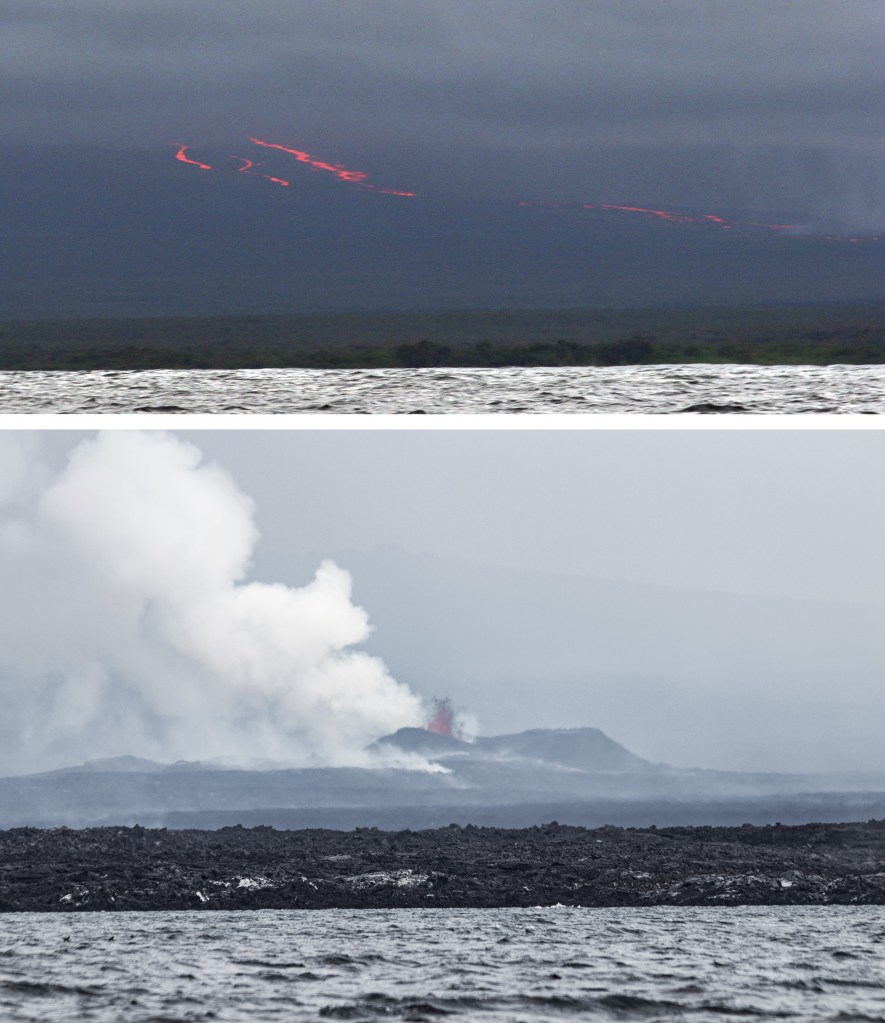
Bottom: Sierra Negra, 2018
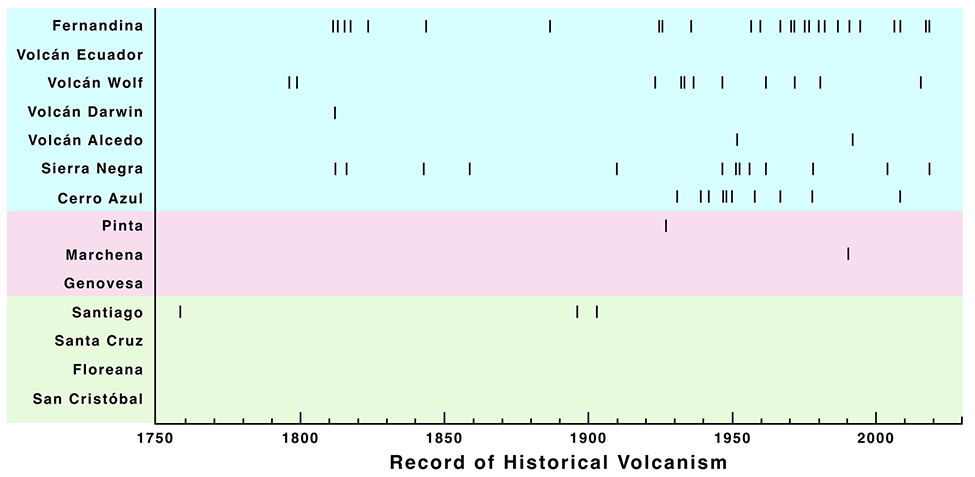
The graphic below shows the Record of Historical Volcanism in the Galápagos Islands. The scarcity of eruptions prior to about 1930 is only apparent. Before this date there were few people in the Galápagos to witness and record eruptions. The last one recorded here is the 2018 Sierra Negra eruption, but there have been several others on Fernandina since.
On 7 September 1835 the Beagle turned its prow toward the Galápagos, arriving on the 15th. Unfortunately, the volcanos were silent during Darwin’s five weeks there, but the marriage of geology and zoology in the Galápagos formed one of the cornerstones on which he based his theory of evolution by natural selection
As land masses go, the Galápagos Islands are not very old. The islands lie on the westernmost end of the Carnegie Ridge where submarine volcanic activity slowly built up the string of islands over a period of some four million years. Darwin was the first to reflect on the volcanic origin of the islands, and he understood the profound implications of this origin for the history of life. For if the islands were volcanic, they must have formed after the creation of the world, and the organisms living there must have migrated there from someplace else. But since those organisms are found nowhere else, Darwin finally had to conclude that they had evolved there from South American ancestors.
After Darwin’s visit, and well into this century, the origin of the islands had been disputed. Many thought that they had once been part of the mainland or connected to it by a land bridge. Eventually, however, Darwin was vindicated; these islands had a volcanic origin separate from the mainland and were never connected to it. But Darwin had barely scratched the surface. The true origin of the Galápagos Islands was more complicated than he, or anyone in his generation could possibly imagine.
Find out more about Galápagos Geology in Volume 1 of
A Paradise for Reptiles.

 Darwin's Galapagos