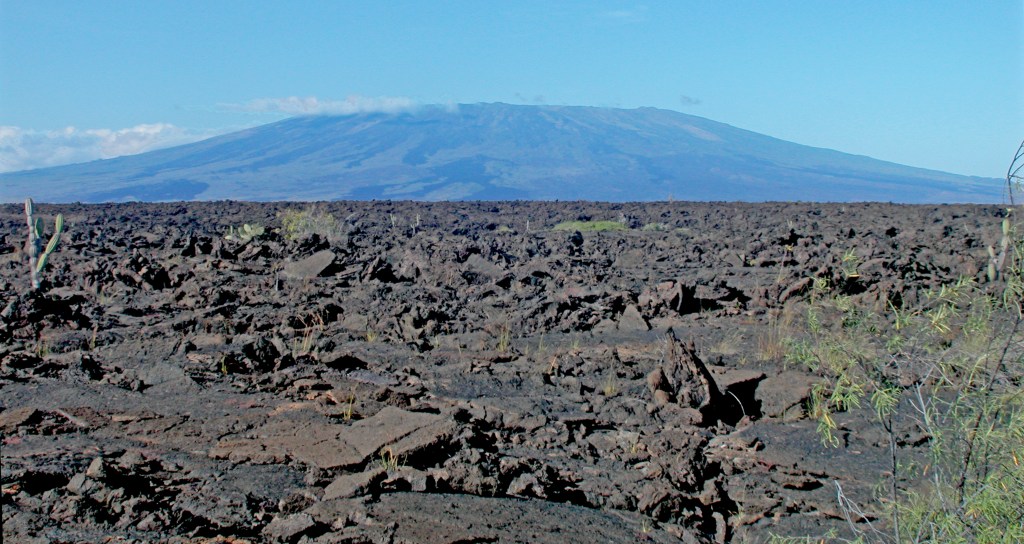
Albemarle Island [Isabela] consists of five, great, flat-topped craters, which, together with the one on the adjoining island of Narborough [Fernandina], singly resemble each other, in form and height. The southern one is 4,700 feet high, two others are 3,720 feet, a third 50 feet higher, and remaining ones apparently of nearly the same height. Three of these are situated on one line, and their craters appear elongated in the same direction. The northern crater, which is not the largest, was found by triangulation to measure, externally, no less than three miles and one-eighth of a mile in diameter. Over the lips of these great, broad caldrons, and from little orifices near their summits, deluges of black lava, have flowed down their naked sides.
— Charles Darwin, Geological Observations on Volcanic Islands
Oceanic volcanism occurs in two general locales; along mid-ocean ridges where two plates are in the process of separating, and at hotspots in the middle of plates. Islands in both locales are built of basalt, but the compositions of the basalts are somewhat different. Ridges at spreading centers are formed by Mid Ocean Ridge Basalt (MORB) while mid-plate island chains like Hawaii are formed by Ocean Island Basalt (OIB). The primary difference between OIB and MORB is in the trace elements that are included in each, particularly those trace elements known as “incompatible elements.” Incompatible elements such as rubidium or thorium have ions so large they cannot fit into the molecular framework of most minerals and are among the first to be lost from a magma when melting occurs. OIB’s tend to be enriched in incompatible elements that the hotspot plume brings up from deep within the mantle. The source of MORB, is the upper mantle, which is depleted of incompatible elements, as is the oceanic crust that it produces.
Classic hotspot islands like Hawaii tend to be chemically monotonous, producing primarily OIB’s. The Galápagos, however, are unusual in that they are formed by a hotspot that is close to and interacts with a spreading center, and are built from a variety of lavas ranging in composition from OIB to MORB. This is most likely due to the fragile nature of the Panama Basin seafloor that has been weakened by the presence of failed spreading centers, permitting magma to be drawn from the upper mantle, and extending the life of volcanism even after the island has been disconnected from the hotspot. If the Galápagos were a simple hotspot chain, it would be surprising to find significant amounts of MORB. OIB and MORB are only general categories of basaltic lavas. Depending upon the degree of partial melting or fractional crystallization, the same magma can produce a variety of lavas. But that is a more complicated story.
Basalt has a very different chemical composition from the andesites and granites that erupt from continental volcanoes. The Andes, like the Galápagos a product of the Nazca plate, are strongly influenced by the descending slab. As the plate descends into the mantle and melts, it carries with it ocean floor sediments, organics, and water. This mix slowly works its way to the surface to produce volcanoes like Cotopaxi. Cotopaxi National Park is close to Quito, and my Galápagos trips always include a side trip there. The park affords an excellent opportunity to see the difference between continental and oceanic volcanism. The key difference is that continental lavas are rich in silica while oceanic magmas are poor. Thus, continental lavas are viscous, and eruptions are explosive while oceanic lavas are fluid, and eruptions are effusive. The difference in silica content leads to very different types of volcanic edifices. Continental volcanoes like Cotopaxi form tall, steep-sided cones while oceanic volcanoes like Mauna Loa form broad, shallow-sloped mounds called shield volcanoes.
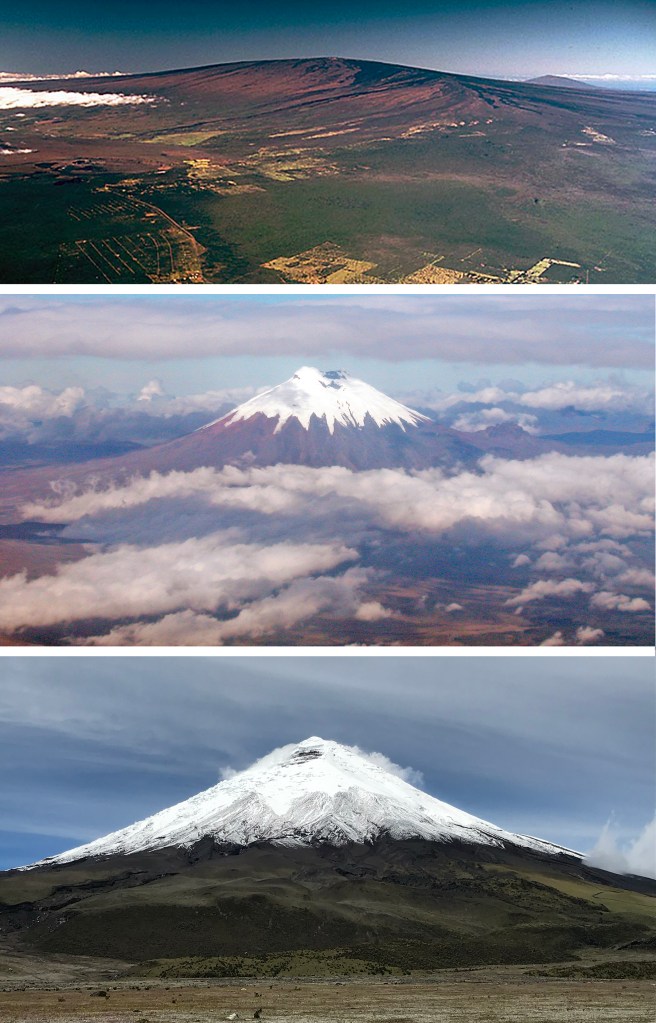
Center and Bottom: Volcán Cotopaxi from an airplane and at the national park in its full glory on a rare cloudless day
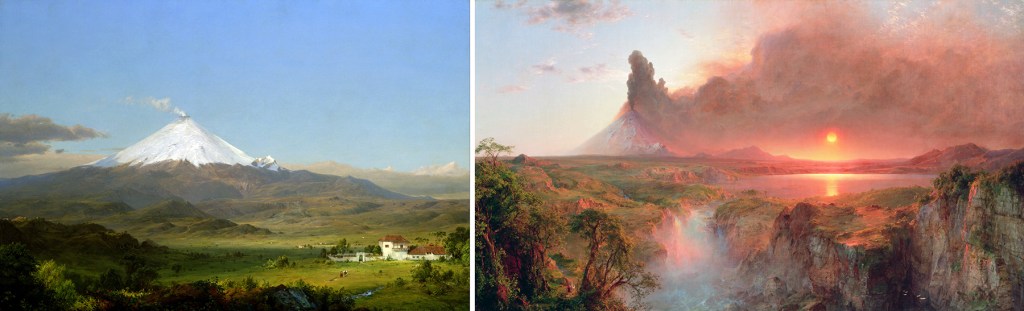
Cotopaxi is active and on a few of my trips the park was closed to visitors. In this context I can’t help but include two paintings of Cotopaxi by my favorite Hudson River School artist, Frederic Edward Church. Church travelled through Ecuador in the 1850’s and produced many paintings of the Andes and the rainforest, including one of Cotopaxi erupting.
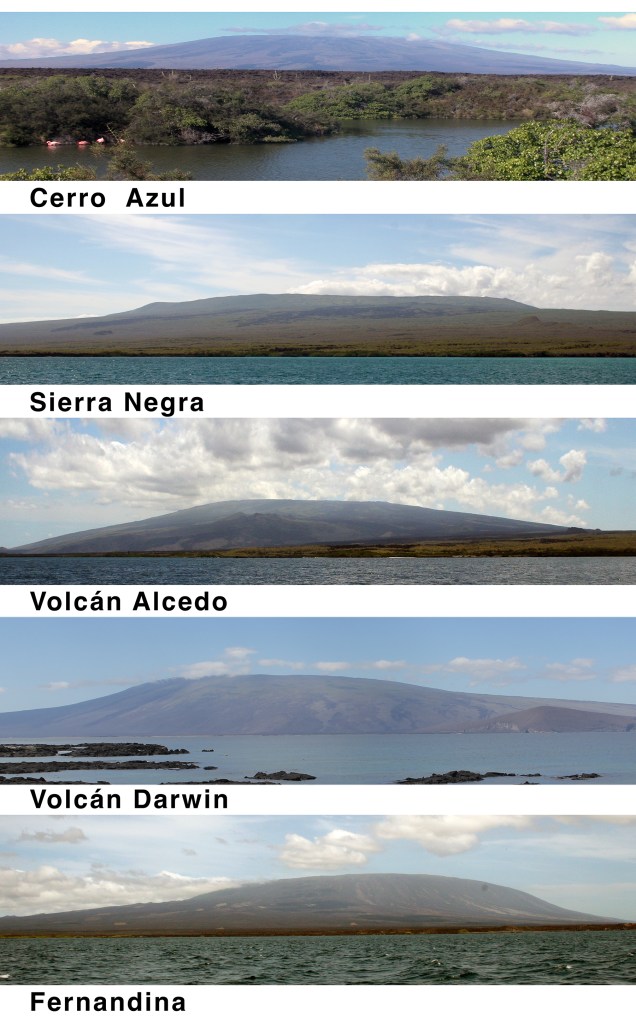
Since so much of the research on island volcanism has been performed in Hawaii, Hawaii is the standard by which other islands are judged. By this standard, the profiles of the Galápagos shields are unusual. The shape of Mauna Loa, for example, rising 4170 m from shore to caldera with a gentle, unbroken slope of 3° – 6°, and has been often described as an overturned dinner plate. In the Galápagos, Cerro Azul, for example, is better described as an overturned soup plate. Like Mauna Loa, Cerro Azul begins its rise in a similarly gentle slope of less than 4° but then breaks to a very steep upper slope greater than 25°. The origin of this unusual morphology has proven to be very controversial. The best explanation is related to the difference in the way that extra-caldera vents are distributed across the volcanoes in the two archipelagos.
Calderas are large-scale circular to elliptical depressions at the summits of many volcanoes. In the Galápagos, it is primarily the western islands that have prominent calderas. On silicic continental volcanoes calderas are formed by massive pyroclastic explosions, while on basaltic oceanic islands like Hawaii and the Galápagos they are associated with shallow magma chambers underneath, and are formed when withdrawal of magma from the underlying chamber causes the roof to collapse into the void below. Rather than forming in a single catastrophic event like continental calderas, basaltic calderas are built in a series of small, incremental subsidence events. In the Galápagos, these events usually are localized to small regions within the caldera, and they leave behind stranded benches whose walls expose the lava flows beneath the original caldera floor. The largest caldera collapse ever recorded on a basaltic volcano occurred on Fernandina in June 1968 when the southeast portion of the caldera floor subsided by about 300 m in a single intact block. During the episode a loud boom was heard on San Cristóbal, 220 km away, and infrasonic long-wave shocks were detected as far away as Bolivia and Alaska.
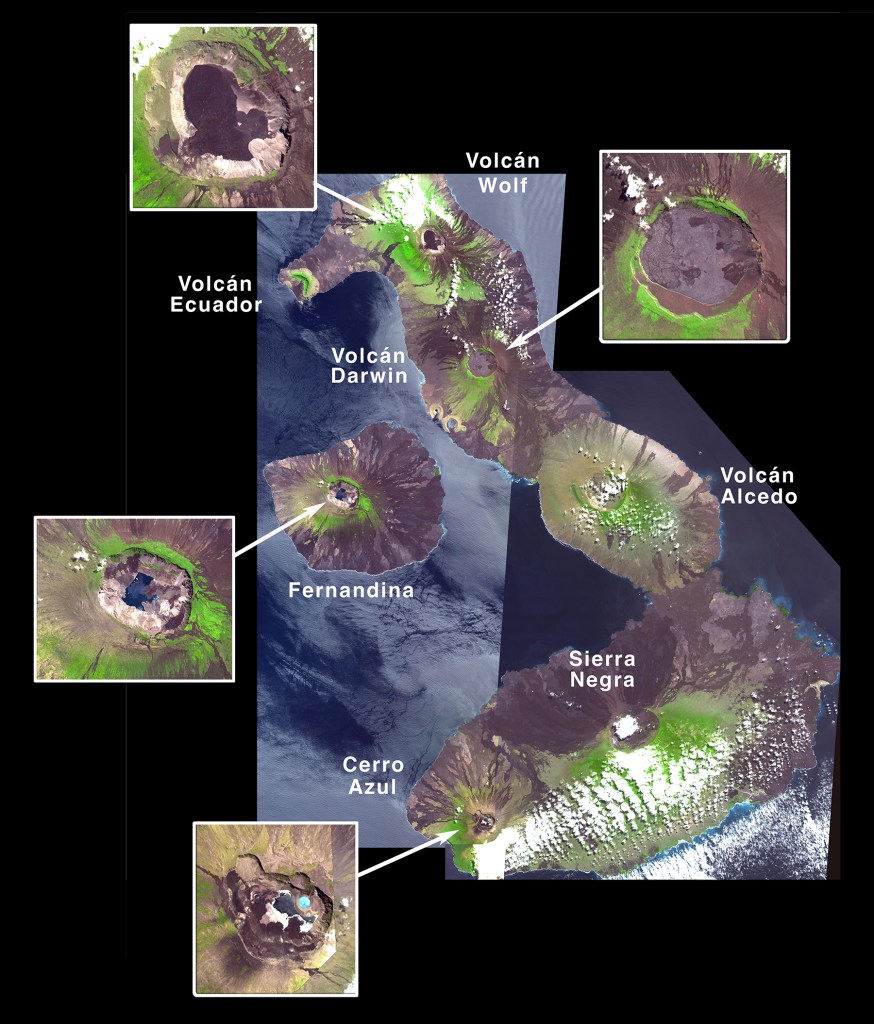
In addition to their summit calderas, basaltic shields generally have a number of extra-caldera vents, whose pattern in the Galápagos differ widely from that seen in Hawaii. In the majority of the Hawaiian volcanoes, these vents are primarily organized into narrow linear bands (typically two in number), 1-3 km wide, radiating out from the caldera in a direction parallel to the boundary of an adjacent volcano. In the Galápagos, the major extra caldera vents are organized primarily around circumferential and radial fissures, Circumferential fissures tend to be found within about 1.5 km of the caldera and can range from 0.3 to 1 m in thickness. They tend to be arranged in parallel rows of varying lengths, but a single fissure never makes a full circle around the caldera. Radial fissures are found mostly on the lower shallow slopes with an average distance of 7.9 km from the caldera to the farthest upslope end While lava may flow from many points along the length of a fissure early in an eruption, the eruption eventually localizes at one or a few sites, producing scoria or spatter cones. Thus, one can identify the fissures, not by open gashes in the ground, but rather by linear arrangements of cones that can be readily identified from the air or by remote sensing. Although both types of fissure systems are present on all of the Galápagos volcanoes, they are not equally well represented on every volcano. Circumferential fissures are better developed on Volcán Darwin while radial fissures are better developed on Cerro Azul, and less so on Sierra Negra, Volcán Darwin, and Volcán Alcedo. On Fernandina and Volcán Wolf, however, both systems are well developed.
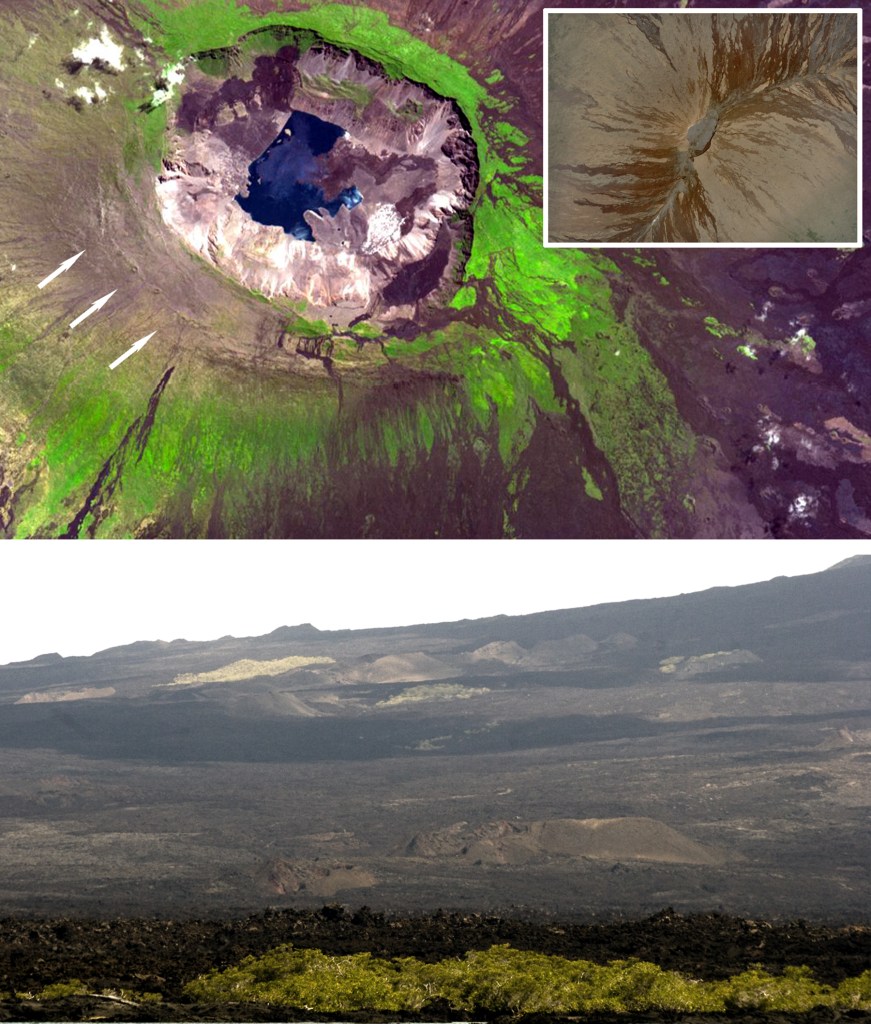
Bottom: Linear arrays of cones on the lower slopes of Fernandina indicating the presence of radial fissures.
Simkin* proposed a model based on the concentration of circumferential vents around the calderas to explain the unusual shape of the Galápagos shields. According to Simkin’s model, lava from these vents would tend to build up a ring-shaped ridge on top of an otherwise gently sloping Hawaiian type shield. If these lava flows were particularly viscous and/or small in either volume or effusion rate, they would tend to solidify on the ridges before flowing very far down on to the flanks, thus building the rim at the expense of the flanks. Once such a ridge formed, the gravitational stress that it imposed on the edifice would lead to the accumulation of additional dikes, thereby continuing to build the ridge. Any caldera subsidence would tend to exaggerate the height of the circular ridge, thus. heightening the upper slopes. More fluid lavas from the flank vents would extend the shallow flanks.
*Simkin, T. 1972. Origin of some flat-topped volcanoes and guyots. Geological Society of America Memoir 132: 183-193
Find out more about Galápagos Geology in Volume 1 of
A Paradise for Reptiles.

 Darwin's Galapagos