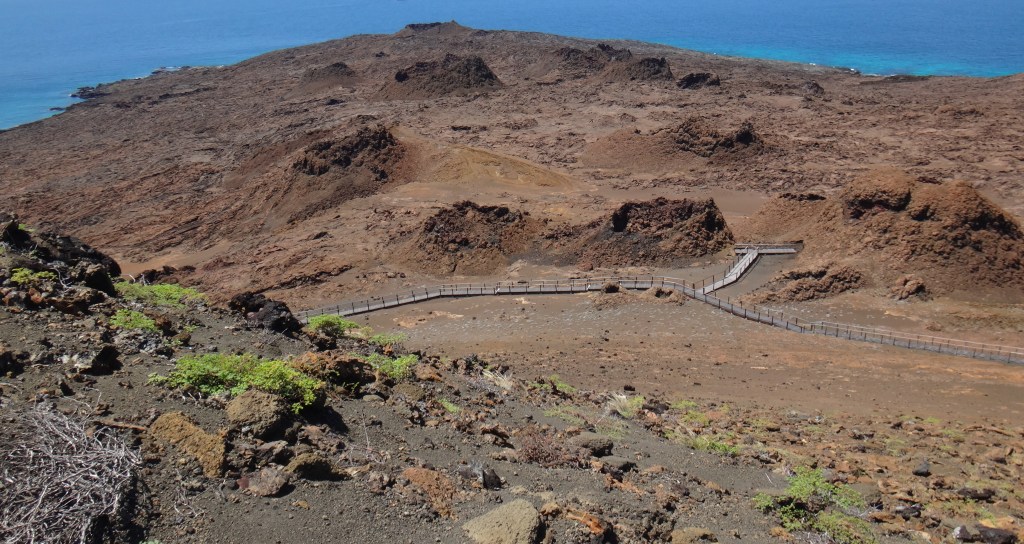
It at first appears very singular, that all the craters formed of tuff have their southern sides, either quite broken down and wholly removed, or much lower than the other sides. I saw and received accounts of twenty-eight; of these, twelve form separate islets, and now exist as mere crescents quite open to the south, with occasionally a few points of rock marking their former circumference; of the remaining, sixteen, some form promontories, and others stand at a little distance from the shore; but all, have their southern sides, either the lowest, or quite broken down.
–Charles Darwin, Geological Observations on Volcanic Islands
In addition to outflow from the central crater, lava can also flow from vents and fissures around the sides and edges of the main volcano. As a fissure eruption progresses, the outflow tends to become localized to one or a few spots as fire fountains, building small cones, often referred to as parasitic or satellite cones. When magma is fragmented during an explosive fire fountain eruption it may solidify and fall to the ground as pyroclastic rocks (from Greek, broken by fire) collectively called tephra (Greek for ash). Tephra, in turn, is classified by size:
- ash (<2mm),
- lapilli (2-64 mm)
- bombs (>64 mm).
Very small droplets of lava in a fire fountain can assume teardrop or dumbbell shapes in flight and fall back to the ground as beads of shiny black glass called Pele’s tears after the Hawaiian goddess of volcanoes and fire. Sometimes the droplets are drawn out into long thin threads called Pele’s hair. The type of tephra that is produced, and the landform that is created, is a function of the mass eruption rate and the environment, dry or wet, in which a vent opens.
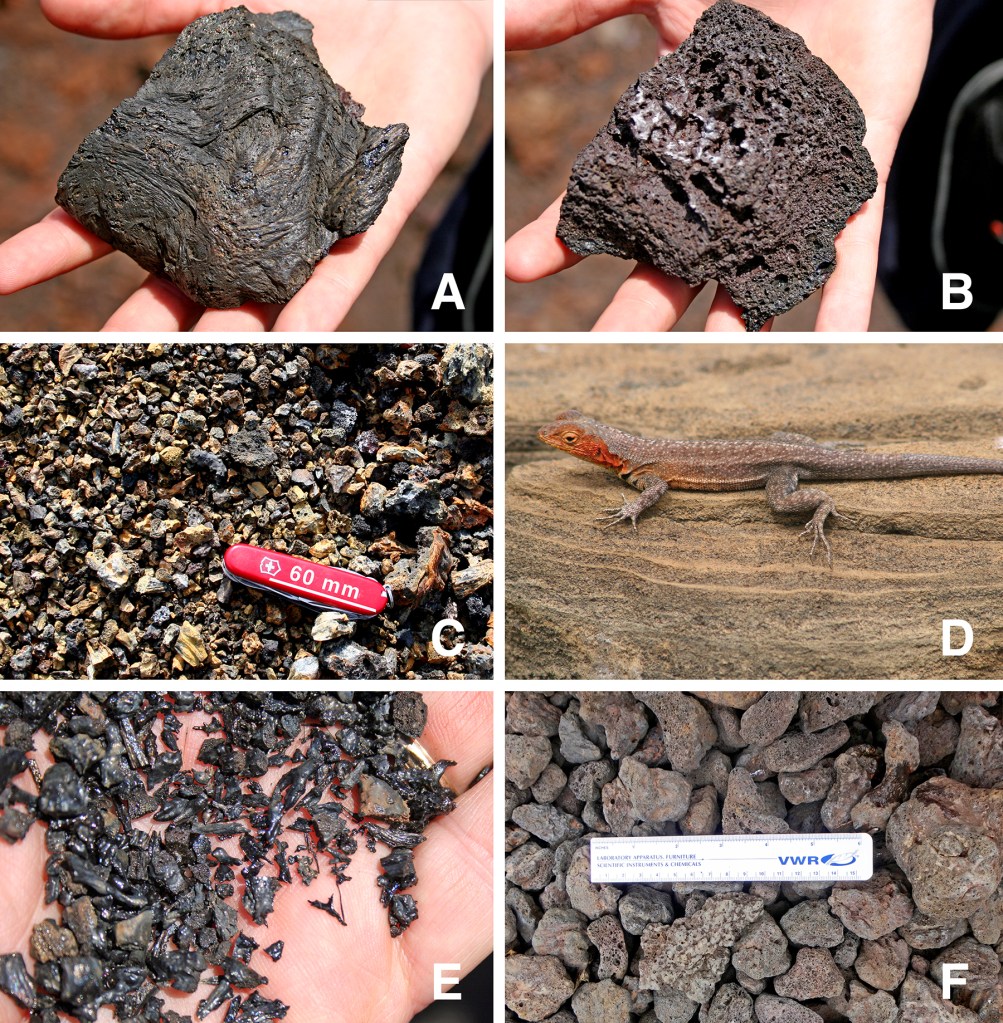
C: Lapilli. D: Ash with lava lizard (Microlophus Jacobi) for scale. E: Glass beads and filaments.
F: Scoria. All photos are from Volcán Chico, Isabela, except for E, from Puerto Egas, Santiago.
Explosive eruptions in a dry environment result in lava fountains that produce clasts of various sizes, the smallest of which can be carried away by the wind to be deposited at great distances. The bulk, however, falls back to the ground, and the form in which it returns to earth is a function of the mass eruption rate. When the rate is low, the gobbets of lava can cool rapidly by radiation and fall back as a pile of loose, unconsolidated, brittle scoria (also referred to as cinders). Gases trapped in the scoria render the clasts highly vesicular. However, if the mass eruption rate is higher, the fountain jets are so crowded with lava gobbets that none of them can radiate away very much heat, and so fall back as viscous, cow-pat-like spatter (also called agglutinate) that anneals to the growing pile of material already fallen. In both cases, the fallen material, scoria or spatter, builds up a cone around the vent. Cones built by spatter can be relatively steep, but being loose and unconsolidated, scoria cones can maintain an angle of repose not much greater than 30º.
Scoria and spatter are ends of a spectrum, however, and while the resulting mound may be either a scoria cone (also called a cinder cone) or a spatter cone, fountains can also produce a combination of scoria and spatter. If the mass eruption rate is very high, the lava cannot cool at all and falls to the ground still molten. This lava, known as clastogenic lava, can pool on the bottom of the growing cone or it can breach the cone and emerge as a lava flow. Bartolomé is probably the best place in the Galápagos to view spatter cones. There are so many spatter cones on this tiny, barren islet that the landscape almost appears lunar. Scoria cones are less easy to see, but they can be viewed from tour boats on the flanks of the western islands like Fernandina. The trail from the summit of Sierra Negra down to Volcán Chico passes by a small but classic scoria cone.
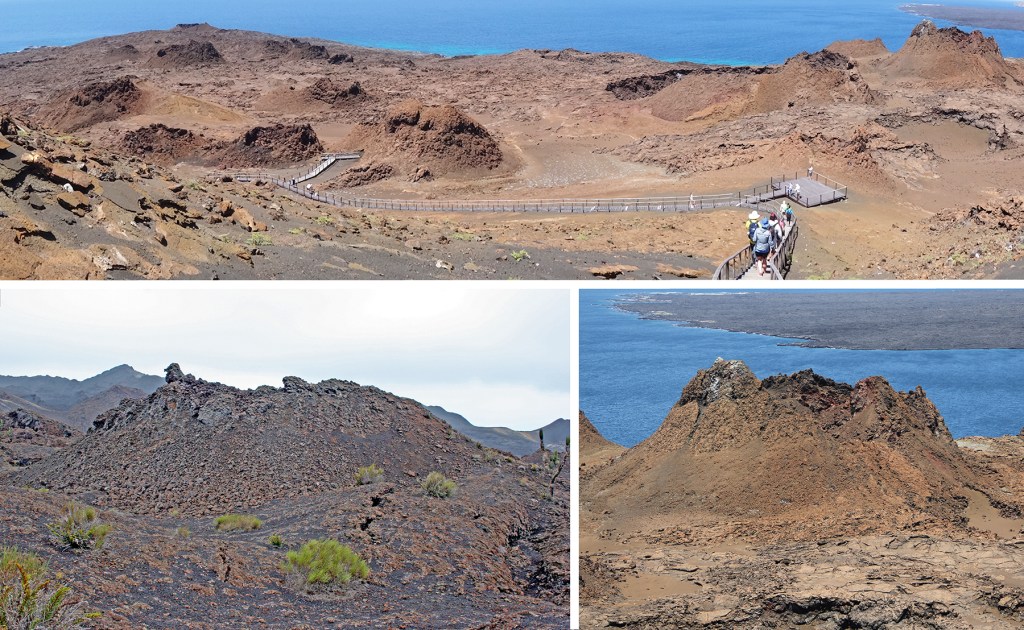
Bottom Left: Scoria Cone. Volcán Chico, Isabela Bottom Right: Spatter Cone. Bartolomé
Darwin was particularly intrigued by cones along the coasts or just offshore, built of consolidated, fine-grained ash called tuff.
The position near the coast of all craters composed of this kind of tuff or peperino, and their breached condition, renders it probable that they were all formed when standing immersed in the sea; considering this circumstance, together with the remarkable absence of large beds of ashes in the whole archipelago, I think it highly probable that much the greater part of the tuff has originated from the trituration of fragments of the gray, basaltic lavas in the mouths of craters standing in the sea.
–Charles Darwin, Geological Observations on Volcanic Islands
As Darwin surmised, tuff is the result of violently explosive eruptions caused when seawater comes in contact with fresh magma. The water instantaneously flashes to steam and pulverizes the magma into ash. Such eruptions are said to be hydrovolcanic or phreatomagmatic. These eruptions tend to pulse, and so the cones are built in easily discernible layers that sometimes include fragments torn from the vent walls. Subsequent hydration of the tuff, Darwin said, transforms it into a yellowish mineral called palagonite.
Darwin also noted that the southern sides of these tuff cones were often lower, and sometimes breached.
The explanation is simple: at this Archipelago, the waves from the trade-wind, and the swell propagated from the distant parts of the open ocean, coincide in direction,…and with their united forces attack the southern sides of all the islands; and consequently the southern slope, even when entirely formed of hard basaltic rock, is invariably steeper than the northern side. As the tuff-craters are composed of a soft material, and as probably all, or nearly all, have at some period stood immersed in the sea, we need not wonder that they should invariably exhibit on their exposed sides the effects o f this great denuding power. Judging from the worn condition of many of these craters, it is probable that some have been entirely washed away. As there is no reason to suppose, that the craters formed of scoriæ and lava were erupted whilst standing in the sea, we can see why the rule does not apply to them.
–Charles Darwin, Geological Observations on Volcanic Islands
The twin cones at Punta Baquerizo, just south of the visitor site at Puerto Egas on Santiago are beautiful examples of tuff cones with lowered sides. At the foot of Volcán Darwin, Caleta Tagus features a pair of nested cones in which the outer ring is breached and the inner lowered. Nearby, the side of the Beagle Crater, which Darwin explored, is also breached.
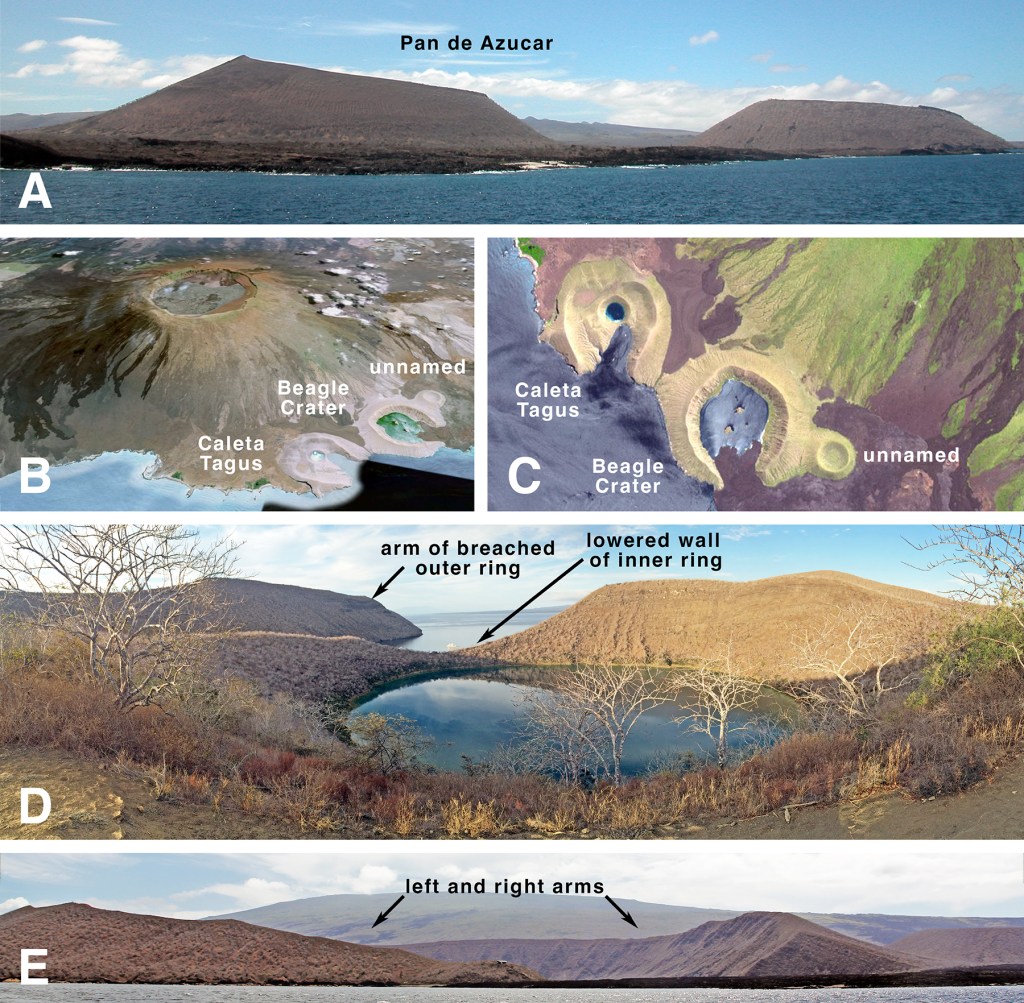
B & C: Tuff cones at the foot of Volcán Darwin. Google Earth (B) and NASA Earth Observatory (C)
D: Caleta Tagus.
E: Mouth of the Beagle crater. Small building on left arm is a ranger station
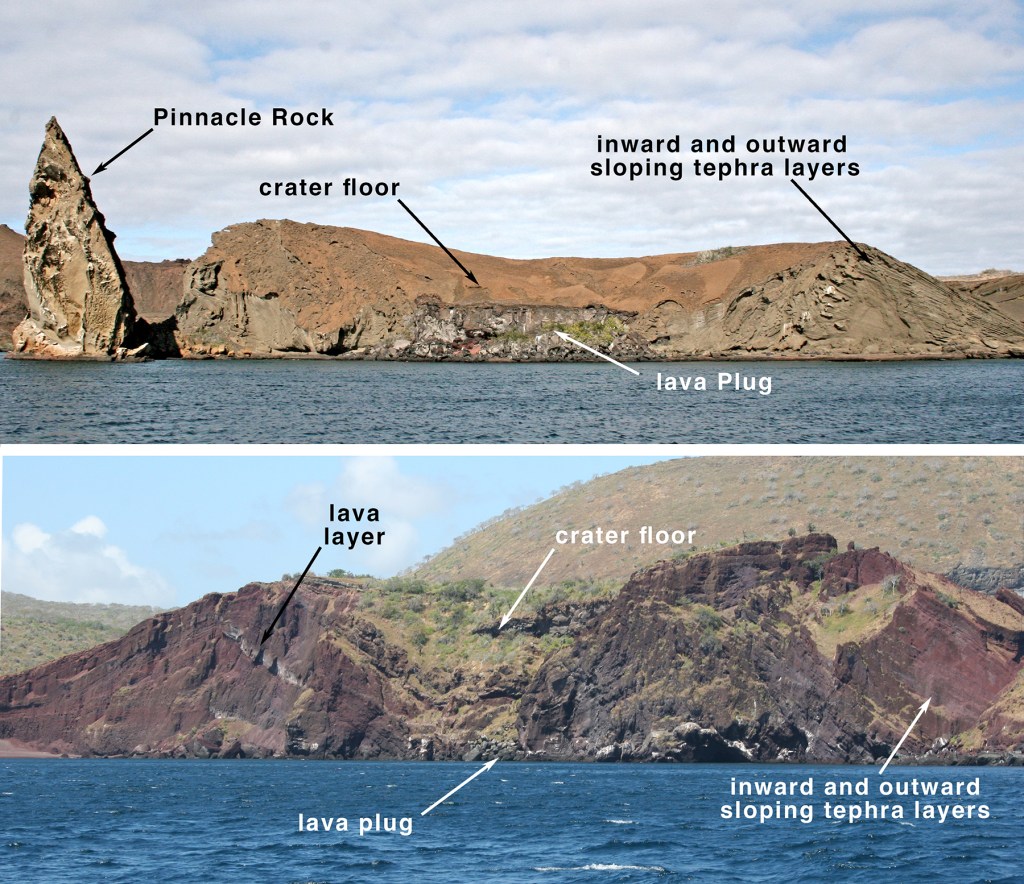
Once a tuff cone builds up high enough to protect the vent from further contact with the water, the crater then pools with lava that forms a plug as the eruption finally dies away. Tuff is easily eroded and there are a number of cones around the archipelago that reveal their inner structure. The one most often seen by visitors to Galápagos is the tuff cone on Bartolomé that includes the famous landmark, Pinnacle Rock. In this cut-away, one can clearly see the inward- and outward-dipping layers, the inner floor of the crater, and the lava plug. A dissected cone at Caleta Buccaneer features interbedded layers of ash and lava.
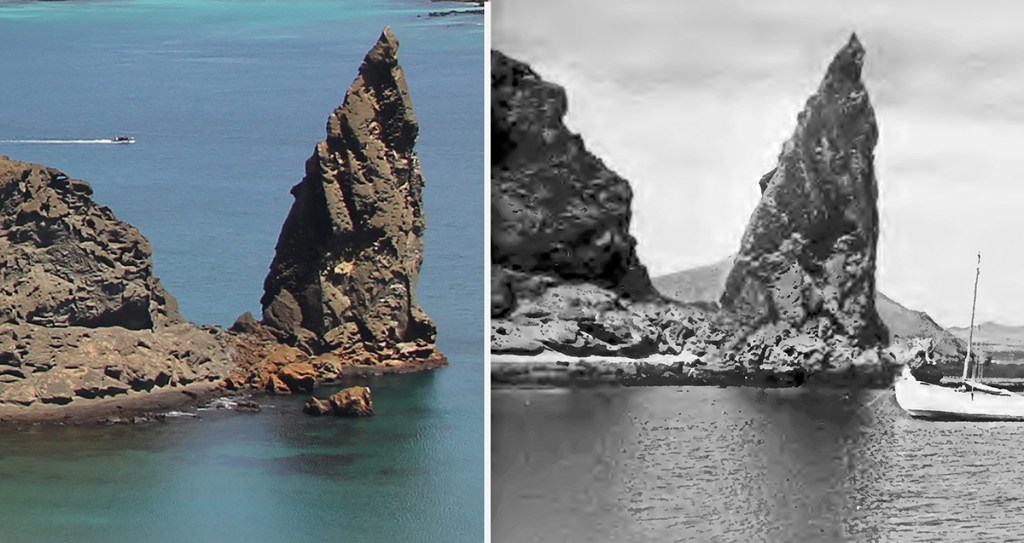
Pinnacle rock itself is a highly resistant segment of the cone that stands nearly alone. In my years of travel to the Galápagos, I have heard many stories about how Pinnacle Rock was shaped by US Airforce pilots who used it for bombing practice. I have asked guides about this but have never gotten a clear answer. However, there appears to be no difference between the photograph I took in 2009 and a photograph in Voyages of Velero III (1939), a privately published account of G. Allan Hancock’s scientific expeditions in the Pacific..
Often at some time after a tuff cone has formed, a new dike may cut up through the cone to produce a scoria/spatter cone. Cerro Inn, the dominant tuff cone at Bahia Sulivan has two such cones on its breached wall, and the trail at Caleta Tagus ends with a series of crescent-shaped spatter/scoria cones that formed on the rim as part of the fissure system on nearby Volcán Darwin. Punta Vicente Roca, at the foot of Volcán Ecuador is a deeply eroded tuff cone that exposes dikes that cut up through the wall of the cone and extruded their lava onto the floor of the crater
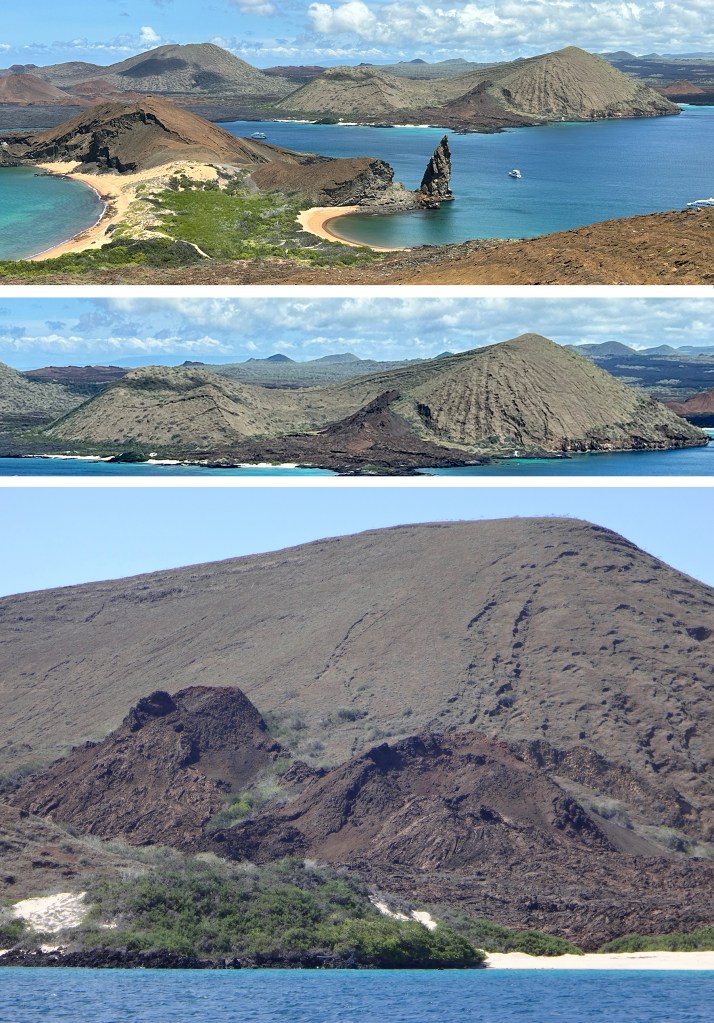
Center: Cerro Inn, the dominant tuff cone at Bahia Sulivan
Bottom: Detail of Cerro Inn showing two spatter cones in the breached wall. Note the clastogenic lava that has flowed from both cones.
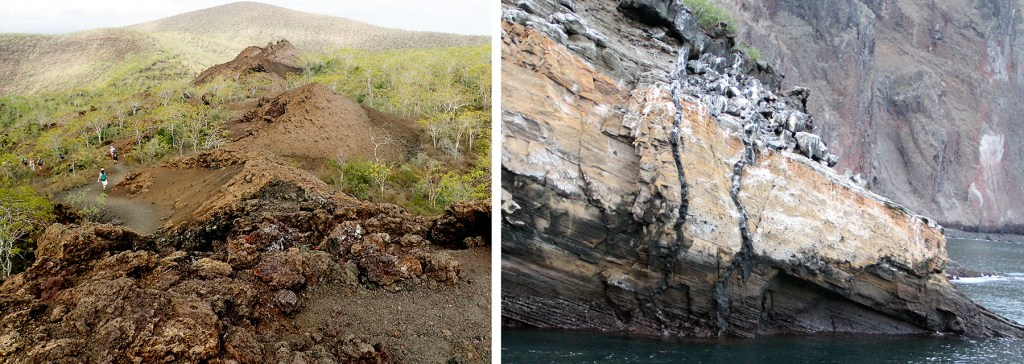
Right: Small lava flow from dikes cutting through the remains of a badly eroded tuff cone. Punta Vicente Roca, Isabela.
Although tuff cones are primarily found along the coast and are associated with incursions of seawater, they are not limited to that environment. Several of the calderas at the summits of the western volcanoes have freshwater lakes that have provided the water for phreatomagmatic eruptions. Fernandina’s caldera used to contain a prominent tuff cone that was ultimately buried by a landslide in 1988.
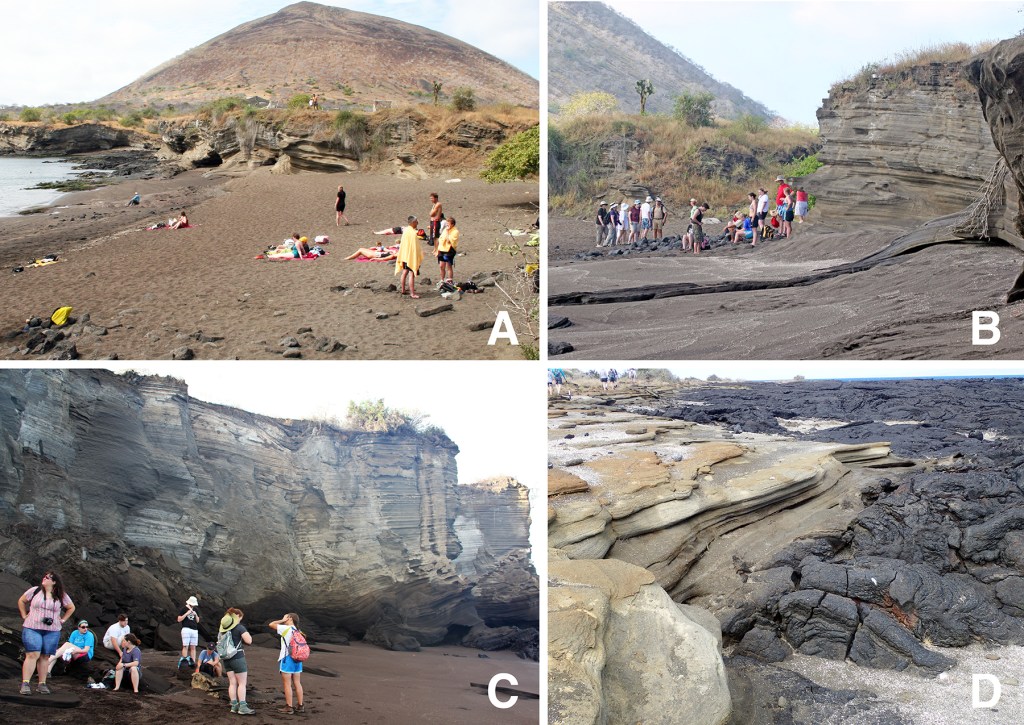
One final feature of tuff cones that must be mentioned is the base surge. Base surges, which were first recognized during analysis of atomic bomb tests, occur when gravity causes rising ash to fall back and spread horizontally. An eruption at Puerto Egas, probably from Cerro Pan de Azucar the large tuff cone that dominates the landscape at the visitor site (and is also the larger of the two cones at Punta Baquerizo), resulted in a base surge that formed the low, fine-grained cliffs along the beach at the landing site, and covered the young lava flows along the trail with volcanic ash.
Find out more about Galápagos Geology in Volume 1 of
A Paradise for Reptiles.

 Darwin's Galapagos