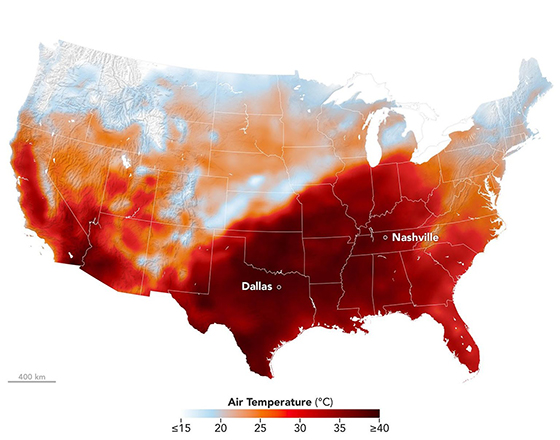
As I write this on 3 October 2026 the high in Los Angeles is 107ºF (41.7º C). Normally, the average temperature at this time of year is in the upper 70º’s F (40º’s C). As hard hit as we seem to be in LA, NASA’s map of temperatures across the US on 15 September shows that other parts of the country are even worse. According to NOAA, the heat dome responsible for these unusual temperatures closes out the warmest summer (June – August) in 132 years. These anomalous temperatures fit into a pattern of global climate change. If this was not bad enough, we are now entering a new El Niño event.
Concern over the current event began in late May when NOAA modeling predicted the arrival of a major El Niño and the World Meteorological Association issued a formal warning on 11 June, the official start date of the 2026-2027 event. Many weather forecasters were calling the last major event (2015-2016) a “Godzilla” El Niño. The 2026-2027 event is predicted to be of epic proportions. California has already declared a state of emergency, directing state agencies to begin protecting vulnerable communities and critical infrastructure.
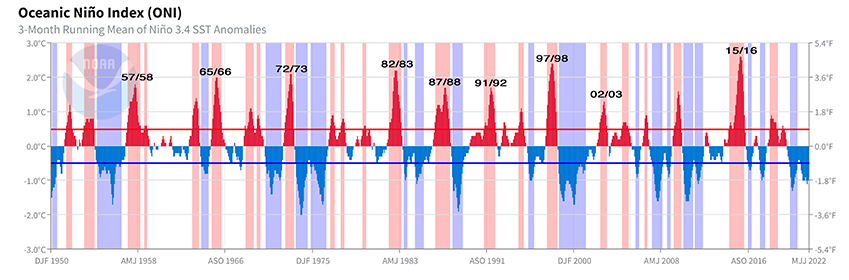
El Niño events occur on an irregular cycle, generally every 2 – 7 years and can last from 9 to 12 months. Normally, the peak of El Niño occurs around December, Christmas time, hence the name El Niño (the boy) is a reference to the Christ child. The strength of an El Niño event is measured as the Oceanic Niño Index (ONI). ONI is defined as the 3-month running average difference from normal temperature. The graph below traces El Niño events back to the 1950’s. When the difference exceeds ±0.5°C, the event is considered to be a warm phase (El Niño) or a cold phase (La Niña). El Niño’s vary in strength, some weak, others strong; a few have been deemed “super.” The 1982-1983 El Niño was at that time the most severe on record, and the first to be intensively studied. Since then, there have been two additional super El Niño’s, 1997-1998 and 2015-2016.
The counterpart to El Niño is La Niña. If equatorial east Pacific waters are warmer than normal during an El Niño, they are colder than normal during a La Niña. The cycle depends on the strength of the equatorial trade winds that typically blow from east to west. Normally, these winds push equatorial waters westward, such that sea level in Asia and Australia is 0.5 m higher than coastal South America and the water is about 7°C warmer. However, during an El Niño event, the trade winds weaken, and warm western Pacific waters flow eastward, raising both sea level and sea-surface temperature, causing heavy rainfall and suppressing the upwelling of nutrient laden cold-water currents that normally surround the Galápagos,
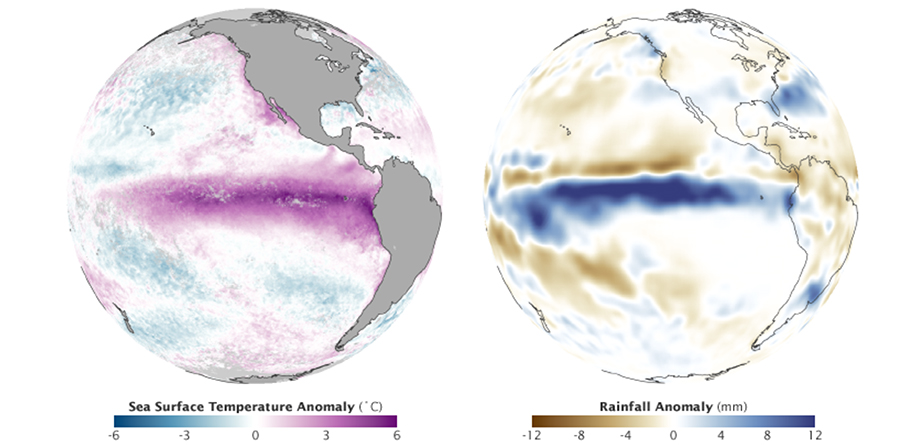
NASA Earth Observatory map of sea surface and rainfall anomalies, 1997-1998 El Niño
But more than affecting the waters of the eastern equatorial Pacific, El Niño events are associated with broader climate affects, their teleconnections. As the eastern Pacific warms, atmospheric pressure over the ocean drops and global atmospheric circulation is disrupted, leading to world-wide climatic anomalies. The atmospheric disruption that accompanies an El Niño is referred to as the Southern Oscillation. Taken together, El Niño is usually referred to as the El Niño – Southern Oscillation, ENSO.
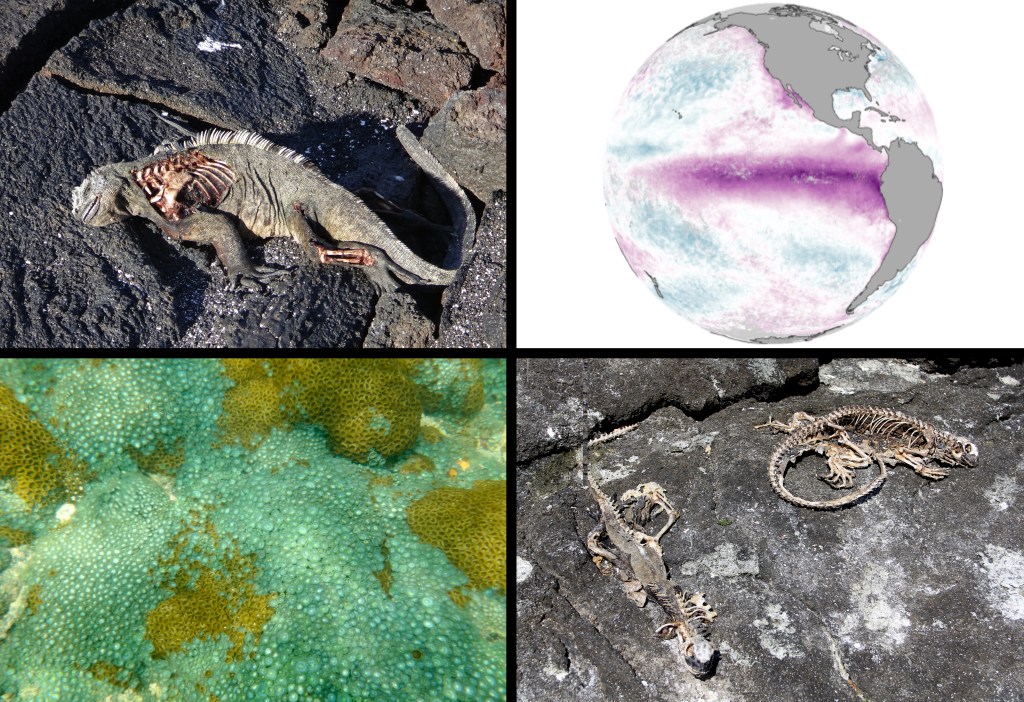
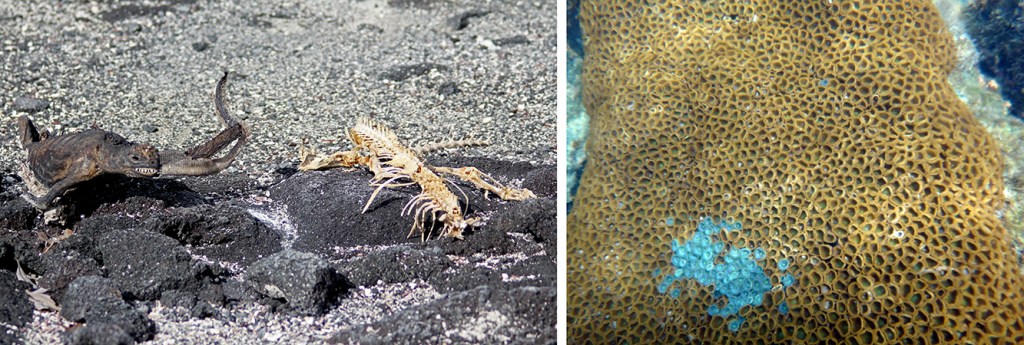
Galápagos is essentially ground zero for El Niño and the effects can be drastic. For animals that depend on the sea, El Niño is a time of devastation. Deprived of nutrients brought to the upper level of the ocean, phytoplankton dies off. Fish that feed on the phytoplankton also die. During the 1982-1983 event large sea birds and sea-lions starved to death. Marine iguanas died in droves when Giffordia mitchelliae, an undigestible brown alga not previously known in the Galápagos, overran the intertidal zone to the exclusion of the red algae that the iguanas normally eat. A quirky YouTube video claims that El Niño is the reason why marine iguanas are number one on a list of five animals with the saddest lives in the wild. 95-99% of coral was lost.
During my snorkeling outings in 1997, the water, which my students usually find a bit too cold for comfort, felt like swimming in a bathtub. There were so many jellyfish in the water that several of the group were stung and on a few days, we couldn’t snorkel at all. That was the first and last time that I encountered jellyfish in more than 30 Galápagos trips.
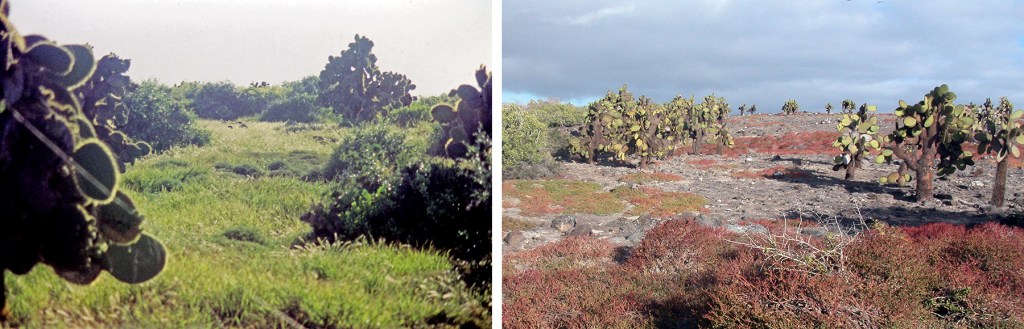
For other species, however, El Niño is a time of plenty. Heavy rains cause an overgrowth of plants that land birds can eat. During the 1997–1998 El Niño, at least two species of finch—the medium ground finch, Geospiza fortis, and the common cactus finch, Geospiza scandens—bred longer (8 vs. 4 months), and females produced more clutches (10 vs. 5), larger clutch sizes (4 vs. 3), and four times as many eggs and fledglings as in a normal year. I have experienced two El Niño’s, 1997-1998 and 2015-2016. Early one morning during my 1997 trip, we were anchored at Tagus Cove, Isabela, and the air was filled with the cacophony of hundreds of calling finches. I had never experienced anything like that before.
The most recent data indicate that the 2026-2027 El Niño continues to strengthen as the sea surface anomaly in the equatorial Pacific, measured as the degree of departure from the 1999-2020 average, already exceeds 3.0ºC. According to the National Weather Service Climate Prediction Center, the probability of a very strong El Niño event is better than 90%. The probability that it will be stronger than any event going back to 1950 is 75%! Galápagos conservation agencies are justifiably worried. The Galápagos Conservancy reports that sea level is already beginning to rise, sea surface temperature is already warmer than usual, and rains are continuing further into the season. During periods of stress, animals shift their energies from reproduction to other behaviors that will promote their survival. Waved albatrosses are already abandoning their eggs and limiting their mating behaviors. Fishermen are struggling as their catch has dropped significantly.
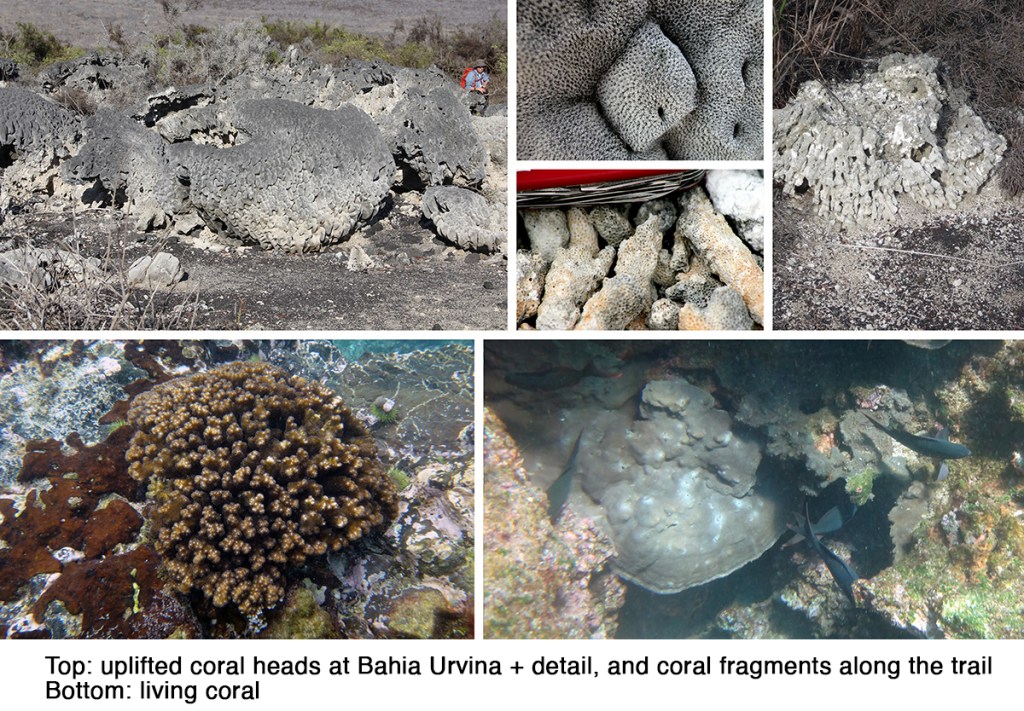
There is a general impression that the frequency and strength of El Niño’s have been increasing over time due, presumably, to anthropogenic global warming. But ENSO is so complicated and involves so many variables, both oceanic and atmospheric, that this is hard to prove. A recent study of corals in the Galápagos (see references below) is providing a clearer history of El Niño in the eastern Pacific over the past 1000 years based on analysis of Sr/Ca and 18O/16O ratios in their carbonate skeletons.
The skeleton of corals, the theca, is made of aragonite, a form of calcium carbonate (CaCO3) that is precipitated from seawater in annual bands. As the theca grows, it also incorporates strontium. Strontium ions carry the same +2 charge as calcium and forms strontium carbonate (SrCO3), which is also incorporated into the growing theca, but at a lower rate than calcium carbonate. While calcium carbonate forms the basic structure of the theca, the strontium carbonate within it provides strength. The uptake of strontium carbonate is temperature dependent and the ratio of Sr/Ca decreases with increasing temperature. Thus, the ratio of these two elements in fossil coral can be used to calculate the temperature of sea water at the time the coral was alive.
Similarly, the ratio of 18O/16O in coral can also be used to estimate water temperatures. 16O is preferentially incorporated at higher temperatures, so as ocean temperature rises during an El Niño, the ratio of 18O/16O falls. Together, these two ratios can be used to track El Niño events over time.
In their recent study, Cole et al. sampled living and fossil coral across the Galápagos to construct a 1000-year record of El Niño’s in the eastern pacific. This record extends from the present to the pre-industrial past and shows that the strength of El Niño has increased by 36% over the past 40 years. The timing of this increase follows the rate of postindustrial warming and closely corresponds to anthropogenic climate change. While not proof, it is not difficult link the one as the cause of the other. If so, human activity will likely lead to stronger and more frequent ENSO events and greater climate disruption. The iconic Galápagos fauna and flora have lived with El Niño over the course of their evolution. While populations may be devastated, they always seem to come back. But never, apparently, have they faced El Niño’s of present day magnitude and frequency. How they will, or will not, cope with this new situation remains to be seen.
Find out more about El Niño and marine iguanas in Volume 2 of A Paradise for Reptiles
Cole, J. E., D.M. Thompson, K. A. Dyez, C. J. Trip, A. W. Tudhope, M. Lofverstrom, S. Stevenson, J. M. Okun, A. E. Lawman, J. L. Conroy, J. T. Overpeck, G. Jimenez, and R. L. Edwards. 2026. Recent strengthening of eastern Pacific ENSO in the last millennium paleorecord.Science 394: 192-196.
Vaz, J. 2026. Climate change is strengthening El Niño, Coral records suggest Science 393: 846 – 847