
The flightless cormorant (Nannopterum harrisi) is the only cormorant (family Phalacrocoracidae) found in the Galápagos, and of the numerous cormorant species world-wide, it is the largest, and it is the only one that has lost the ability to fly. It was first discovered during the 1897 Webster-Harris expedition and was formally described and named it in honor of its discoverer and expedition leader, Charles Miller Harris, by Walter Rothschild, who funded the expedition. Historically all cormorants were assigned to the genus Phalacrocorax. And so, Rothschild naturally named the flightless cormorant Phalacrocorax harrisi.
In 1899 the flightless cormorant was assigned to a new genus, Nannopterum to emphasize its flightlessness, and many of the older guidebooks have it listed as such, but more recent books have returned to Phalacrocorax. However, in 2014 DNA analysis revealed that the flightless cormorant is a recently evolved sister to the double-crested cormorant, P. auritus of North America and the neotropical cormorant P. brasilianus. Accordingly, the genus name Nannopterum has been resurrected and these three cormorants have now been assigned to that genus.
It is surprising that Darwin did not see, or at least mention, the flightless cormorant during his voyage because the Beagle was anchored at Caleta Tagus (also known as Banks’ Bay), a key anchorage on the western coast of Isabela, an area that Darwin had explored, and a site well within the cormorant’s range. Today, Caleta Tagus is a major visitor site and on at least two occasions I have seen a pair of cormorants nesting right at the landing spot, making a tricky disembarkation even more difficult. Surprisingly, when Captain David Porter navigated Galápagos waters in the USS Essex during the war of 1812, he put in near Punta Vicente Roca on the northern head of Isabela and recounted in passing that the crew caught “a number of shags and penguins, and killed some pelicans and other birds.” Shags are somewhat more lightly built cormorants and have traditionally been assigned to Phalacrocorax.. This had to be the flightless cormorant, but Porter had nothing to say about them. And they remained unnoticed – or unremarked – by anyone, including Darwin, until the 1897 Webster-Harris expedition.

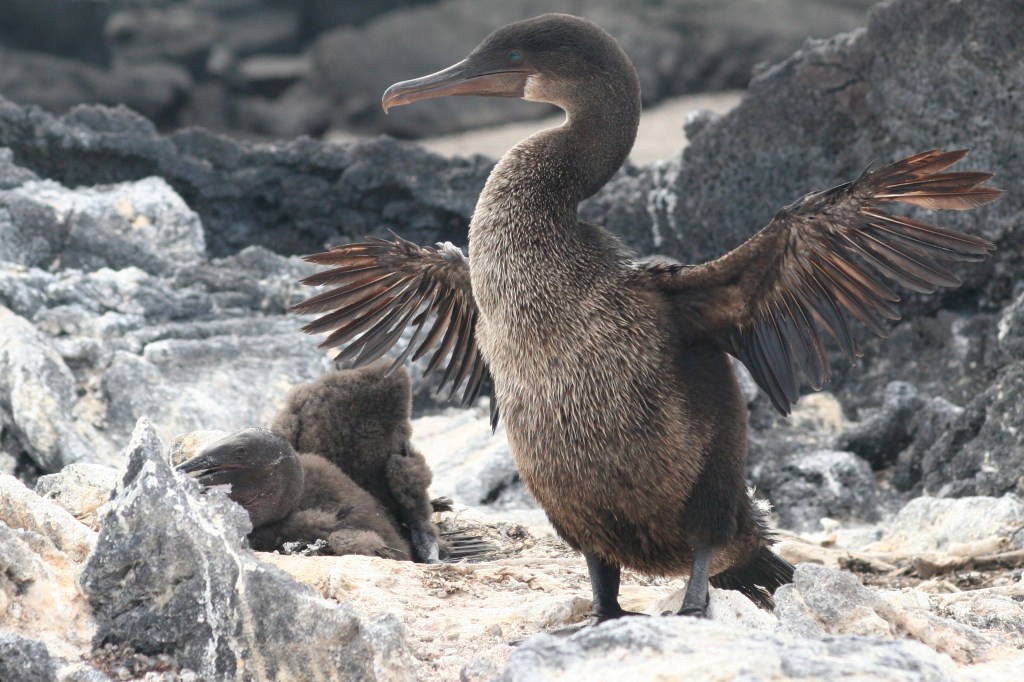
Although all cormorants feed underwater, their feathers are not completely waterproof. Thus, upon emerging from the water, they typically stand for some time with their wings outstretched to dry. Flightless cormorants preserve this behavior, and it is not uncommon to see them standing with their stunted, scruffy-looking wings held out. The flight and contour feathers are much like those of other cormorants, but the body feathers are much thicker, softer, denser, and more hairlike. They produce very little oil from their preen gland, and it is the air trapped in their dense plumage that prevents them from becoming waterlogged.

The loss of flight is probably related to both an absence of natural predators in the Galápagos, and to a restricted feeding area. They are only found on the coastline of Fernandina and the northeastern and western shores of Isabela where there are upwellings of the cold Cromwell and Humboldt currents. The ability to fly imposes strict constraints on a bird’s body conformation. Freed of this constraint, the body can respond to selection pressure imposed by other behaviors. Like other flightless birds, the keel on the breastbone, which supports the large flight muscles, is drastically reduced. Instead, the legs are heavier and more powerful than in other cormorants. Unlike the penguin, whose wings are used as paddles to literally fly through the water, the flightless cormorant propels itself by powerful kicks, and its legs are heavier and more powerful than in other cormorants.

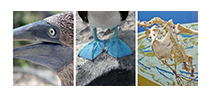
Bottom: Breastbones of a great cormorant and two flightless cormorants in the collection of Harvard’s Museum of Comparative Zoology. Specimen numbers 342652, 2654, and 2653 (l-r).
Once while snorkeling at Caleta Tagus I turned to see a cormorant floating next to me. It suddenly dived and in doing so it accidentally kicked me in the shoulder. It really hurt! The birds forage no more than 100 m offshore, feeding near the bottom on squid, octopus, eel, and fish.

Flightless cormorants have a complex courtship behavior which begins in the water and then continues on shore. The pair swims around each other, their long necks bent into a snake-like figure. The male then leads the female ashore, turning back towards the female, and assuming the snake-neck posture. The pair builds a nest composed of sea weed, sea urchins, starfish, and dead fish, and the male continually brings “gifts” to the female, which she incorporates into the nest. They have been known to incorporate bits of flotsam such as rope, bottle caps, and plastic six-pack holders. In 1998, I saw a nest in which the pair had incorporated a dead marine iguana! The female lays three eggs, though usually only one chick survives. Both male and female share in incubation. I observed the owners of the nest trade places. The male had been sitting patiently on the nest when his mate emerged from the water. She slowly ambled over to the nest and stood in front for about 15 minutes with her wings outstretched. She then stepped on to the nest and they exchanged some coarse grunts, the only vocalization these birds make. The male got off the nest, walked over to the water and dove in.

The nest in these photographs is the one mentioned above that has incorporated a dead marine iguana. Normally the nest is made mostly of seaweed to which other items may be added, and then over time, the nest is cemented with guano. But 1998 was a severe El Niño year and seaweed was scarce. This nest is made up primarily of twigs and pencil sea urchins. The marine iguana is difficult to see in this mess, but is enlarged in the inset. The most prominent part of the iguana is the several vertebrae indicated by the red arrow.

Once the eggs have hatched, both parents continue to share responsibilities of feeding and brooding (protecting the chicks from exposure to heat and cold), but once the chicks are old enough to be independent, and if food supplies are plentiful, the female will leave the male to carry out further parenting, and she will leave to find a new mate. Females can breed three times in a single year. Thus, although their population size is small, flightless cormorants can recover fairly quickly from envirnomental disasters.The flightless cormorant is among the rarest of the Galápagos sea birds with a population size of only around 1000 pairs. Nevertheless, the population is stable, and the IUCN Red List of Endangered Species considers it vulnerable.