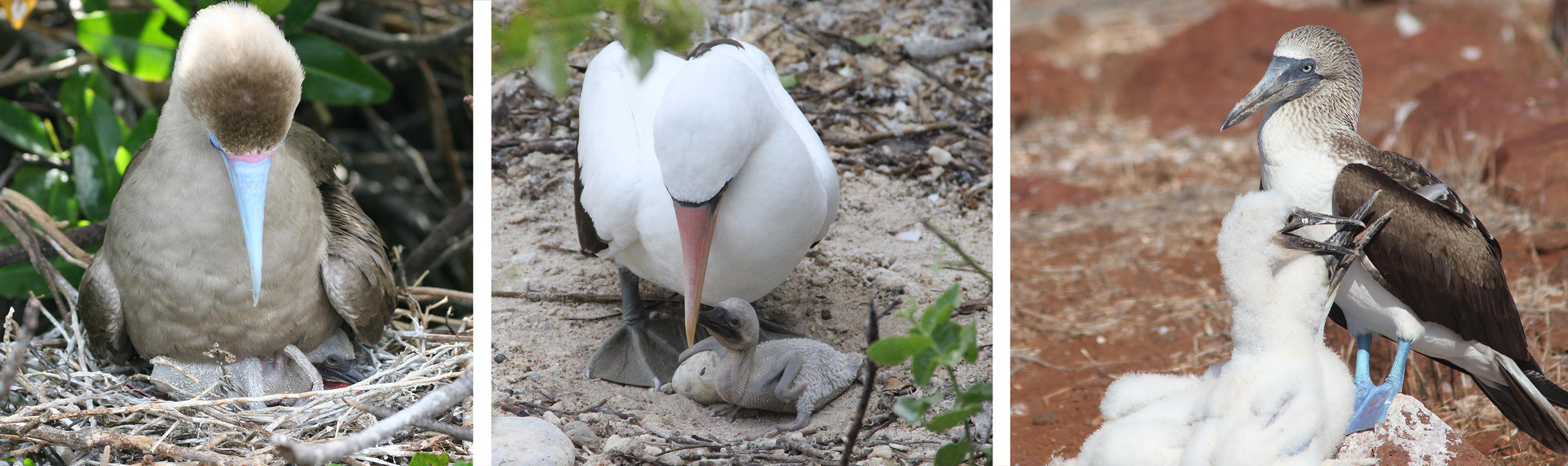
Boobies belong to the family Sulidae, which also includes gannets. In the Galápagos, there are three boobies: the red-footed booby (Sula sula), the blue-footed booby (Sula nebouxii) and the Nazca booby (Sula granti). Up until 2002, the Nazca booby had been identified as the masked booby (Sula dactylatra). There are two subspecies of masked booby in the Pacific, S. d. personate and S. d. granti, the former with a greenish bill and the later with a yellow bill. S. d. granti is found on the Revillagigedo Islands, the Galápagos, Ecuador, and northern Peru. However, both subspecies are found on Clipperton Atoll where they segregate into separate breeding colonies. Thus S. d. granti was raised from subspecies to full species status, Sula granti.
Despite the obvious color differences, the three boobies are very similar in body shape, with the Nazca being the largest and the blue-footed the smallest. Though small by comparison, the blue-footed booby has, proportionately, the largest tail of the three. All three have torpedo-like bodies with sharply pointed beaks. Indeed, the local Spanish name, “piquero” is derived from the beak shape: “piquero enmascarado” (Nazca booby), “piquero patas rojo” (red-footed booby), and “piquero patas azul” (blue-footed booby).The origin of the name booby is less clear, probably derived from Spanish “bobo”, or clown, in reference to their habit of landing on ships at sea and being easily approached – and killed – by sailors.
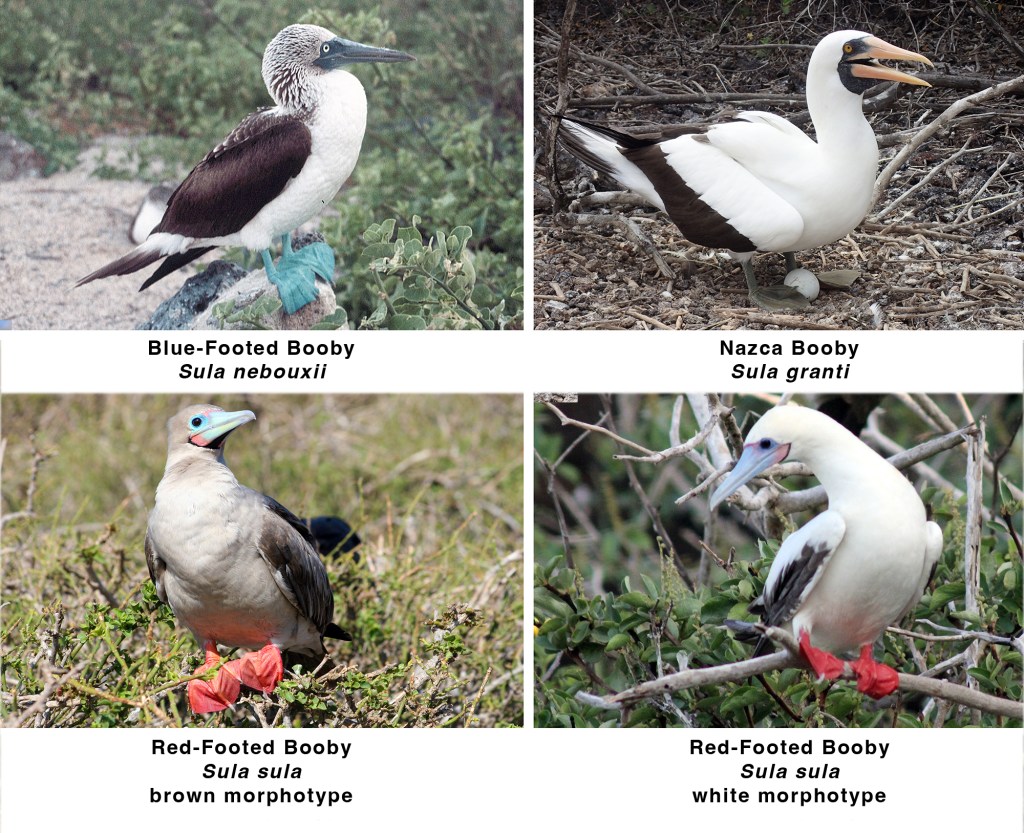
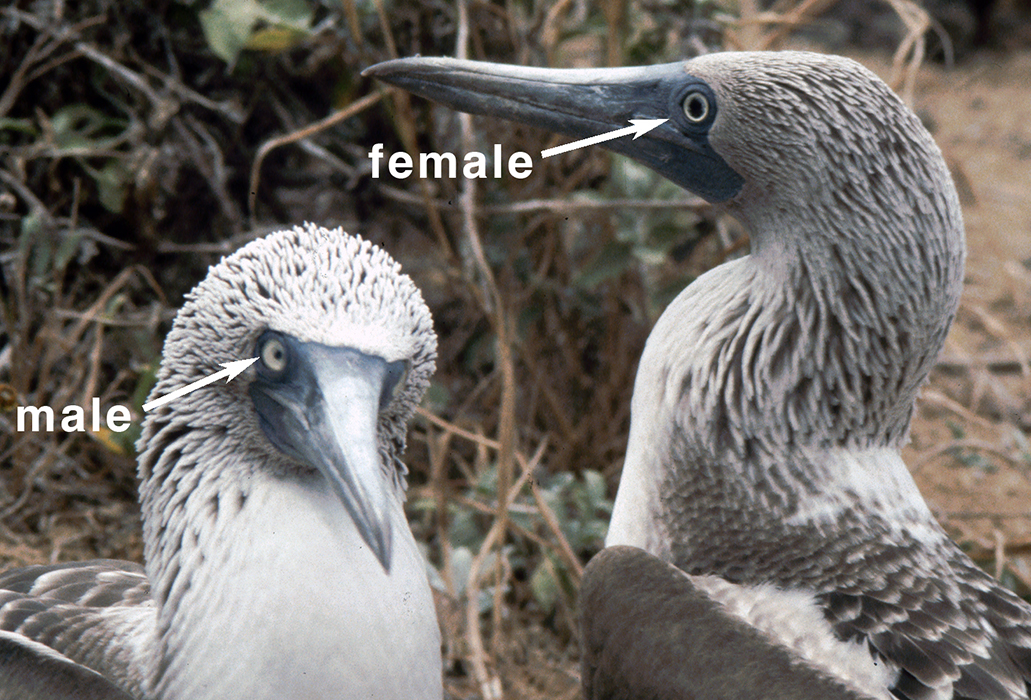
It is fairly easy to distinguish males from females by voice – males make an asthmatic whistling sound while females croak. Blue-footed boobies can also be distinguished because the females have a ring of dark pigment around their pupils, making them look bigger than those of the males. Red-footed boobies are dimorphic for plumage. About 95% of the birds have brown plumage while 5% have a white plumage very similar to that of the masked booby. It is curious that in red-footed booby populations in other parts of the world, the percentages are reversed, with the white morph being the more abundant They are, nevertheless, the same species and, if you are lucky, you can see a brown/white pair.
All three birds have similar body shapes, and they lead similar lifestyles, but refrain from competing with one another because they fish in different areas. Blue-footed boobies tend to fish very close in to shore, masked boobies a bit farther out, and red-footed boobies fish well out at sea. The distributions of their fishing grounds influences the distribution of their nesting sites. Blue-footed boobies nest in the center and edges of the archipelago (Española, Daphne, and Seymour Norte). Similarly, Nazca boobies tend to nest at the edges of the archipelago (Española, Daphne, and Genovesa), while red-footed boobies tend to be found only at the fringes of the archipelago (Genovesa and Punta Pitt on the northeastern tip of San Cristóbal). Because of their distribution, it is typically the blue-footed booby that visitors tend to see fishing.
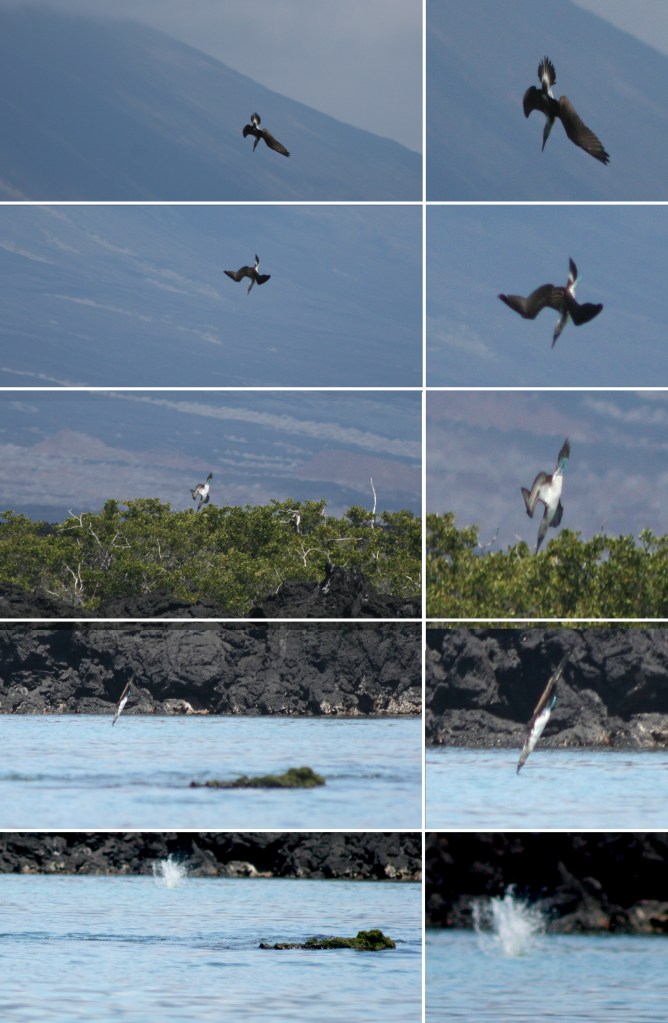
Boobies are plunge divers and their dive is spectacular. When they spot fish, from 30-50 feet in the air, they power-dive, beak-down into the water, folding their wings back only at the last minute disappearing for several seconds and then bobbing up to the surface. Blue-footed boobies dive in remarkably shallow water, and they use their large tails to pull themselves out of the dive. One usually sees individual birds fishing, but it is not at all uncommon to see a small group of boobies flying in formation, heads down, looking for fish.
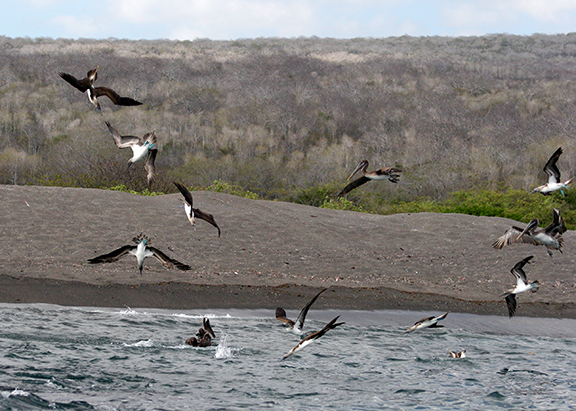
Occasionally one can see large flocks of boobies fishing together. Amasa Delano, a yankee sea captain who visited the islands in 1801 described such a sight:

There is another remarkable bird found here which has not before been described. It is called the diver. They resemble the small kind of booby, and something similar to the kind which is described at the Lobas Islands, called Bonaparte’s army, excepting they are of rather a darker colour on the breast and neck, and their beaks and feet are of a prussion blue. These birds collect together in small flocks for the purpose of diving. They fly round in a circle and continue to rise till they get to the height of from sixty to a hundred yards in the air, when one of them makes a pitch to dive, at which motion everyone follows. They fly down with remarkable swiftness till within four or five yards of the surface, and then suddenly clasp their wings together and go into the water with the greatest velocity that can be conceived of, exceeding anything of the kind that I ever witnessed. This bird should be contrasted with the pelican. They go into the water with such force as to form a curve of thirty or forty yards in length, before coming to the top again, going to a great depth under water. They glide under water at almost as great a degree of swiftness as when flying in the air. The water was so very transparent where the ship lay, that they could plainly be seen during their submarine course.
The plunge dive of the blue-footed booby is just as awe-inspiring today as when Delano described it nearly 200 years ago.
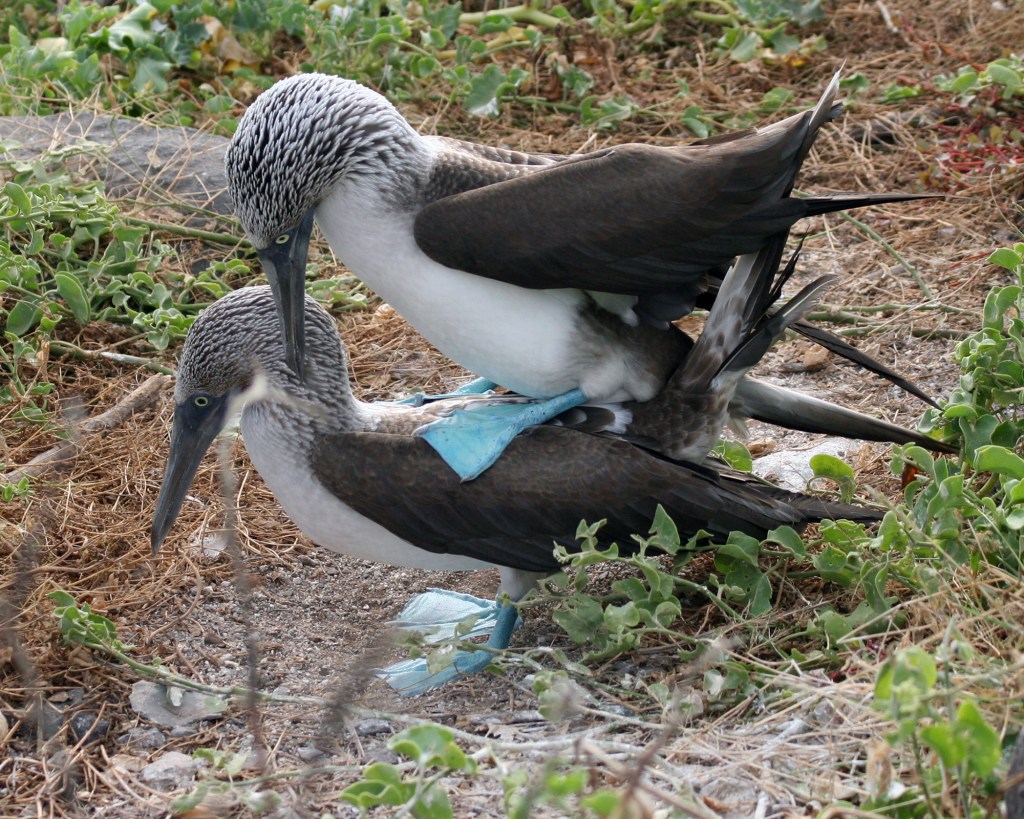
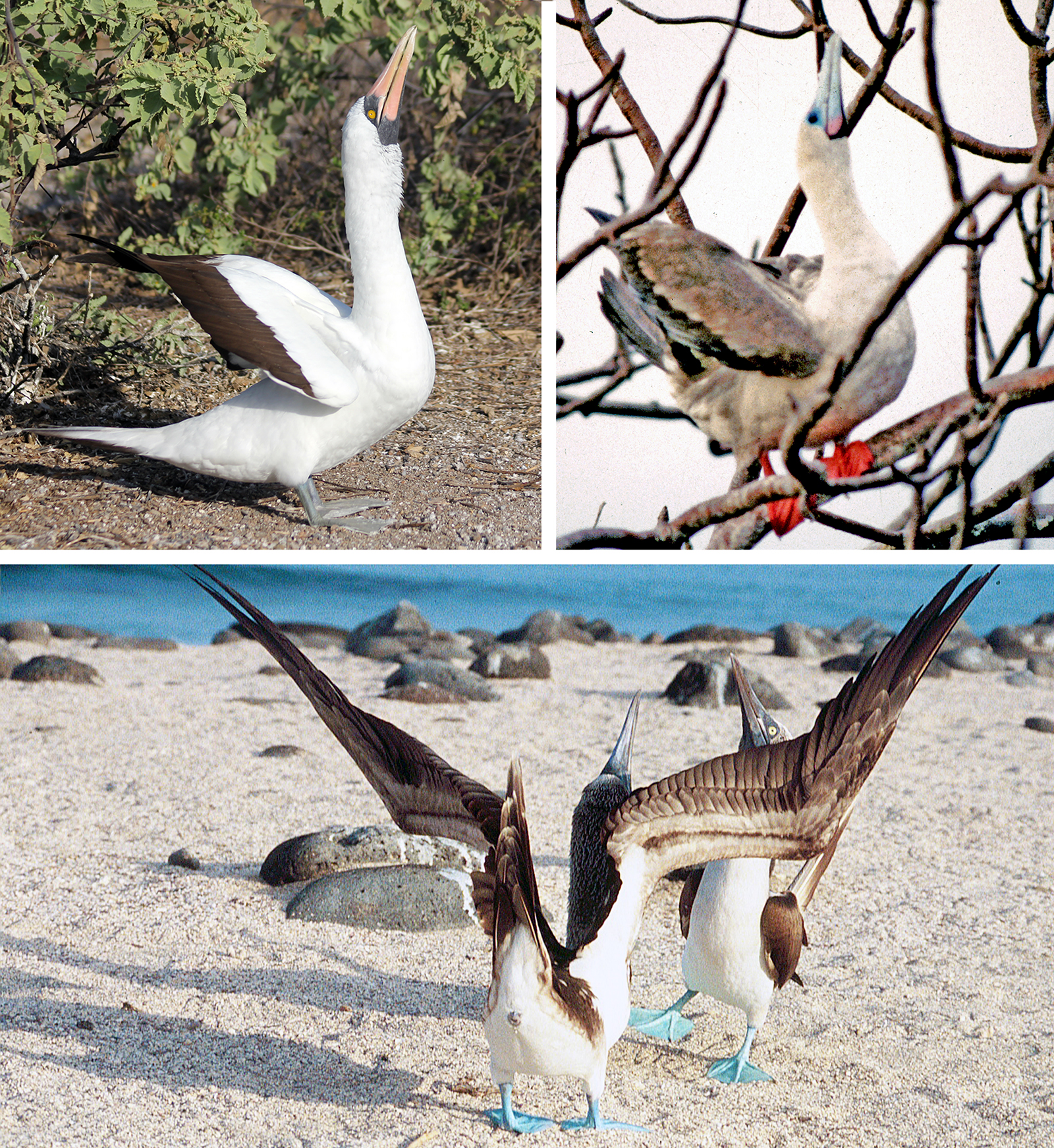
Boobies and gannets, in general, have complex courtship rituals and in the Galápagos, the courtship of the blue-footed booby is most complex. The male attracts the female’s attention by a behavior called sky pointing, in which he tips his beak, tail, and wing tips to the sky while letting out a whistle, or a rattling call in the case of the red-footed booby. Nazca booby males stand often stand on a symbolic nest of twigs and calls to passing females. The red-footed booby performs his sky point on a branch. In my experience the sky point is deep within the mangroves where they nest and it is difficult to see. However, in the photo below, the male was standing among branches devoid of leaves. Blue footed-boobies slowly march around each other, lifting their bright blue feet in a high, slow step. Of the three species, the blue-footed booby’s sky point is the most extreme – nearly turning its wings inside out.
Many members of the Sulidae build nests, but in the Galápagos, only the red-footed booby does. Both the blue-footed and theNazca boobies nest on the ground, the blue-footed boobies often making a guano ring around the nest area. Nevertheless, as part of the courtship process, the male blue-footed booby offers the female a twig as part of a ritual nest.
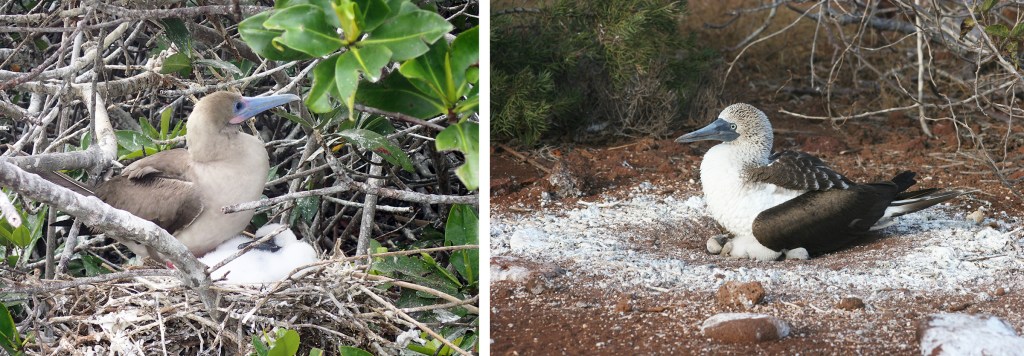
Both booby parents help in rearing the chicks and take turns guarding the nest and incubating the eggs. Most birds, but not boobies, develop a brood patch on their belly during nesting season. This is a spot where the feathers are relatively thin and blood vessels in the bare skin keep the eggs warm. Boobies compensate for their missing brood patches by laying their feet over the eggs and the blood vessels in the webbing accomplish the same purpose.
The three boobies have very different reproductive strategies. The red-footed booby lays one egg and raises one chick. Likewise, the Nazca booby also rears one chick, but it approaches the problem differently. Nazca boobies lay two eggs, several days apart and the older chick is much bigger than the younger. Assuming that the older chick survives, it will push its younger sibling out of the nest, where it will die — all under the eyes of a seemingly uncaring parent. If the older chick dies, however, then the younger chick acts as a back-up. Blue-footed boobies, on the other hand, can lay up to three eggs and, in a good year, can raise all three chicks. At least part of what makes this possible is that by fishing in very close to shore, blue-footed boobies parents can make more and frequent trips in for feeding. In lean years, however, the older chicks engage in siblicide.