The brown pelican (Pelecanus occidentalis) is found throughout the islands, skimming over the water, plunge-diving, and resting in mangrove trees. In addition to Galápagos, the brown pelican is found along the western coasts of northern South America, Central America, and North America, and throughout the Caribbean. The Galápagos population of brown pelican is considered to be an endemic subspecies.
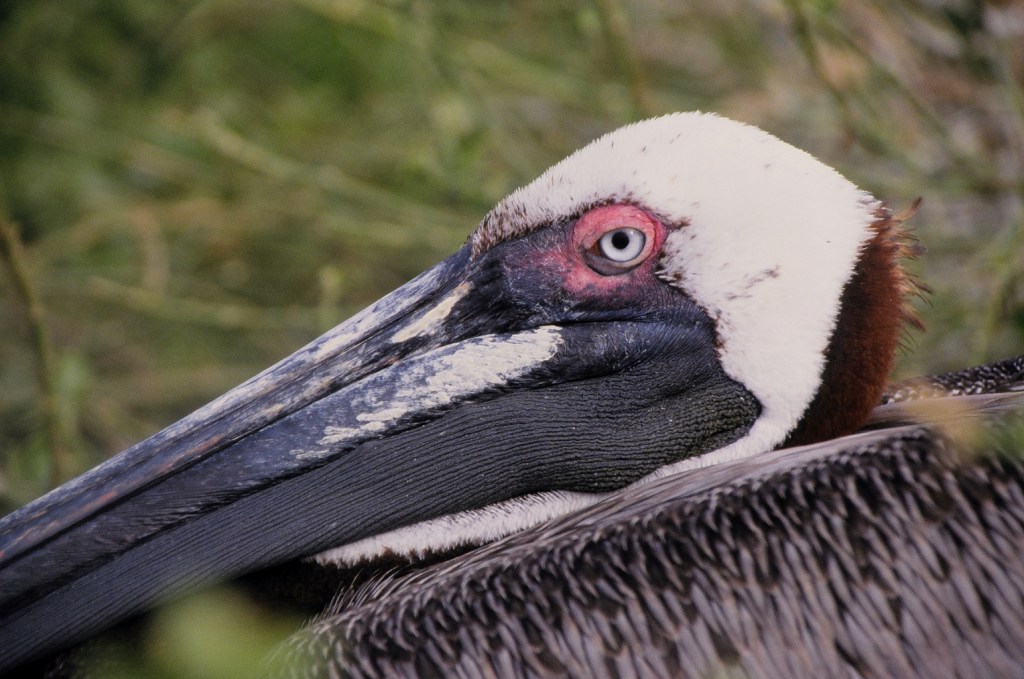
Adult pelicans can be distinguished from juveniles by their plumage. Juveniles tend to have gray face, skin, bill, and legs, with a brown body. Adults have a white neck, gray-brown upper body and brown to black lower body. The neck is white, often with a yellowish crown. In breeding season, the back of the neck is a rich chestnut brown. The individual in the picture above is an adult in non-breeding plumage.

They build their nests in mangroves or in low-lying coastal bushes such as salt bush (Cryptocarpus). Female pelicans lay two to three eggs and both parents share in incubation and feeding. Of all the pelecaniformes, the pelican has the largest gular sac, from which the juveniles feed. Pelicans breed throughout the year, but individual colonies tend to breed synchronously.
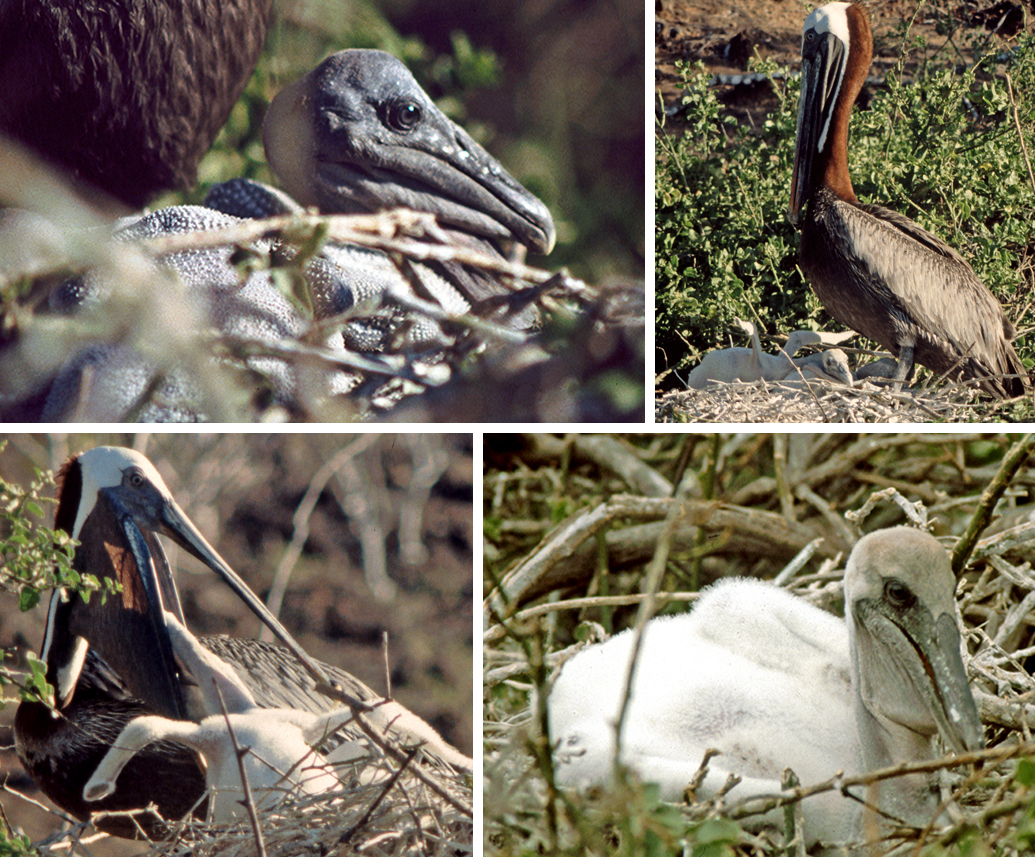
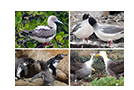
During the early and middle years of my trips, the best place to see mating and nesting pelicans was Rábida. The landing site at Rábida is a red beach, at the back of which is a barrier of salt bush (Cryptocarpus) where many pelicans nested, and it was possible to see them up close. They also nested on the adjacent hill. Behind the salt bush barrier there is a brackish lagoon where flamingos would visit to feed and nest (panel A in the photo below). There was a hiatus in my trips between 2009 and 2015, and when I returned to Rábida in 2016, the site was empty. According to the guide, there had been too much human disturbance over the years and the pelicans had moved on. They still nest on Rábida, along the cliffs, and it is possible to see them via a panga ride. The flamingos are gone too. Again, according to the guide, heavy rainfall had altered the salinity of the lagoon, killing off the invertebrates on which the flamingos feed. On one recent visit, I saw a single lonely flamingo.

B & C: Nesting pelicans in 2004
D: Young pelican in nest along the cliff face
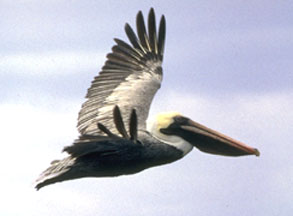
The brown pelican is an extremely graceful flier, soaring easily on the thermals and, as noted above, it is a plunge diver. As graceful as it is in the air, however, its plunge is shallow and sloppy, quite unlike that of the booby. Amasa Delano, who first described the blue-footed boobie’s plunge dive, also described the pelican’s:

The pelicans of this place are much like those in the West Indies. They have a monstrous large bill, more than a foot long, with a cot, or bag, growing to the underpart of the bill. The underjaw is divided in such a manner that it can be spread open similar to a net bow, so as to contain near a peck of grain. They are the most clumsy bird I ever saw. When diving, they make the most awkward appearance that can be imagined, which cannot be better described than by comparing it to the manner in which a sailor washes his clothes, by making them fast to the end of a rope and throwing them from the forecastle into the sea. When they strike the water, they spread out, with the trousers in one direction, the shirt in another, and the jacket in a third. The pelican makes a plunge into the water for the purpose of obtaining its food in a similar manner – its wings extended, its mouth open, and its bill expanded, with two enormously large feet spread out behind.
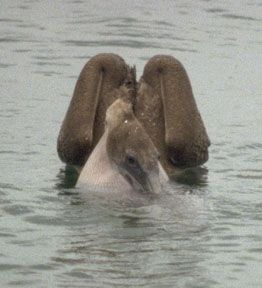
The pelican hits the water with open mouth and it seems to flatten on the surface, with its tail and feet never penetrating. Underwater, the pelican traps fish along with several gallons of water in its gular sac. It will sit for a moment with its beak in the water, trying to remove the water while retaining the fish. Not surprisingly, it sometimes loses some or all of its catch. I have often seen mixed flocks of pelicans, blue-footed boobies, and brown noddies fishing. When the pelicans dive, the noddies swarm them, sometimes perching on the pelicans’ heads, hoping to pick up a free meal. I have never seen them mob the boobies in a similar manner. Nevertheless, this style of fishing seems to be difficult to learn. Pelicans tend to be successful at raising their chicks, but many juveniles, once on their own, die of starvation because they cannot master the technique.