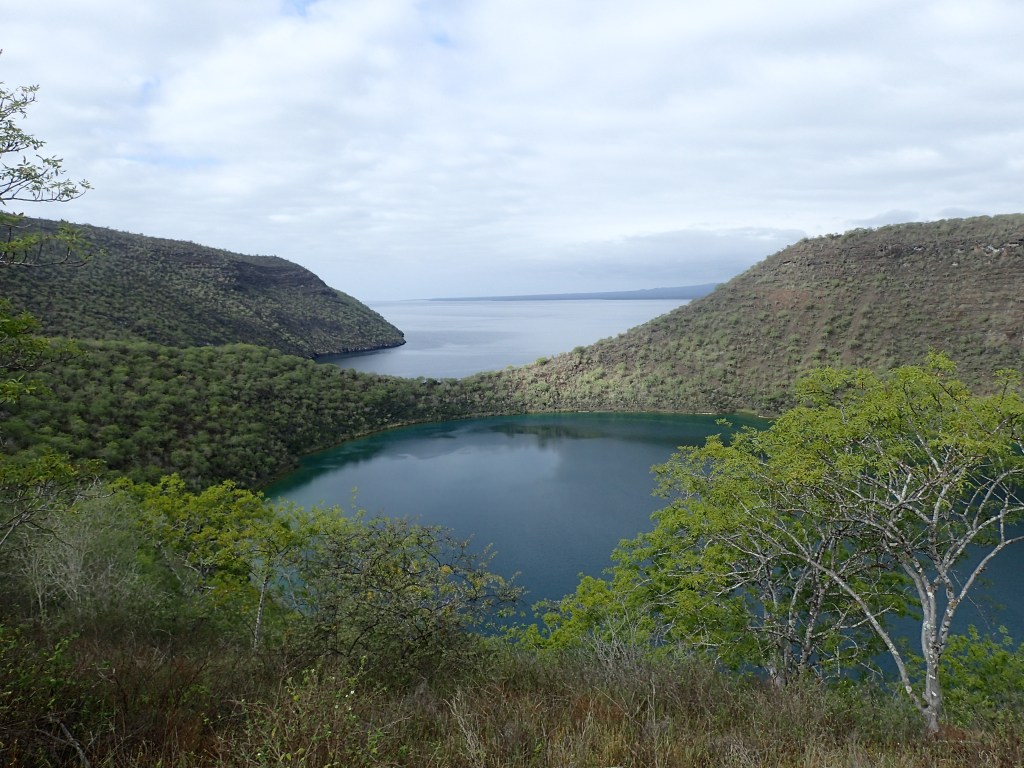
Tagus Cove, also known as Bank’s Bay, is a historic site that was frequently visited by pirates, whalers, and mariners because it afforded a sheltered anchorage not too far from the major whaling area. Perhaps the most notable visitor to this site was Charles Darwin, who explored the nearby Beagle Crater. The walls of Tagus Cove are covered with graffiti – the names of many ships that have visited there, including the oldest date, 1836.
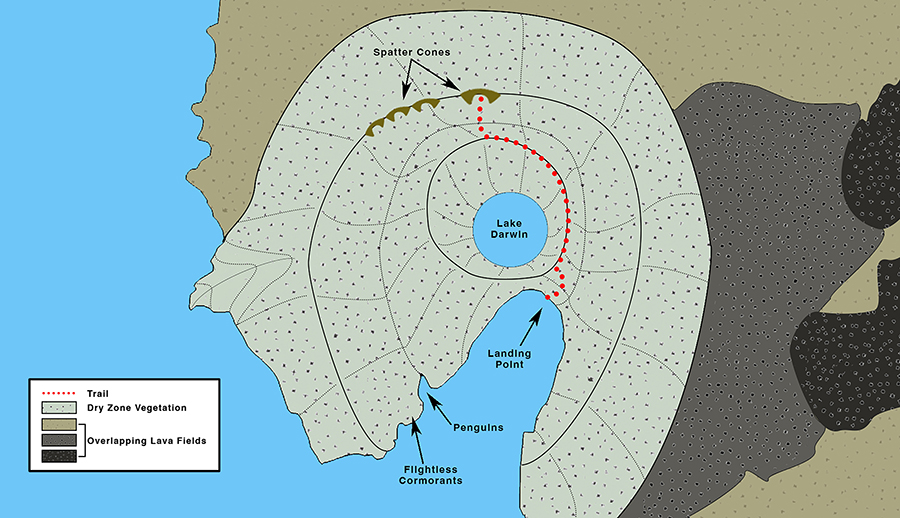
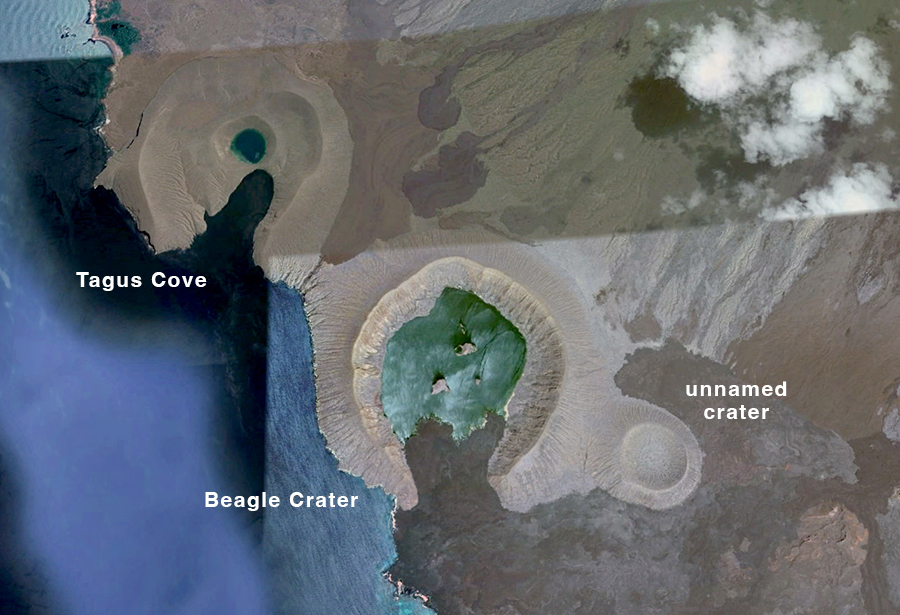
Tagus Cove is geologically interesting. It is a tuff cone within a tuff cone. Tuff cones are caused by phreatomagmatic reactions, where water comes in contact with erupting lava. At Tagus Cove, the outer cone formed first, followed by the inner cone, which erupted through a lake at the bottom of the older crater. The inner crater also has a lake, Lake Darwin, filled with very salty water. At a later date fissures on the rim of the outer cone produced a series of small half cones (because of prevailing winds at the time) that formed as spatter cones because they were protected from contact with water.
The trail begins as a series of steps climbing to the rim of the inner cone. Half way around the cone, the trail crosses over to the highest point on the rim of the outer cone, where one obtains a spectacular overlook of Volcán Darwin, Fernandina, Volcán Wolf, and Volcán Ecuador.
- Common Animals:
- Large Ground Finch (Geospiza magnirostris)
- Medium Ground Finch (Geospiza fortis)
- Small Ground Finch (Geospiza fuliginosa)
- Small Tree Finch (Camarhynchus parvulus)
- Woodpecker Finch (Camarhynchus pallidus) – occasionally
- Galápagos Dove (Zenaida galapagoensis)
- Galapagos Penguin (Spheniscus mendiculus
- Blue-footed Booby (Sula nebouxii)
- Flightless Cormorant (Phalacrocorax harissi)
- Common Plants:
- Palo Santo Trees (Bursera graveolens)
- Macraea lancifolia
- Galapagos Lantana (Lantana peduncularis)
- Darwin’s Cotton (Gossypium darwinii)
- Scalesia affinis

 Darwin's Galapagos