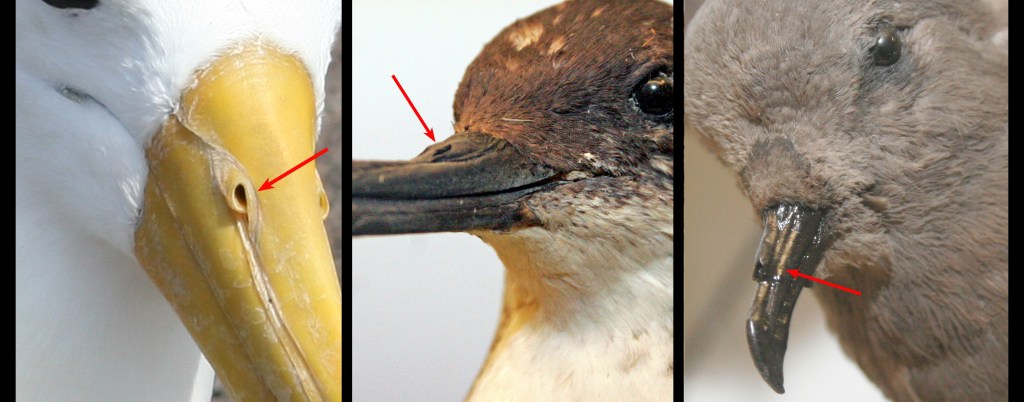
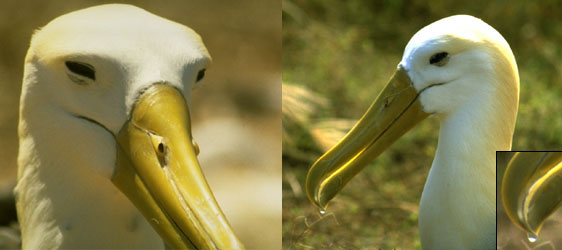
Procellariiformes is an order of birds ranging in size from the Least Storm-Petrel (six inches) to the giant Wandering Albatross (wingspan close to 12 feet). They are distributed throughout the world, but they tend to be found primarily in southern waters.Their bills are always hooked, and are divided into plates, which are separated by grooves. There is a salt gland in the eye socket that concentrates salt and excretes it in drops that travel down the grooves, to drip off of the tip of the bill (see inset below).
The most distinguishing feature of Procellariiformes, however, is their nostrils, which form raised tubes, as can be seen in the picture below of the Galápagos Waved Albatross. The picture at the top of this page features a Waved Albatross, an Audobon’s Shearwater (Puffinus lherminieri), and a Leach’s Storm Petrel (Hydrobates leucorhous). These later two photos are mounted specimens at the Harvard Museum of Natural History.
The portion of the brain that is associated with smell is enlarged in Procellariiformes, and it has been suggested that they are able to smell their prey. It is not known, however, whether their tube-like nostrils are an aid in olfaction. A second function of the tubular nostrils may be in the spreading of stomach oil over the feathers.
In addition to the oil formed in the uropygial, or preen gland at the base of the tail, Procellariiformes form a foul-smelling oil in their stomachs that are also spread on their feathers. It may be that the tubular nostrils are the conduit for the oil. This stomach oil is responsible for the characteristic musty odor of Procellariiformes, and is squirted by young and old alike, at intruders.
The order Procellariiformes contains four families, three of which are found in Galapagos:
| Family | species |
| Diomedidae | Albatrosses • Waved Albatross (Phoebastria irrorata) |
| Procellariidae | Shearwaters and true Petrels •Galápagos Petrel (Pteroderma phaeoygia) •Galápagos Shearwater (Puffinus subalaris) |
| Hybrobatidae | Storm Petrels •White-Vented Storm Petrel (Ocanites gracilis) •Band-Rumped (Madeiran) Storm Petral (Oceanodroma castro) •Wedge-Rumped (Galápagos) Storm Petrel (Oceanodroma tethys) |
| Pelecanoididae | Diving Petrels |
Albatrosses and frigatebirds are the most primitive members of their orders (Procelariiformes and Pelecaniformes, respectively), and skeletal similarities suggest that the two orders are related. Procelariiformes are also closely related to Sphenisciformes, the penguins.


 Darwin's Galapagos