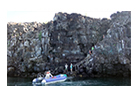
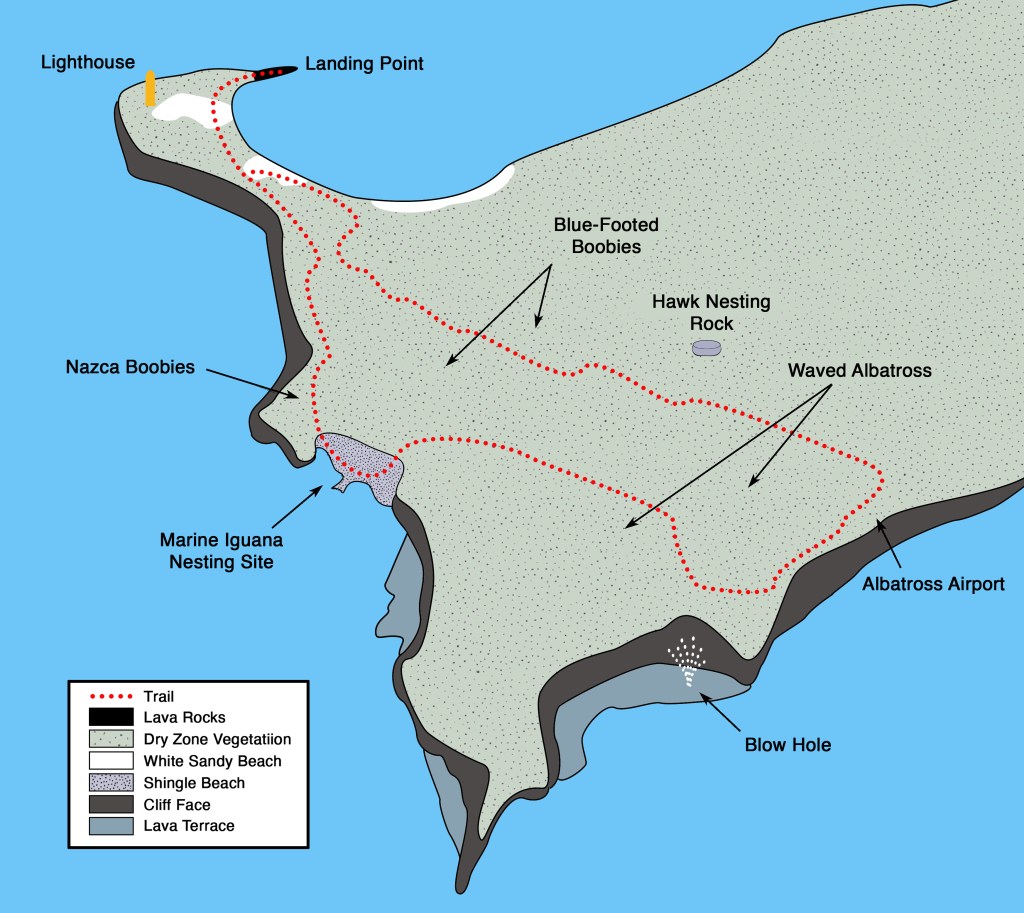
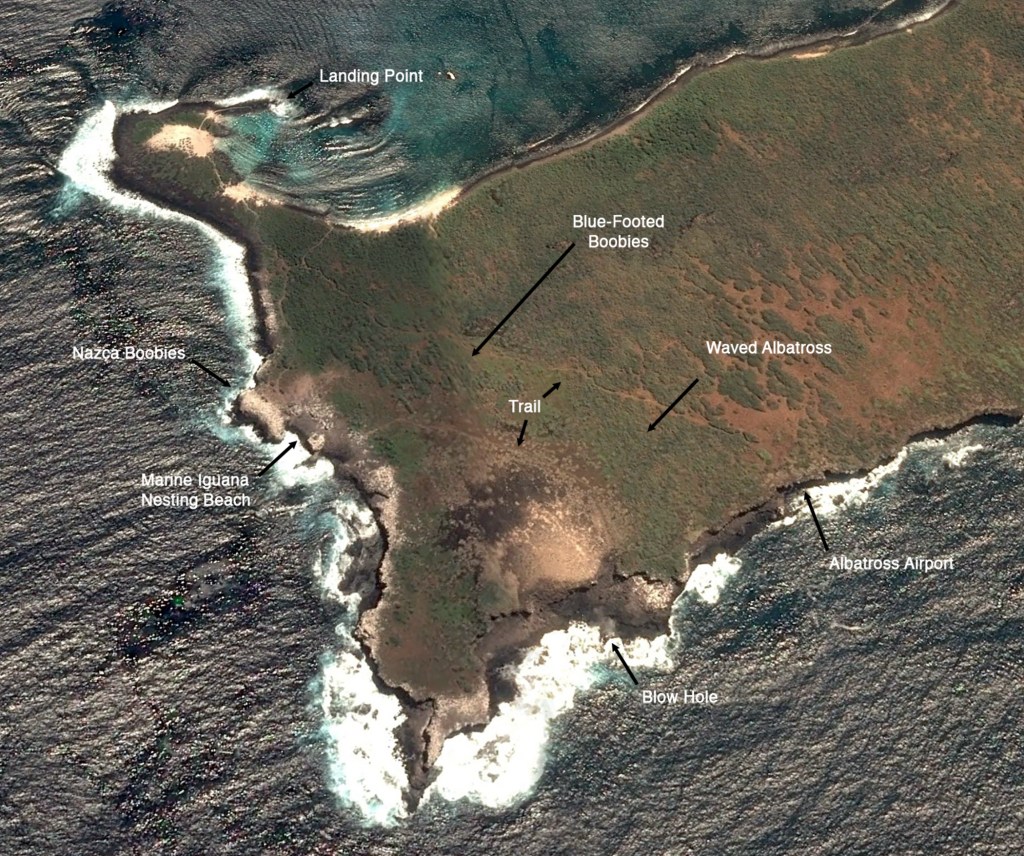
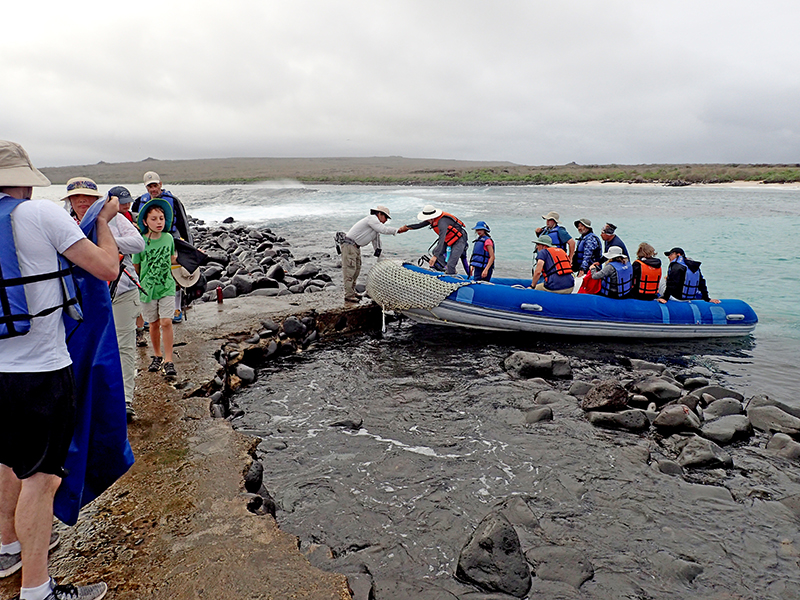
Located on the western end of Española, Punta Suarez is among the richest wildlife sites in the archipelago. The approach to the landing point is a bit of a nail biter as huge waves seem to threaten the panga, but I have never heard of a mishap. The landing point itself is a cement-over-lava boulders jetty. You may be greeted by marine iguanas or sea lions as you navigate the jetty. Once off the jetty the trail continues past two small white sand beaches. The remainder of the trail is a loop, one side along the sea cliffs and the others inland.
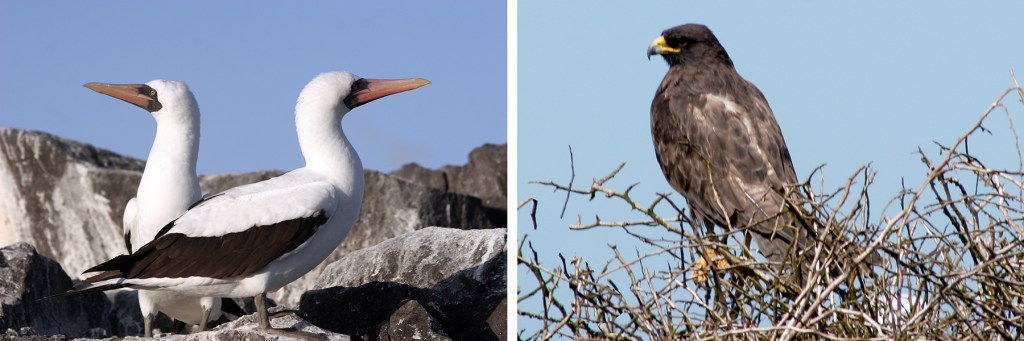
On the cliff side, the trail passes a colony of nesting Nazca boobies. You may see an endemic Galápagos hawk in the bushes near the colony looking for a quick meal of an unprotected chick. As you walk along the trail, keep an eye out for red-billed tropicbirds zipping back and forth along the cliff.
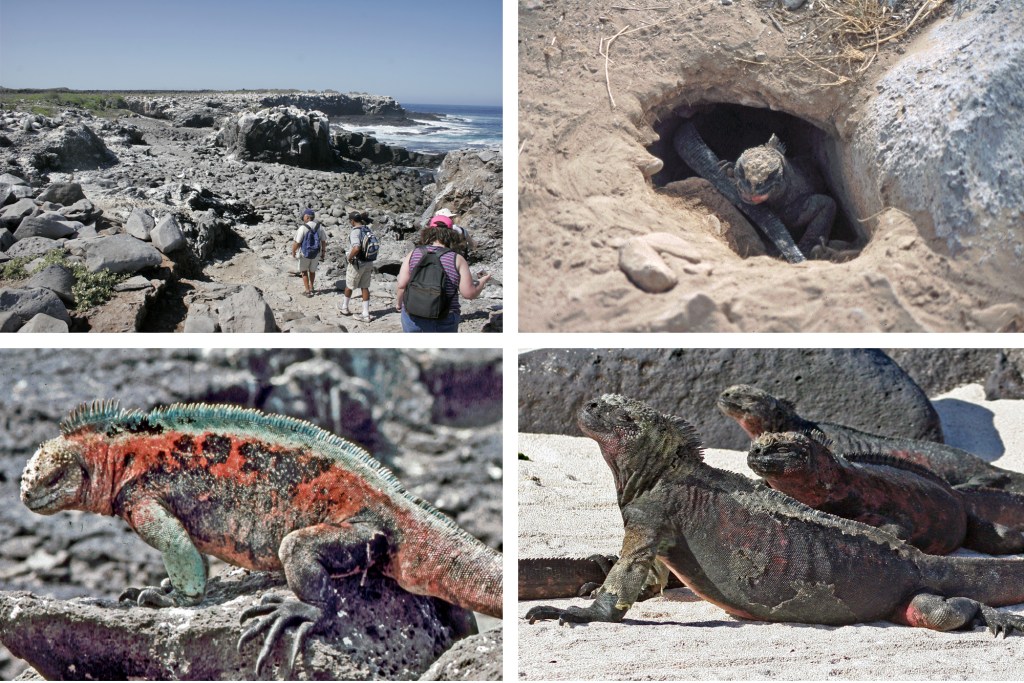
Past the Nazca booby colony, the trail descends to a small rocky beach where marine iguanas dig nests. Marine iguanas throughout the archipelago change color over the course of the year from dusky black to red. The change is seasonal and related to the particular algae that is available for food. It also coincides with the breeding season, which begins in late December and early January, although it is not clear whether or not this change in color is related to mating. Both males and females change color, but the females do so later in the season when they begin nesting and become more aggressive. What makes the Española marine iguanas special is that their change is the most intense than in any other population.
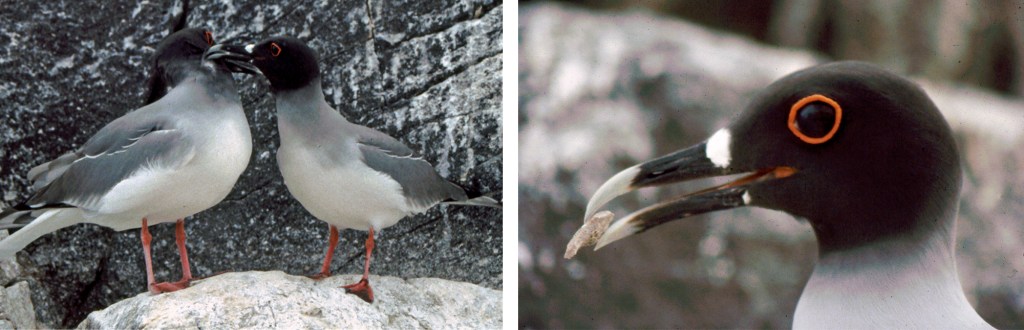
You may also see swallow-tailed gulls on the big rocks there and on the cliffs beyond. One year, one of my passengers was feeling ill and didn’t feel that she could continue the hike, so the guide agreed that I could sit with her there, and the group would meet us on the way back. While we sat there, we observed a pair of swallow-tailed gulls on a ledge above us pair-bonding, grooming each other and picking up and setting down stones and sea shell fragments. They appeared to take great care in the placement. Eventually, another group passed by and one of the tourists suffering from STD (Stupid Tourist Disorder) climbed up on the rocks, scaring the birds away. Afterwards, I climbed up to see what they were doing – the fragments were in no particular order. Swallow-tailed gulls lay a single egg on a small aggregation of stones. Apparently it is the act of placing the stones that is the goal of this pair bonding exercise.
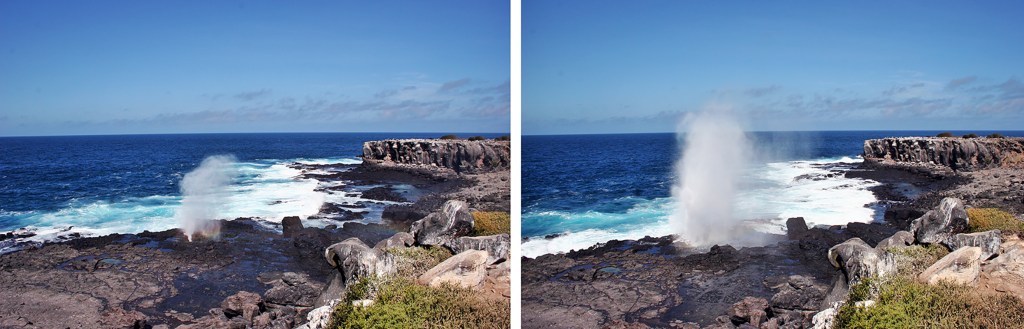
The trail continues past the blowhole. This is a lava tube below the cliff that opens to the ocean. When a wave comes crashing against the cliff, water is forced into the tube and ejected through cracks in the roof, producing a huge and dramatic plume. In my earliest trips, the trail descended to the level of the blowhole and it was possible to walk among the tide pools. It was a fascinating spot, now closed. It seems that a visitor had leaned over the blowhole to take a peek and was severely injured when it blew (yet another case of STD). A cautionary tale – a stupid act may not only injure the tourist, or worse, but it could result in the National Park Directorate deeming the site dangerous and closing it forever.
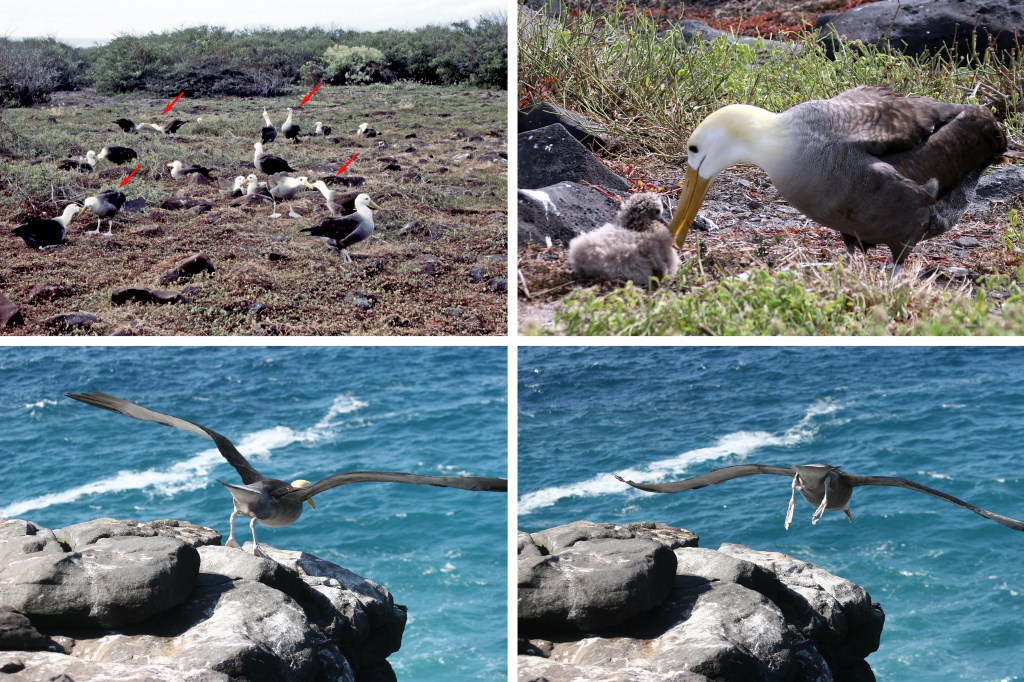
The farthest point on the trail is the albatross airport. Waved Albatrosses are big birds that have a hard time taking off from the ground, so they typically walk to the edge of the cliff and become airborne by jumping off. Waved Albatrosses only nest on Española, and are in residence between March and January. For the remainder of the year they are out at sea. Early in the season they are courting and mating, and if you are lucky, you will see their elaborate courtship dance. Late in the season, there will be chicks and juveniles. While at the albatross airport you will see a number of marine iguanas that have scaled the cliff.
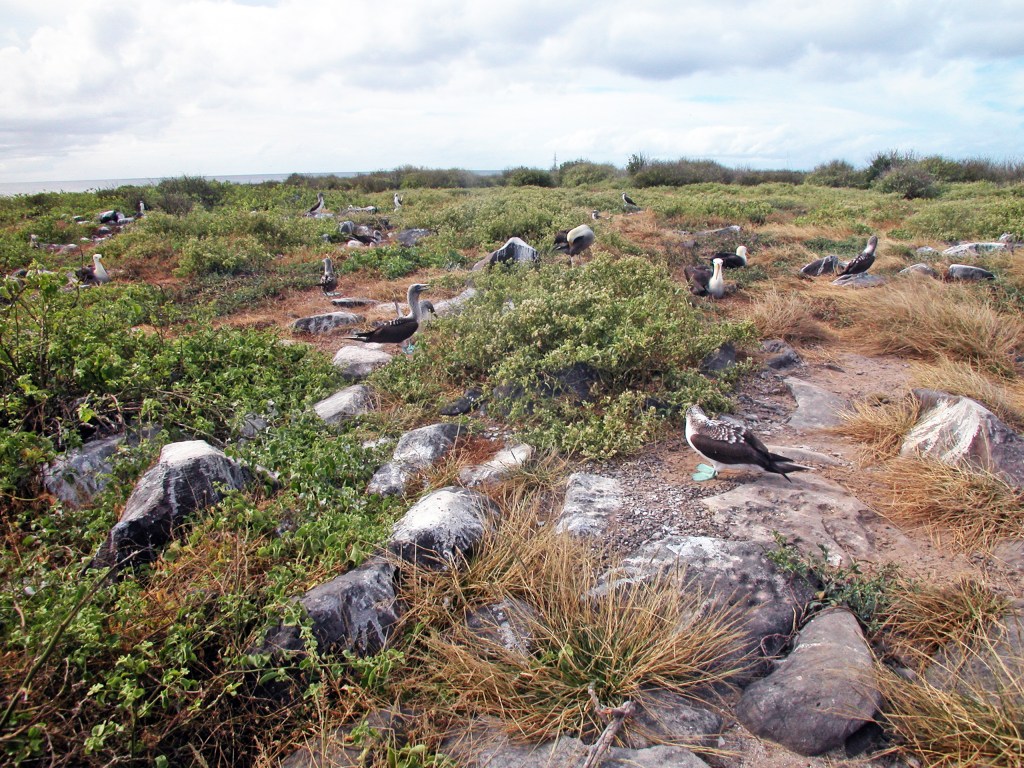
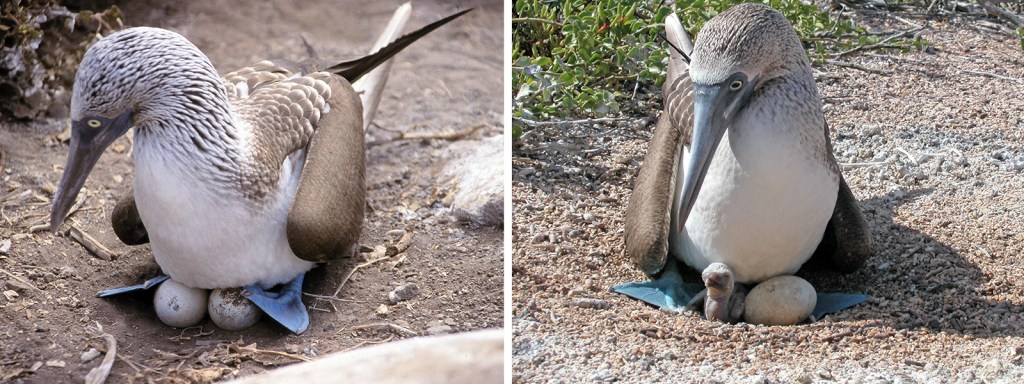
The inland portion of the trail passes through the albatross nesting area and crosses through the blue-footed booby colony. Mating is not synchronized so there may be nests with eggs, chicks, or both. Blue-footed boobies have an elaborate courtship display in which the birds slowly parade around each other, slowly raising and lowering their bright blue feet. The culmination is a sky point in which the birds tip their beaks, tails, and wing tips upwards.
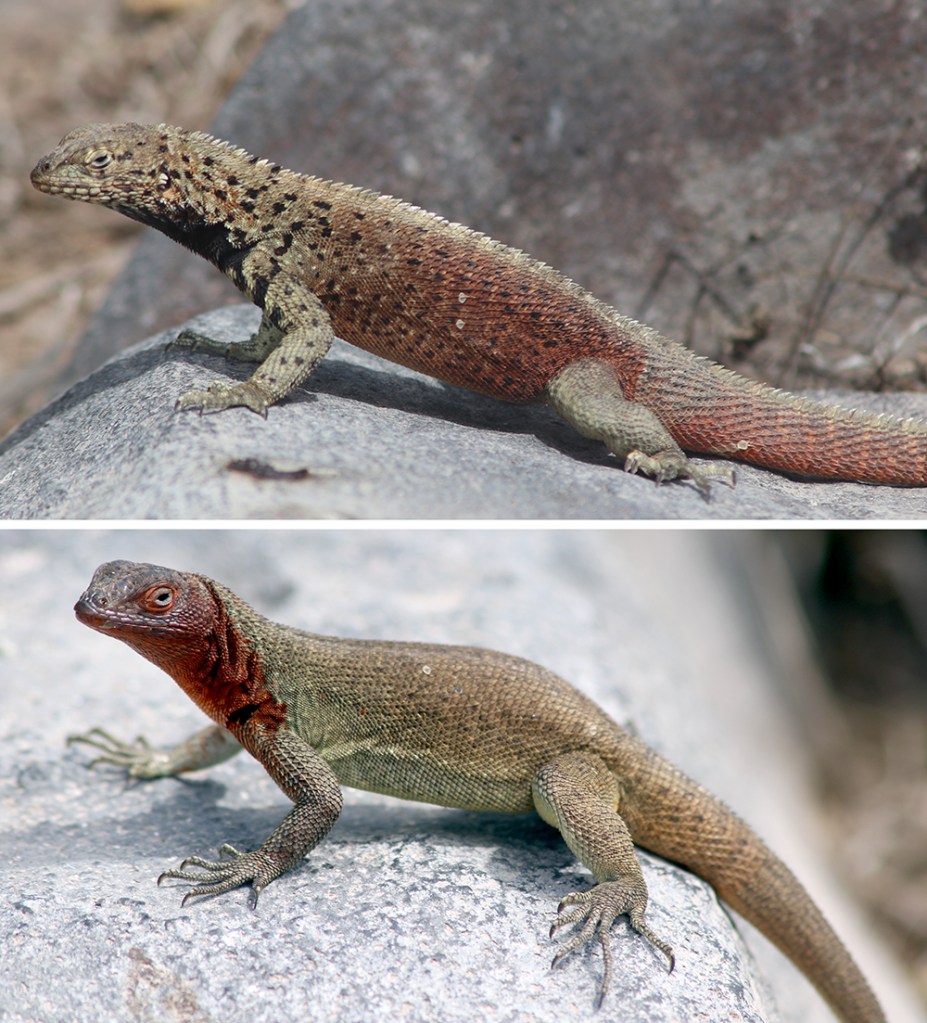
In addition to the marine iguanas, keep an eye out for lava lizards. The Española lava lizard is the largest in the archipelago. Males have a distinct crest and females have splashes of bright red on their throat and chest. Males are territorial and will display from high points within their territory. Their display is a series of push-ups, the pattern of which is species-specific.
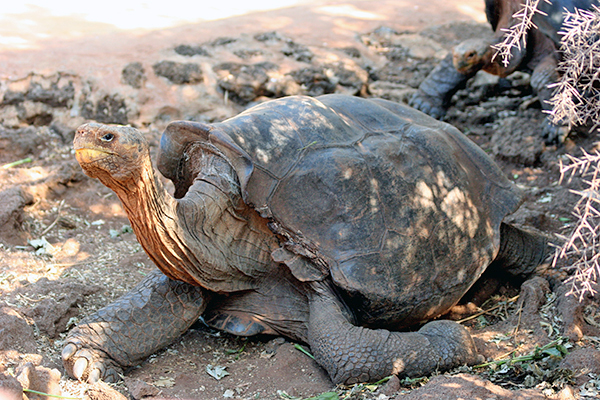
There is a unique species of giant tortoise on Española, Chelonoidis hoodensis, but you will most likely not see one. Hunted to near extinction in the 19th century, the population was reduced to a mere 14, 12 females and 2 males, which were brought to the Charles Darwin Research Station to participate in a captive breeding program. In 1977 the program was augmented by the addition of a third male, named Diego, who had been identified in the San Diego Zoo. The captive breeding program has been remarkably successful, producing around 2000 progeny, many of which were repatriated to Española where they are reproducing naturally. The three release sites are well away from the visitor sites and so far, the repatriates have not wandered far from their entry points. Moreover, some progeny have been introduced to other islands such as Santa Fe and Pinzón where they are engaged in a rewinding program. The Española program was so successful that it was deemed no longer necessary, and was terminated. Diego and his companions were returned to Española to live out the remainder of their lives on their island of birth.
Finally, watch for land birds, Galápagos doves, flycatchers, yellow warblers, mockingbirds, and, most importantly, Darwin’s finches. While it is difficult to accurately identify many of the species, on Española it is easy because there are only three, the small ground finch, the grey warbler finch, and the Española cactus finch, and they are distinctly and unambiguously different. All of these species are present at both Punta Suarez and Gardner Bay, but given the distraction of the large sea birds, you are probably more likely to spot them at Gardner Bay.
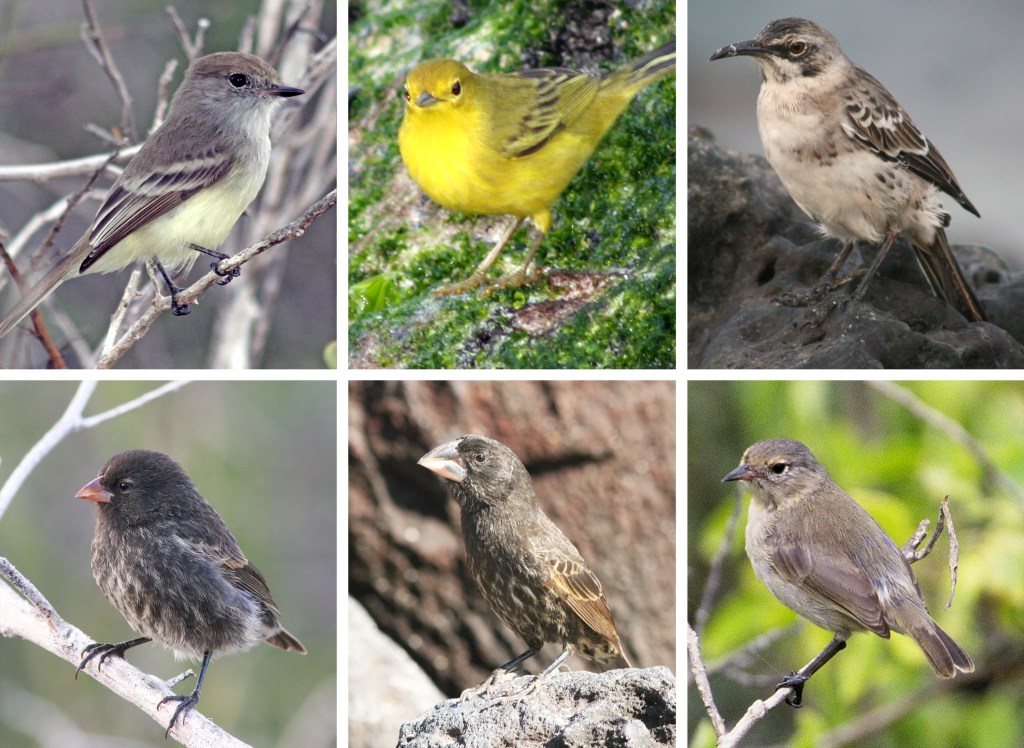
Bottom Row: Small Ground Finch, Española Cactus Finch, Grey Warbler Finch
- Common Animals:
- Marine Iguana (Amblyrhynchus cristatus)
- Española Lava lizard (Microlophus delanonis)
- Small Ground Finch (Geospiza fuliginosa)
- Grey Warbler Finch (Certhidia fusca)
- Española Cactus Finch (Geospiza conirostris)
- Galápagos Dove (Zenaida galapagoensis)
- Galápagos Hawk (Buteo galapagoensis)
- Yellow Warbler (Dendroica petechia)
- Galápagos Flycatcher (Myiarchus magnirostris)
- Blue-footed Booby (Sula nebouxii)
- Nazca Booby (Sula granti)
- Galápagos Sea Lion (Zalophus wollebacki)
- Common Plants:
- Saltbush (Cryptocarups pyriformis)
- Galápagos Shore Petunia (Exedeconus miersii [Cacabus miersii])
- Common carpetweed or Sea Purslane (Sesuvium edmonstonei)
- Puncture Weed or Goat’s Head (Tribulus cistoides)